
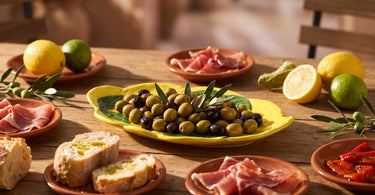
Tapas are small dishes shared at the table. The short answer is to choose a few classics such as patatas bravas and tortilla española, set them out in smaller portions on several plates, and let your guests help themselves. Arrange them on tapas plates and boards in different sizes, so the table looks varied and inviting.
Contents
A tapas evening is about bringing together several small dishes on the table, so everyone can taste a bit of everything. It doesn't take many dishes to make it look lavish, but it does require you to think about the presentation. In this guide, you'll get concrete tapas ideas, both for classic dishes, the cold table, and how to set it all out on plates, bowls and boards, so it looks inviting from the very first moment.
We'll also cover what to drink with tapas, and how to plan the evening, so you're not stuck in the kitchen once your guests have arrived.
The short answer: how to put together a tapas evening
Start by choosing four to six dishes that together cover something hot, something cold, and something with a bit of kick. A good mix is a potato dish, a fish dish, a meat dish and something from the cold table with ham and cheese. Make the dishes in smaller portions, so they fill several plates instead of one big one, and bring them out gradually, so the hot dishes come last. Your guests should be able to reach around the table and help themselves to whatever they fancy, without having to ask for something to be passed along.
What is tapas
Tapas is the name for a range of small Spanish dishes that either work as appetisers before a meal, or are combined to become the meal itself. It's precisely this flexibility that makes tapas well suited to an evening with guests, as you can serve as many or as few dishes as you like.
The word tapa means lid in Spanish, and the use of the word in connection with food is thought to originate from Andalusia. There, people would place thin bread or ham on top of the glass as a lid that could keep insects out of the sherry. Over time, this small piece of food became a dish in its own right, and the name stuck.
Classics to start with
You don't need to make every dish to have a great tapas evening, but these classics are a solid place to start, because together they offer variation in flavour and temperature:
- Patatas bravas: fried potatoes with a spicy sauce
- Tortilla española: Spanish potato omelette
- Gambas al ajillo: prawns in garlic
- Croquetas: small fried croquettes
- Albóndigas: meatballs
- Pimientos de Padrón: small fried green peppers
- Pan con tomate: bread with tomato
Choose three to four of these as your foundation, and supplement with the cold table, so you don't have to stand and make far too much in the kitchen while your guests wait.
Find the plates that can bring all the classics together on the table.
See tapas platesThe cold table: ham, chorizo and cheese
A tapas spread isn't quite complete without the cold table. This includes serrano ham, chorizo, manchego cheese and olives, and they need no preparation, which makes them perfect to put out while you finish the hot dishes. Cut the cheese and chorizo into thin slices, and lay the ham loosely folded, so it's easy to pick up with your fingers.
The cold table works well on a chopping board, where you can bring together ham, cheese and bread on the same surface. Find out more about how to put together a cheese board in our cheese board, and find the board itself in chopping boards.
Presentation: plates, bowls and boards
Tapas is served in small portions on several small dishes and bowls, so guests can taste a bit of everything. That's the whole point of tapas, and it's also what makes the table look great. Feel free to use several sizes and shapes instead of putting everything in matching white bowls. It brings the table to life.
For the smaller dishes like olives, croquetas or nuts, the small dishes and bowls are great, while the larger dishes like patatas bravas or albóndigas fit nicely in one of the tapas dishes. If you fancy something with character, a lemon dish or an oyster dish can give the table a personal touch, and an artichoke dish or a mussel bowl works well for vegetables and olives.
For the cold table and for bread, a chopping board from EJA is a great solution, as it's hand cast in resin and perfect for serving cheese, tapas and bread together. See the whole range of serving bowls, if you're unsure what suits your dishes best.
Tip: Mix large and small dishes on the table, so the eye has something to wander between. Place the smallest bowls with olives and nuts close together, and let the large dishes with patatas bravas or albóndigas have a bit of space around them.
What to drink with tapas
With tapas, people often drink wine, sherry, cava, beer or sangria. Feel free to choose two kinds, for example a white wine or cava for the lighter dishes like gambas and pimientos de Padrón, and a red wine or sherry for the more robust dishes like albóndigas and chorizo.
Put the drinks out in proper drinking glasses, and if you're serving sangria, a carafe is a nice way to bring it together on the table, so guests can pour it themselves.
Timetable: what can be made in advance
The cold table with serrano ham, chorizo, manchego and olives can easily be put out long before your guests arrive, as it doesn't need any preparation. Tortilla española is also a dish that can sit and rest, and it actually tastes good at room temperature.
Save gambas al ajillo and pimientos de Padrón for last, as both dishes are best when they come hot straight from the pan. That way, you can spend the time before your guests arrive on the cold table and the dishes that can sit out, and only head back to the kitchen when it's time to bring the last hot dishes to the table.
Frequently asked questions
What is tapas
Tapas are small Spanish dishes, either served as appetisers or put together for a whole meal, where guests share the dishes at the table.
What does tapas mean
The word tapa means lid in Spanish, and the tradition is thought to come from Andalusia, where bread or ham was placed on top of the glass as a lid to keep insects out of the sherry.
What should you have on a tapas table
A good mix is some of the classics like patatas bravas, tortilla española and gambas al ajillo, supplemented with the cold table of serrano ham, chorizo, manchego and olives.
What to drink with tapas
With tapas, people often drink wine, sherry, cava, beer or sangria, ideally served in proper drinking glasses or a carafe if it's sangria.
How do you arrange tapas
Serve the dishes in smaller portions on several small platters and bowls of different sizes, so your guests can taste a bit of everything, and feel free to add a chopping board for the cold spread.
How many tapas dishes should you make
There's no fixed rule, but four to six dishes covering hot, cold and something with a bit of a kick will give you a varied spread without it becoming too much work.
Summary
A tapas evening is all about picking a few good classics, like patatas bravas, tortilla española and gambas al ajillo, and adding a cold spread of serrano ham, chorizo, manchego and olives. Arrange everything on several small platters, bowls and a chopping board so your guests can help themselves, and pour drinks into proper glasses, whether it's wine, sherry, cava or sangria.
Read also
- The difference between a platter and a bowl, here's how to choose
- Which chopping board is best, and what oil should you use?
- How should glasses be set out on the table?
- Trays and platters: function and decoration in one
Ready to set the tapas table
Find platters, bowls and boards that give your tapas table character, and make it easy for guests to help themselves.
See serving bowls