
The short answer: wood is the most versatile choice for everyday cutting, because it's gentle on the knife's edge. Plastic is handy for raw meat, while hard materials like glass, stone and resin are best suited for serving and presentation, not heavy-duty cutting work.
Contents
There isn't one chopping board that's best for everything. The choice depends on whether the board will be used for daily cutting, for raw meat, or whether it mainly needs to look good on the table when serving cheese or tapas. Here's an honest overview of the materials, which wood lasts longest, and how to care for a wooden board with oil.
Which chopping board is best?
For everyday cutting of vegetables, bread and cold cuts, a wooden board is the most versatile choice. It's gentle on the knife and lasts a long time if you look after it. If you need to cut raw meat or poultry, a plastic board that can go in the dishwasher is a practical solution. Glass, stone and resin, on the other hand, shouldn't be used for cutting, as they're hard on the edge. They're better suited for serving instead.
Wood, plastic, bamboo or resin: pros and cons
The material determines both how gentle the board is on the knife and how easy it is to keep hygienic.
- Wood is gentle on the edge and the classic choice for everyday cutting, but needs to be washed by hand and oiled regularly.
- Plastic can often go in the dishwasher, which is handy for raw meat and poultry, but deep knife scratches collect dirt and bacteria, so the board should be replaced once it's very scratched.
- Bamboo is hard and durable, but harder on the knife than ordinary wood.
- Glass, stone and resin are hard materials that wear down the knife's edge quickly. They're best suited for serving and presentation, not cutting work.
Which wood is best for a chopping board?
Dense hardwoods such as oak, beech, ash, walnut and olive wood are good choices for a chopping board, as they're durable and gentle on the knife. Soft softwoods get deep scratches more quickly and therefore don't last as long.
There's also a difference in how the wood is cut. An end-grain board, where the fibres point upwards, is extra gentle on the knife, because the edge slides down between the fibres instead of cutting across them. A long-grain board, on the other hand, is lighter and cheaper, but wears a bit faster.
Which chopping board is most hygienic?
Hygiene depends more on how you use and look after the board than on the material itself. Deep knife scratches, whether in wood or plastic, collect dirt and bacteria and make the board harder to clean properly.
- Feel free to use a separate board for raw meat and poultry.
- Wash wooden boards by hand with hot water and washing-up liquid, and dry them straight away.
- Never leave a wooden board to soak, and avoid putting it in the dishwasher.
- Replace plastic boards once they've become very scratched.
If you're after a beautiful board for serving rather than cutting work, take a look at the hand-cast resin boards from EJA.
See chopping boardsWhich oil should you use on a wooden chopping board?
For a wooden board, you need a food-safe oil, for example a chopping board oil or paraffin oil. Ordinary cooking oils like olive and sunflower oil can turn rancid and give the board an unpleasant smell, so it's best to avoid those.
The board needs oil when the surface starts to look dry and pale. Apply a thin layer of oil with a cloth, let it soak into the wood, and then wipe off excess oil with a clean cloth.
Tip: Look at the surface rather than guessing. When the wood looks dry and pale, it's a sign that the board needs a thin layer of oil.
Serving board: platters for cheese, tapas and bread
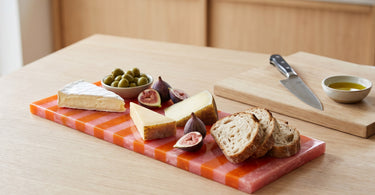
If the board is mainly going to be used for serving and presenting rather than cutting on, a hard material like resin is a beautiful choice. At Dims Studio you'll find chopping boards from EJA, hand-cast in resin, where each board is unique in colour and pattern. The boards cost 349 DKK and come in sizes including 29.5 x 23 cm, 38 x 16 cm, 45 x 15 cm and 26 x 20 cm.
The EJA boards are designed as serving and presentation boards for, for example, cheese, charcuterie, olives, tapas and bread. Wipe them clean with a damp cloth, hand washing is recommended, and keep them away from the dishwasher as well as prolonged contact with water and high heat. Oil isn't necessary on resin.
Frequently asked questions
Which chopping board is best?
For everyday cutting, wood is the most versatile choice, while plastic is practical for raw meat. Hard materials like glass, stone and resin are best suited for serving.
Which oil should you use for a chopping board?
Use a food-safe oil such as chopping board oil or paraffin oil. Ordinary cooking oils like olive and sunflower oil can turn rancid and cause a smell.
Which wood is best for a chopping board?
Dense hardwoods like oak, beech, ash, walnut and olive wood are good choices. Soft softwoods get deep scratches more quickly and don't last as long.
Which chopping board is most hygienic?
It's more about maintenance than material. Use a separate board for raw meat and poultry, and replace the board once it gets deep knife scratches.
Is wood or plastic best for a chopping board?
Wood is gentle on the knife and good for everyday cutting, while plastic can often go in the dishwasher and is therefore practical for raw meat and poultry.
Can you cut on a resin chopping board?
Resin is a hard material that wears down the knife's edge, so it's best suited for serving and presenting, for example cheese, tapas and bread.
Summary
Choose wood for everyday cutting, plastic for raw meat, and hard materials like resin for serving. A wooden board lasts a long time if it's hand washed and oiled regularly, while a resin board from EJA is designed as a beautiful presentation board for cheese, tapas and bread.
Read also
- The difference between a platter and a bowl
- Trays and platters: function and decoration in one
- Kitchen design: personality at the heart of the home
- Table decorations: how to build the centre of the table
- How do you make a kitchen cosy?
- Cheese board ideas: how to arrange a lovely cheese board
Find your presentation board for serving
See the handpicked selection of serving and presentation boards from EJA, and find the board that suits your next cheese board or tapas spread.
See serving boards