
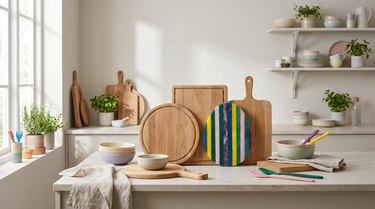
Cutting Boards
Discover cutting boards in wood, marble, and colorful materials – perfect for both cooking and serving.
Read moreShow less
At Dims Studio, you’ll find cutting boards ranging from classic wood to vibrant plastic and marble. Dinna has handpicked models with both practical and decorative details, so you can use them for everything from cooking to serving.
Materials and Shapes
Choose between sturdy cutting boards in acacia wood, lightweight plastic models, and elegant marble boards. Some are round, others elongated or with playful shapes that catch the eye on your kitchen counter.
Colors and Prints
- Pastel shades from Rice and Bongusta
- Simple, light wood types from AU MAISON
- Patterned plastic cutting boards with graphic designs
- Marble boards with natural veining
Brands You Can Find
The selection includes cutting boards from Rice, Bongusta, AU MAISON, Selected by Dims Studio, and Kersten. Each brand has its own style – from playful colors to classic wood details.
For Both Kitchen and Serving
Use the cutting board for vegetables, bread, or arranging tapas. The decorative models also work as serving trays when you have guests. Whatever your style, you’ll find a cutting board that fits your daily life and kitchen.


All reviews
A cutting board is the surface you cut, chop and prep food on in the kitchen, and at Dims Studio it's also a colourful object that's welcome to stay out between meals. The cutting boards are hand-cast in resin by EJA, where pigments flow together into marbled patterns, so no board looks like another. In this guide you'll get an overview of material, sizes, use, styling and care, so you can quickly find the cutting board that best suits your kitchen and the way you like to serve food.
What makes a resin cutting board special?
A cutting board is classically used to cut vegetables, bread and cold cuts without scratching the table or dulling the knife. The cutting boards from EJA are cast in resin, a synthetic resin that differs from the traditional wooden board in several ways. The surface is smooth, hard and non-porous, which means it doesn't absorb moisture or smells from food the way a wooden board does.
Cutting board for everyday chopping
The boards can be used for everyday cutting of vegetables, fruit, bread and cold cuts. Because resin is harder than many types of wood, the knife glides easily across the surface, though it's also worth knowing that very sharp knives can dull slightly faster against resin than against wood over time.
Cutting board for serving
With their marbled play of colour, the boards work just as well as a serving board. Put out cheese, charcuterie, olives or tapas straight on the board, and let the pattern be part of the presentation. Several of the boards are thin and compact enough to go straight from cutting board to dining table. See also our cheese board for inspiration.
| Use | Description | Good to know |
|---|---|---|
| Everyday cutting | Vegetables, bread, fruit and cold cuts | Avoid heavy chopping with weighty knives |
| Serving | Cheese, charcuterie, olives and tapas | The smooth surface is easy to wipe between courses |
| Decoration | Standing against the tiles between meals | The marbled pattern works as a splash of colour in the kitchen |
Material: resin compared to wood
Resin and wood are two of the most common materials for cutting boards, and each has its strengths. A wooden cutting board is a natural material that often develops a patina over time, is gentle on knife edges, but needs regular oiling and shouldn't be soaked. Resin is a synthetic material that's cast liquid and hardens into a dense, non-porous surface that doesn't soak up water, grease or odour the same way. In return, resin can't go in the dishwasher, withstand boiling water, or take hot pots directly on the surface.
Why choose resin?
Resin allows for a play of colour that isn't found in solid wood. Because the pigments are poured liquid and mixed before the material hardens, organic, marbled patterns emerge that make each board unique. At the same time, the surface is easy to wipe clean and doesn't take on colour or smell from food, which makes it practical for vegetables, meat and strongly staining ingredients like beetroot or berries.
How to care for your resin cutting board
- Wash the board by hand with lukewarm water and mild washing-up liquid, and dry it right away.
- Avoid the dishwasher, as high heat can affect the resin's surface and colours over time.
- Don't let the board soak or sit in water for long periods.
- Avoid placing hot pots or pans directly on the board, as resin is sensitive to intense heat.
| Material | Surface | Benefit | Care |
|---|---|---|---|
| Resin (EJA) | Smooth, dense and non-porous | Colourful, unique patterns, doesn't absorb moisture or odour | Hand wash, no dishwasher, avoid heat |
| Wood (general) | Natural, more porous | Gentle on knife edges, develops a beautiful patina | Needs regular oiling, must not be soaked |
Sizes: which cutting board suits you?
The cutting boards from EJA come in several sizes, so you can choose based on whether the board will mainly be used for everyday chopping, for serving, or both.
| Size | Shape | Best for |
|---|---|---|
| 26 x 20 cm | Compact and square | Both everyday cutting and serving, when space needs to be shared |
| 29.5 x 23 cm | Medium | Versatile use for vegetables, bread and serving cheese and tapas |
| 38 x 16 cm | Elongated | Serving board for cheese, olives and charcuterie |
| 45 x 15 cm | Long and narrow | A striking serving board for the dinner table |
The smaller, more square formats are the most versatile if the board will be used daily in the kitchen, while the long, narrow formats especially work as a serving board, where the colourful pattern comes into its own across the table. If you're unsure, a medium board at 29.5 x 23 cm can often cover both needs, without you having to choose between everyday use and serving.
The brand behind the boards: EJA
All cutting boards in this category are hand-cast by EJA. Each board is made by pouring colour pigments into the liquid resin and mixing them by hand before the material hardens. Because the colour flows land differently from cast to cast, no board ends up looking quite like another, neither in pattern, shade nor marbling. Some of the boards are kept multicolour, while others, like the board at 45 x 15 cm, are cast in a specific colour combination such as orange and pink.
The craftsmanship behind each board
Because each board is cast individually by hand, the process is slower than for machine-made cutting boards. In return, you get a board that sits somewhere between a functional object and a piece of craft, and that works just as well as an eye-catcher on the kitchen counter as it does as a tool when food needs preparing.
How the pattern is created
The process starts with liquid resin, which EJA colours with pigments before it's poured into the mould. Instead of mixing the colours completely evenly, they're allowed to flow and settle in layers, so the pattern becomes organic and partly random. Some boards end up with clear streaks where the colours run in one direction, while others get a more cohesive, marbled look where several shades blend together. It's exactly this process that means no two boards from EJA are ever identical, even when cast in the same size and with the same colours.
From functional object to craft
Because each board requires manual work from start to finish, it differs from most other cutting boards, which are made in large, uniform batches. That makes the board something close to a small one-off in the kitchen, where the purpose is still practical, but the look sits closer to functional art than an ordinary, single-colour tool. For many, it's exactly this combination of function and a unique, handmade look that makes the board interesting, whether it's used daily for cooking or mainly as a serving piece for special occasions.
Colour and decor: the cutting board as part of the kitchen
Because the boards from EJA are so colourful, they work as more than just a tool tucked away in a drawer. They're meant to be left out, where the pattern can be seen.
A splash of colour among everyday things
Stand the board against the tiles behind the sink, or against the wall next to herbs and a coffee pot. The marbled pattern works as a fixed, colourful detail in the kitchen that doesn't require changing anything else in the room. Swap the board out from time to time, depending on which colour combination suits the season or your mood best.
Match the board with the rest of the table
When serving, you can let the cutting board's colours play along with the rest of the table setting. A board in orange and pink tones can, for example, be paired with warm, earth-toned plates, while a multicolour board works as an eye-catcher on otherwise simple white tableware. Pair the board with cutlery from one of our other colourful ranges, so the table gets a cohesive look.
The cutting board as part of a collection
Because each board is unique, some choose to collect several sizes and colour combinations, so there's always the right board for the task, whether it's a weeknight dinner or a bigger gathering with guests. A small board for everyday cutting, and one of the larger, elongated boards for serving when there's more to celebrate, makes it easy to switch between everyday life and festivities without compromising on look.
The cutting board as a gift
Because each board is hand-cast and unique, it's a gift that feels personal, even though it's a kitchen tool. It suits the host, the food lover, or someone who appreciates handmade things with character. A gift that's also used in everyday life is often experienced as more valuable than something purely decorative, and the same applies here. Consider giving one of the smaller boards as a small thought, or one of the larger, elongated boards if the gift should mark something bigger, like a housewarming or an anniversary within the family or close circle of friends, where the gift is allowed to feel a bit extra.
The cutting board in the kitchen and at the table
A resin cutting board from EJA fits naturally in several places around the home. Use it as part of everyday cooking under the kitchen category, or let it stand against the tiles as a colourful detail when it's not in use. For serving, the board works well together with cutlery for cheese and cold cuts, and paired with one of our cheese boards, if you're hosting a bigger dinner and need more space on the table.
How to choose the right cutting board: decision guide
If you're still unsure which board to choose, you can start from how it will mainly be used.
| Situation | Our recommendation |
|---|---|
| You'll use the board daily for cooking | A compact board at 26 x 20 cm or 29.5 x 23 cm |
| The board will mainly be used for serving | A long, narrow board at 38 x 16 cm or 45 x 15 cm |
| You want a striking play of colour | The cutting board in orange and pink at 45 x 15 cm |
| You want a versatile board for both purposes | A medium board at 29.5 x 23 cm |
| The cutting board is a gift | Any board from EJA, since every board is unique and therefore personal |
Myths and facts about resin cutting boards
- Myth: Resin isn't suitable for cooking. Fact: The boards are made for kitchen use and can be used for both cutting and serving food.
- Myth: A resin cutting board can go in the dishwasher just like a plastic board. Fact: High heat can affect the resin's surface and colours, so the board should be washed by hand.
- Myth: All cutting boards from EJA look the same. Fact: Because each board is cast individually with liquid pigments, the pattern and colour distribution differ from board to board.
Frequently asked questions about resin cutting boards
What is a cutting board?
A cutting board is a surface you use to cut, chop and prepare food, without damaging the table or unnecessarily dulling the knife.
What's the difference between a resin and a wooden cutting board?
Resin has a smooth, dense and non-porous surface that doesn't absorb moisture or odour like wood, and doesn't need oiling. Wood, on the other hand, is gentler on knife edges and develops a patina over time, but needs to be maintained with oil and mustn't be soaked.
Can you cut directly on a resin cutting board?
Yes, the boards from EJA are designed for cutting vegetables, bread, fruit and cold cuts with ordinary kitchen knives. Very heavy chopping with weighty knives can over time leave marks on the surface, as with most other cutting boards.
How do I maintain a resin cutting board?
Wash the board by hand with lukewarm water and mild washing-up liquid, and dry it right away. Avoid the dishwasher, boiling water and hot pots directly on the surface, as high heat can affect the resin's colours and shine.
What sizes do the cutting boards come in?
The cutting boards from EJA come in sizes including 26 x 20 cm, 29.5 x 23 cm, 38 x 16 cm and 45 x 15 cm, so you can choose based on whether the board will be used for everyday cutting, serving, or both.
Why do two cutting boards from EJA never look quite the same?
Each board is cast individually by hand, with colour pigments mixed into the liquid resin before it hardens. Colour flows and marbling occur randomly during the process, so no board ends up completely identical to another.
Can the cutting board be used for serving?
Yes, the boards work well as a serving board for cheese, charcuterie, olives and tapas, where the marbled pattern also functions as part of the table decoration.
Can a resin cutting board handle heat?
No, resin is sensitive to high temperatures and shouldn't come into contact with hot pots, pans or ovenproof dishes. Use the board for cold serving and cutting at room temperature.
Is the cutting board food safe?
Yes, the boards are made for kitchen use and can be used to cut and serve food. It's recommended, however, to avoid very hot dishes directly on the surface.
Is a cutting board from EJA a good gift?
Yes. Because each board is unique in colour and pattern, it's a personal gift that's also practical. It's an obvious choice for birthdays, housewarmings or as a host gift.
Can the cutting board go in the dishwasher?
No, the boards should always be washed by hand. The dishwasher's high temperatures can affect the resin's surface and colours over time.
Why does a resin cutting board often cost more than an ordinary plastic board?
Because each board from EJA is individually hand-cast, with manual colour mixing and casting, there's far more work behind it than machine-made cutting boards in plastic or single-colour resin. It's the same reason no board ever turns out quite the same.
Can the cutting board be used outdoors, for example for a picnic or on the terrace?
Yes, the board can easily be used outdoors for serving cheese, tapas or fruit. Just avoid direct, strong sunlight over long periods, and make sure to wash the board when it comes back inside.