
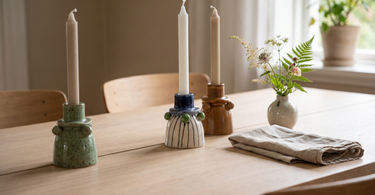
Table decorations are everything that sits in the centre of the table — candlesticks, vases, dishes and greenery. The simplest formula that works: build the height up through the light rather than large arrangements, keep all decorations below eye level when guests are seated, and stick to two colours. Then the rest can vary without the table feeling cluttered.
Contents
- What are table decorations?
- Build the height up through the light
- Keep everything below eye level
- Choose two colours — and stick to them
- Flowers, greenery and whatever's in the garden
- Table decorations for everyday
- Table decorations for Christmas, New Year's Eve, confirmations and weddings
- Five mistakes that are easy to avoid
- Frequently asked questions
- Summary
There's a difference between table setting and table decorations. The table setting is the place setting — plate, glass and cutlery in the right spot. The table decorations are everything in between the place settings that makes you want to sit down at the table. The good news is that table decorations require fewer things than you'd think. Here's the formula we use ourselves.
What are table decorations?
Table decorations are the decorative elements in the centre of the table: candlesticks and candles, small vases with flowers or greenery, dishes and bowls, and whatever you place by the setting as a little touch. Unlike the table setting, table decorations have no fixed rules — but they do have a few mechanics that make the difference between a table that works and one that's simply overloaded.
If you want to sort out the place setting itself first, start with our guide to table setting and to how cutlery should be arranged.
Build the height up through the light
Light is the single element that does the most for a table. A row of candlesticks at varying heights down the centre of the table creates both height and movement, and because the flame sits above the decorations, it draws the eye upward without taking up space.
Use several small candlesticks rather than two big ones. Three or four candlesticks of varying heights along a metre of table centre work far better than a symmetrical pair at each end. Feel free to mix materials — stoneware, ceramic, glass, brass and crystal can all stand side by side, as long as the colour scheme ties together.
Reckon on roughly one candlestick for every 30-40 cm of table centre. If you have a table for eight, four to six candlesticks is plenty.
We've worked out the details in how many candlesticks you should have on the dining table.
Keep everything below eye level
The most common mistake is decorations that are too tall. If guests are seated and can't see each other across the table, they'll end up talking past each other all evening. The rule is simple: all decorations should be lower than a seated guest's eye level, or so tall and slender that you can see past them.
This is why tall, heavy flower arrangements rarely work at home. If you want height in your flowers, choose a slender vase with a few stems rather than a wide bouquet.
Choose two colours — and stick to them
Two colours plus the tabletop or tablecloth as a third tone is enough. From three colours upwards, the table starts to feel restless, no matter how beautiful the individual items are.
It doesn't have to be neutral colours. Green and brass, pink and red, yellow and white — the key is that you choose two and stick with them all the way round the table. If you want more colour, let it come from the food and flowers rather than from more objects.
Flowers, greenery and whatever's in the garden
Table decorations don't have to cost anything. A handful of stems from the garden in three small vases down the middle does more than a bought bouquet, and it can be changed every week. In winter, fir, eucalyptus and dried branches work just as well.
Small vases are more versatile than large ones for exactly this. A large vase needs a whole bouquet to avoid looking empty; a small one can carry two stems and still look intentional. The smallest jugs also work as mini vases, if you'd rather use those.
Table decorations for everyday
A table that's decorated all the time never feels decorated. The everyday version is therefore deliberately smaller: two candlesticks, a small vase and a bowl that's allowed to stay out between meals.
- Leave the candlesticks out, even when they're not lit
- Use a bowl you actually use — then it's not decoration that needs moving
- A tea towel laid as a runner down the middle adds colour without a full table setting
- Change the flowers rather than the whole setup
Table decorations for Christmas, New Year's Eve, confirmations and weddings
The basic recipe stays the same all year round. It's only the accents that change:
- Christmas — fir, cones and glass ornaments instead of flowers. See the Christmas table.
- New Year — more glasses per place setting and height in the candles. See the New Year table.
- Confirmation — one colour of the confirmand's own choosing, repeated all the way round. We have a guide to the confirmation table.
- Wedding — the candlesticks should recur on every table, so the room feels connected. See the wedding table.
Five mistakes that are easy to avoid
- Decorations that are too tall. Guests should be able to see each other.
- Too many colours. Two is enough, three is the limit.
- Too much. There needs to be room for bowls and glasses when the food arrives.
- Fragrance. Scented candles and strongly scented flowers compete with the food — use them away from the dining table.
- Everything matches. A table where every item is identical looks contrived. Keep one element consistent and let the rest vary.
Frequently asked questions
What's the difference between table setting and table decoration?
The table setting is the place setting — plate, glass and cutlery in the right position. The table decoration is the decorative centrepiece: candles, flowers, vases and dishes.
How tall should the table decoration be?
Lower than a seated guest's eye level, or slim enough to see past. Otherwise guests end up talking past each other.
How many candlesticks should there be on the table?
Reckon on roughly one for every 30-40 cm of table length. Several small ones at different heights work better than a few large ones.
How many colours can you use in the table decoration?
Two colours plus the tabletop or tablecloth as a third tone. From three colours upwards, the table becomes restless.
Should the table decoration match the tableware?
No. Keep one element consistent — the same material or the same colour family — and let the rest vary. A table where everything matches often looks contrived.
What can you use as table decoration without buying anything?
Stems and branches from the garden in small vases, a tea towel laid out as a runner, and the dishes you're using for the food anyway.
Summary
The table decoration is the centre of the table, and it requires fewer things than you'd think. Build height with candlesticks rather than large arrangements, keep all decoration below a seated guest's eye level, and limit yourself to two colours plus the tabletop. Use several small candlesticks at different heights, small vases with just a few stems, and let one element recur all the way round while the rest varies. That way the same formula works for Wednesday evening, Christmas, confirmations and weddings alike.
Read also
- Table setting: How to set a beautiful table
- How many candlesticks should there be on the dining table?
- How do you fold napkins?
- How to mix ceramics, colours and shapes on the table setting
- Christmas table setting: how to set the Christmas table
- New Year's table: how to set the table for New Year's Eve
- Table setting for weddings
Find the centre of your table at Dims Studio — explore table setting, candlesticks and small vases.