
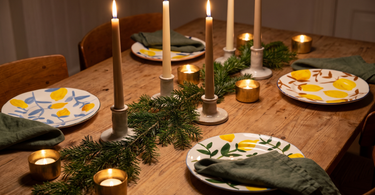
A Christmas table doesn't get better with more things, but with fewer things chosen deliberately. Start with the candlesticks down the centre of the table, choose two colours and stick to them, and let the plates be different rather than completely matching. Red and green aren't a requirement — green and brass or white and light grey give a table that doesn't look like everyone else's.
Dims Studio's own figures: Half of the sold items in the Christmas table category cost under DKK 190 (more than 3,000 items sold), and half of the sold candlesticks cost under DKK 170 (more than 1,000 items sold), both from November 2025 to October 2026.
Contents
The Christmas table is the one evening of the year when it's completely fine to go all out. But there's a difference between a table with a lot on it and a table that actually works. Here's the approach we use ourselves, and the tricks that make the biggest difference.
Start with the light
The candlesticks are the most important thing on the Christmas table. A row of candlesticks at different heights down the centre of the table does more for the atmosphere than any other single thing — and because the flames sit above the decorations, they give height without taking up space.
Use several small ones rather than two big ones, and feel free to mix materials. Stoneware, ceramics, glass, brass and crystal can stand side by side, as long as the colour scheme ties together. Keep the flames below eye level when guests are seated — otherwise you'll be talking past each other all evening.
Allow for roughly one candlestick for every 30-40 cm of table centre. Light them half an hour before guests arrive, so the wax is soft and the flame burns steadily.
Choose two colours — and not necessarily red and green
Classic red and green is one choice among many. Green and brass, white and light grey, muted purple and gold or even pink and red give a Christmas table with more personality. Two colours plus the tabletop or tablecloth as a third tone is plenty.
From three colours and up, the table starts to look restless, no matter how beautiful the individual pieces are. If you want more colour, let it come from the food and the greenery rather than from more objects.
Below are some of the colour combinations the article mentions for the Christmas table.
| Colour combination | Expression |
|---|---|
| Red and green | Classic choice |
| Green and brass | More personal |
| White and light grey | Calm expression |
| Muted purple and gold | Soft and elegant |
| Pink and red | Surprising combination |
The place setting
On Christmas Eve, there are typically more courses and more glasses than on an everyday basis, and it's worth setting the table correctly from the start, so there's room. The cutlery is laid from the outside in, in the order it's used, and the glasses are placed to the right above the knives.
We cover it all in detail in how cutlery should be laid and how glasses should be placed on the table.
Feel free to mix the plates. A table where everything matches looks staged; a table where the plates vary within the same colour family looks coordinated but lively.
Christmas ornaments as table decorations
The ornaments don't have to hang on the tree. Placed by the place setting, a single ornament can replace the place card, and gathered in a bowl in the middle of the table, they become an eye-catcher that can be packed away and used again next year, unlike fresh fir, which needs replacing.
Fir, pine cones and eucalyptus laid loosely down the centre of the table between the candlesticks tie it all together. Keep it low and let it be irregular; a tight garland looks more formal than cosy.
Tablecloth, table runner or just the table
If you don't have a tablecloth in the right colour, use one or two tea towels laid as a runner down the centre of the table. It adds colour, keeps the candlesticks in place and doesn't cover the tabletop, if that's worth showing off.
An advantage of the bare tabletop: there's always wax dripping on the Christmas table, and wood is easier to clean than fabric. Should it end up on the tablecloth anyway, see how to get wax off a tablecloth.
Set the table the day before
Everything except food and lit candles can be ready the day before. Besides giving you peace of mind on the day itself, it's the best way to see whether the colours work, a table that looks good in lamplight in the evening can look completely different in daylight.
If you're unsure about something, this is also when you can take it away. It's easier to remove one thing too many the day before than in the middle of serving.
After Christmas the table still stands
The candlesticks, the plates, the salt and pepper sets and the butter dish aren't Christmas, they're just table. So the whole setting can stay in place for the New Year's table and on into January, once the ornaments and the fir have been packed away.
It's also the argument for investing in the basic table setting itself rather than in decorations that can only be used in December.
Frequently asked questions
How do you set a Christmas table?
Start with the candlesticks down the centre of the table, choose two colours and stick to them, and let the plates be different rather than completely identical. Keep all decorations below eye level.
What colours suit a Christmas table?
Two colours are enough. Green and brass, white and light grey or muted purple and gold give a calmer table than classic red and green.
How many candlesticks should there be on the Christmas table?
About one for every 30-40 cm of table centre. Several small ones at different heights work better than two large ones.
Do the plates need to match on the Christmas table?
No. Keep one element in common, the same material or the same colour family, and let the rest vary. A table where everything matches often looks staged.
What can you use instead of a Christmas tablecloth?
One or two tea towels laid as a runner down the middle of the table. It adds colour without covering the tabletop, and wax is easier to remove from wood than from fabric.
How early can you lay the Christmas table?
Everything except food and lit candles can be ready the day before. That gives you peace of mind on the day and a chance to see if the colours hold up in daylight.
Summary
Setting the Christmas table is about choosing a few things deliberately. Build the table around candlesticks of varying heights down the middle, keep the flames below a seated guest's eye level, and limit yourself to two colours plus the tabletop — red and green aren't compulsory. Mix plates within the same colour family, use Christmas ornaments by the place setting instead of place cards, and lay the table the day before. The basic setting can stay out until New Year and on into January, once the tree is gone.
Read also
- How to lay a table: from everyday to celebration
- How many candlesticks should there be on the dining table?
- How do you remove wax from a tablecloth, candlestick and table?
- Christmas decorations with personality: how to build a unique Christmas collection
- Table decor: how to build the centre of your table
- New Year's table: how to lay the table for New Year
- Christmas lunch menu: the classic menu and good planning
- Mulled wine: how to make it, and what goes with it
Find everything for the table at Dims Studio — see Christmas table, candlesticks and Christmas decorations.
