
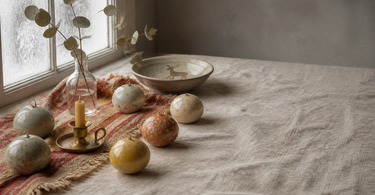
A Christmas collection with personality is built piece by piece over several years — not bought as a ready-made set. Start with motifs that mean something to you, mix materials like glass, ceramics and textiles, and add a couple of new ornaments each year. The result is a Christmas tree where every ornament tells a story rather than matching a colour palette.
There are two kinds of Christmas trees: those with matching baubles in two colours — and those where every ornament tells a story. The first is easy. The second takes a bit of patience, but the result is a tree that's clearly your own. Here's a guide to building a Christmas collection with character, piece by piece and year after year.
Start with what means something to you
Forget the rule about a consistent colour theme. The most interesting Christmas tree is the one you can point around and explain: here hangs the doughnut from the year we lived in the little flat; there sits the cat we found in a shop in Lisbon. Ornaments with personal meaning create the kind of trees people stop and look at.
Start by identifying what you actually find fun: animals, food, travel motifs, humour, concrete references from everyday life. That's a far more useful starting point than a Pantone guide. Our range of Christmas ornaments spans from classic glass figures to hand-painted porcelain shapes with character — precisely because there's no single right way to decorate for Christmas.
Tip: Decide on one theme or motif you want to collect over time — for example, animals, fruit or figures from a particular universe. That gives the collection a common thread without locking you into one colour or style.
Hand-painted ornaments: why they stand out
Mass-produced baubles are hassle-free and reliable, but they don't carry anyone's mark. A hand-painted ornament is different: the colour distribution varies from piece to piece, facial expressions aren't identical, and the surface texture reveals that a person has held it in their hand and applied the paint. That gives each ornament a slightly different personality.
In practice, this means your collection will never be a copy of someone else's — even if you buy the same ornament as your neighbour, the two pieces won't look quite the same. That's not a flaw, it's the point.
Materials in hand-painted ornaments
Hand-painted ornaments are typically made from three types of materials:
- Papier-mâché: Light and durable, a good base for detailed illustrations
- Ceramic and porcelain: Weight and detail, the surface can be glazed and fired
- Mouth-blown glass: Hand-painted after blowing — the colours sit on the outside and vary naturally
European manufacturers — particularly from Poland and the Czech Republic — have a long tradition of mouth-blown glass ornaments, where glassmakers blow shapes out in series, but each individual ornament is unique due to the manual process. A standard 8cm bauble in mouth-blown glass typically weighs 15-25 grams depending on the glass thickness.
Mix materials for depth and contrast
A Christmas tree made up entirely of glass baubles can look lovely, but it quickly becomes monotonous. The eye needs variation — in texture, weight and surface — to keep finding something new to look at. The solution is to mix materials deliberately.
| Material | Property | Effect on the tree |
|---|---|---|
| Glass | Reflects light, transparent or painted | Shine and depth, classic Christmas feel |
| Ceramics / porcelain | Weight, matte or glossy surface | Solid, earthy contrast to glass |
| Felt and textile | Soft, absorbs light | Warmth and cosiness, tones down otherwise shiny wood |
| Metal (brass, iron) | Hard surface, catches pinpoint light | Sharpness and metallic glint |
| Wood and papier-mâché | Light, matte, rustic | Naturalness and organic form |
A rule of thumb: let glass make up the base (60-70% of ornaments), and use the other materials as accents. Place heavy ceramic ornaments on the inner, sturdier branches, and let light glass and felt pieces hang on the outermost ones.
If you want more texture in your home's festive atmosphere generally, candles in colourful tones are a simple way to add warm light and scent — without needing an extra Christmas tree.
Christmas decoration beyond the tree
Christmas decorations aren't reserved for the Christmas tree. In fact, it's the rest of the home that sets the context for whether it all comes together.
The dining table
A pair of candlesticks with candles in deep winter colours — dark red, olive green, midnight blue — changes the mood at the dining table without a single ornament. Keep the shape simple and let the colour do the work.
Shelves and bookcases
A small group of porcelain figurines arranged on a shelf works like a miniature scene. Use odd numbers (3, 5 or 7 figurines) and vary the heights using books or a small plinth. It looks more natural than a symmetrical row.
Windows
Ornaments don't need a Christmas tree. Hang two or three pieces in a window with a thin nylon thread — they'll turn slowly in the warmth from the room and catch the daylight. It's particularly effective with mouth-blown glass, which breaks the light differently to flat material.
The hallway
The hallway is the first room guests see. A hook with a festive ornament hanging from itor a small display on a narrow console table is enough to set the tone for the rest of your home.
Build the collection over time
The best Christmas collection isn't bought all at once. It's built up over years, and that's exactly what gives it character.
A concrete strategy: set a budget for 2-4 new ornaments a year. It might seem modest, but over ten years you'll have added 20-40 pieces, each with its own personal story attached. Buy what you fall in love with when you see it — even outside December. Many of the best finds turn up in September and October, before the Christmas season really kicks in.
Store ornaments in individual boxes or wrapped in acid-free paper. This keeps surfaces, particularly on painted glass ornaments, intact for decades. Avoid bubble wrap directly against hand-painted surfaces — the plastic can stick to the paint during temperature fluctuations.
Tip: Note down on a small slip of paper, kept with the ornament in the box, when you bought it and where from. When you unpack it again in 5 years, it's nice to have the concrete details — not just a vague sense that it was "somewhere in Southern Europe".
Also look for ornaments that mirror the rest of your décor. If you have a soft spot for vases with animal motifs or colourful ceramic dishes, it makes sense to let that same universe sneak its way into your Christmas collection. It creates a sense of continuity in your home that doesn't feel forced.
Frequently asked questions
How many ornaments does a nice Christmas tree need?
It depends on the size of the tree, but a rule of thumb is 10-15 ornaments per 30 cm of tree height. A 150 cm tree can therefore carry 75-100 ornaments, but fewer if you're using large figures. The most important thing is that the branches don't bend noticeably downward — that's a sign you've packed them too tightly.
Can I mix hand-painted ornaments with cheap standard baubles?
Yes, and it's actually a good idea. Standard baubles fill gaps in the tree and create a neutral backdrop that lets the hand-painted pieces stand out. Use the plain-coloured baubles as a base and place the ornaments you want to highlight at eye level or slightly above.
How do I store hand-painted glass ornaments so they last?
Wrap them individually in acid-free paper or cotton wool — not bubble wrap directly against the surface. Store them at a stable temperature without major fluctuations (avoid the loft and an unheated garage). Hand-painted glass ornaments stay intact most easily when they don't rub against each other in storage.
Is there a rule for which colours go together on the Christmas tree?
No hard rule, but a guideline: choose one or two dominant colours and let the rest be accents. Alternatively, you can drop the colour rule entirely and let motif and material take the lead — a tree with exclusively figure-shaped ornaments in mixed colours looks intentional, because the motifs create cohesion.
When's the best time to buy ornaments?
Many producers launch their Christmas ranges as early as August-September. If you're after specific handmade pieces, it's wise to shop early — limited editions and hand-painted series typically sell out before December. Sales of last season's ornaments often happen in January.
Can ceramic ornaments hang on the Christmas tree?
Yes, but place them on the inner, sturdier branches — not the outermost ones. A ceramic ornament typically weighs 50-150 grams depending on size, and weak branches will visibly bend. Use a sturdier hanging cord and double-check that the eyelet is secure in the ornament before hanging it.
Summary
A Christmas collection with personality doesn't come from following a décor guide to the letter. It comes from choosing, over time, pieces that actually mean something to you — a hand-painted glass ornament, a ceramic figure with an absurd sense of humour, a little brass star bought at a local market. Mix materials deliberately, spread decoration throughout your home rather than just on the tree, and add 2-4 new pieces each year. In ten years, you won't just have Christmas decorations — you'll have a collection.
Explore our range of hand-painted Christmas ornaments and decorations and find this year's additions to your collection.