
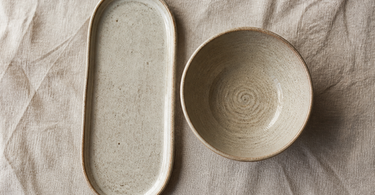
A dish is flat, oval or rectangular and primarily designed to present and serve food in a single layer — think roasted vegetables, a whole fish or bread. A bowl is deeper and typically round, meant to hold liquids, sauces and dishes with volume. Once you know the difference, you'll buy the right piece and avoid serving soup in a dish or salad in a container that's too shallow.
Ask ten people about the difference between a dish and a bowl, and you'll get ten slightly different answers. Yet there's a clear functional logic behind the two shapes — a logic that comes from how food behaves physically. A dish and a bowl fundamentally solve different tasks on the table, and once you understand that difference, it becomes much easier to put together a dinner service that actually covers all the situations you encounter in a busy kitchen or at a dinner party.
Definition: what is a dish, what is a bowl?
The shortest and most precise definition looks like this:
- Dish: A serving item with a flat or very shallow domed base and low, often almost vertical edges. The width is typically greater than the height — usually in a ratio of 8:1 to 12:1.
- Bowl: A vessel with noticeable depth, a curved side and a height-to-width ratio that typically ranges from 1:2 to 1:3. The depth means liquids and loose ingredients stay in place.
Both pieces belong to the serveware category, and you'll often find them side by side in the same collections. On dishes and bowls you can clearly see how the two silhouettes differ, even when designed in the same style and from the same material.
The edge reveals everything
The easiest way to tell them apart is to look at the edge. A dish's edge extends almost horizontally from the base — it's there to give you something to hold, not to contain the contents. A bowl's edge, on the other hand, is a continuation of the side: it curves inwards or straightens up to form an actual space. If you fill a bowl halfway with liquid, it won't spill out. It would in a dish.
Shape, dimensions and depth — the actual figures
Exact measurements naturally vary between manufacturers and styles, but the ranges below are typical for handmade ceramic tableware:
Dishes
- Depth: 1.5–4 cm
- Width/diameter: 20–45 cm
- Shape: Oval, rectangular or round
- Edge: Narrow, low or almost non-existent
Bowls
- Depth: 6–14 cm
- Diameter: 14–36 cm
- Shape: Mainly round, occasionally oval
- Edge: Curved or slightly flared to make serving easier
Want something in between — for example for tapas, butter or nuts — is small dishes and bowls the category that covers the smallest sizes of both types, typically under 16 cm in diameter.
Tip: Measure the depth with a ruler before you order online. If the depth is under 4 cm, it's a dish. If it's over 6 cm, it's a bowl. The zone in between — 4–6 cm — is the grey area, which manufacturers label differently. Here you should look at the shape's profile and the stated volume.
When do you use a dish?
A dish is the right choice when the main goal is presentationrather than storage of liquid or volume. The following situations typically call for a platter:
Serving fried or baked food
Roast potatoes, roasted vegetables, a whole chicken or a fish fillet — all of this is best presented on a flat surface, where heat can escape and the surface stays crisp. If the food sits in a deep bowl, it steams and loses texture on the bottom.
Bread and cakes
A flat platter lets guests take a piece without navigating around high edges. It's also easier to cut directly on a platter — though this will of course wear on the glaze.
Cheese board and charcuterie spread
Here it's about spreading out lots of elements so they're visible. A platter of 35–40 cm gives room for four types of cheese, grapes, nuts and crackers without them being stacked on top of each other.
Sushi and tapas
Individual bites in one layer. No argument for depth.
In the range of Citron bowls and platters you'll find, for example, flat oval platters that are well suited to exactly these purposes — form closely follows function.
When do you use a bowl?
A bowl is the right choice when either volume, liquid or mixing is part of the dish. Examples:
Salads and pasta salads
Even a seemingly "dry" salad produces liquid from dressing and vegetables. A bowl holds this in and gives room to toss the dish at the table without it flying all over the tablecloths.
Soup, porridge and dishes with sauce
Obvious: liquid requires depth. A soup bowl of 14–18 cm in diameter with 8–10 cm depth holds 400–700 ml, which corresponds to a normal portion.
Snacks and loose ingredients
Crisps, olives, almonds and similar tend to roll. A bowl's curve keeps them together and makes it easier to reach in with your hand.
Mixed and marinated
If you're using the serving piece to marinate or mix in, a bowl is always better. The sides act as a guide for the utensil, and you avoid spills.
Explore the full range of options in the bowls collection, which includes everything from large salad bowls to smaller serving bowls for sauces and dips.
Comparison table: dish vs. bowl
| Property | Platter | Bowl |
|---|---|---|
| Typical depth | 1.5–4 cm | 6–14 cm |
| Typical diameter | 20–45 cm | 14–36 cm |
| Dominant shape | Oval / rectangular | Round |
| Holds liquids? | No / very little | Yes |
| Best for | Presenting in a single layer | Voluminous dishes, sauce, salad |
| Stackability | Good (flat base) | Varies (curved base) |
| Used as a cake stand/cheese board? | Yes | Rarely |
| Used for soup/porridge? | No | Yes |
| Suitable for the oven (ceramic) | Yes | Yes |
Material and finish matter more than you think
The choice between a platter and a bowl isn't just about shape — the material determines what the piece can handle and how it performs in practice.
Stoneware and ceramic
The most widespread choice for handmade serving pieces. Stoneware is fired at 1200–1300°C, which gives a dense and impact-resistant body. Glazed stoneware platters and bowls are usually oven-, microwave- and dishwasher-safe, but always check the manufacturer's guidelines. The wall thickness of a good stoneware platter is typically 6–9 mm, which gives it heat retention — the food stays warm at the table for 10–15 minutes longer than with a thin-bodied porcelain variant.
Porcelain
Thinner-bodied and more translucent than stoneware. Porcelain bowls are often lighter and more elegant in expression, but can be more delicate when it comes to temperature shock. Suitable for cold and lukewarm dishes, but check whether the piece is approved for oven use at high temperatures.
Glazed vs. unglazed surfaces
An unglazed base is typically rough and provides good friction against the table. Glazed bases can slip — a practical argument for a napkin or a piece of cork under the platter. On the inside, glazing is important: a dense glaze is necessary if the bowl is to be used for acidic ingredients like lemon juice or vinegar, otherwise porous material can absorb flavour over time.
The whole dishes and bowls range gives you an overview of which pieces come in glazed and unglazed finishes respectively, and which are oven-safe.
Frequently asked questions
What's the most important difference between a platter and a bowl?
The crucial difference is the depth. A platter is flat — typically 1.5–4 cm deep — and is designed to present food in a single layer. A bowl is 6–14 cm deep and holds volume, liquids and loose ingredients. The shape reflects the function: platter = presentation, bowl = containment.
Can I use a platter as a salad bowl?
You can, but it's impractical. The dressing runs over the edges, and you can't toss the salad properly. A shallow platter under 4 cm deep also doesn't hold enough volume for a salad for 4+ people. Choose a bowl at least 8 cm deep and 28–32 cm in diameter for that purpose.
What's a serving bowl vs. an eating bowl?
A serving bowl is meant to sit on the table for guests to help themselves from — it's typically 25–36 cm in diameter. An eating bowl is individual and holds one portion, typically 14–18 cm in diameter and 400–700 ml. Size and context distinguish them, not the shape itself.
Are oval platters more practical than round ones?
An oval shape suits long ingredients like fish, asparagus and baguettes better, and follows the table's natural length. Round platters are more versatile for bread, cakes and cheese. Neither shape is objectively better — it depends on what you serve most often.
Can I put ceramic platters and bowls in the oven?
Most stoneware pieces can handle it, but this requires that the glaze and body are fired for oven use, and that you avoid rapid temperature changes. Always place the piece in a cold oven and let it heat up gradually. Check the manufacturer's labelling — oven-safety isn't automatically guaranteed for all types of ceramic.
What's a small platter suited for?
Small platters under 16 cm are ideal for sauces, dips, butter, flaked salt, nuts and olives — everything that should be within easy reach on the table without taking up much space. They also work as saucers under sauce bowls or as individual serving pieces for tapas and mezze.
Summary
The difference between a platter and a bowl is concrete and functional: the depth determines what the piece can be used for. Platters — with their 1.5–4 cm depth and flat base — are superior for presenting food in a single layer, roasted dishes, bread and arrangements where you want to show off the surface. Bowls — with 6–14 cm depth and a curved profile — are the right choice when the dish has volume, contains liquid, or needs to be mixed and tossed at the table. Once you know these two basic rules, you'll always choose correctly — whether you're putting together a new dinner set from scratch or adding to what you already have.
Explore our range of dishes and bowls — or go straight to bowls and small dishes and bowls to find the right piece for your table.