
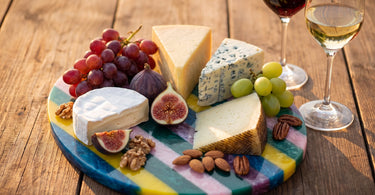
A beautiful cheese board is all about variety in cheeses and accompaniments set out alongside it. Arrange it all on a board or platter with plenty of room, so your guests can help themselves to whatever they fancy.
Contents
- The short answer to how you make a beautiful cheese board
- Choosing cheeses: create variety in taste and shape
- Accompaniments: what ties the cheese board together
- Temperature: why the cheese should come out in good time
- Presentation: a board or platter with room for it all
- Finishing touches: the last details on the cheese board
- Frequently asked questions
- Summary
A cheese board doesn't have to be complicated. What makes the difference between a messy table and an inviting cheese board comes down to a few simple choices: which cheeses you choose, what you put alongside them, and how you arrange it all on a board or platter. Here's an overview you can use next time you're laying the table.
The short answer to how you make a beautiful cheese board
Start by choosing several types of cheese, so there's something for every taste. Put accompaniments such as fruit, nuts and crackers next to the cheeses rather than mixing them in between. Arrange it all on a board or platter with enough room that the cheeses don't touch each other, and where guests can easily reach in and cut a slice.
These are the three tricks that give a cheese board a thoughtfully put-together look, without taking long to assemble.
Choosing cheeses: create variety in taste and shape
A cheese board works best when there's variety to choose from. A good rule of thumb is to start with four types:
- A hard cheese, which can be cut into thin slices or smaller pieces.
- A soft cheese that's creamy and easy to spread or cut into a piece.
- A blue cheese for those who like a stronger flavour.
- A goat's cheese, which often has a slightly tangy and light character.
With that combination, the board gets variety in both flavour and appearance, without you needing to have too many cheeses out at once.
Accompaniments: what ties the cheese board together
The accompaniments are just as important as the cheeses themselves. They add contrasts in flavour and let guests put together their own plate. Think:
- Fruit, fresh or dried, to add sweetness.
- Nuts to add crunch.
- Olives for a salty counterpart.
- Jam to balance out stronger cheeses.
- Crackers and bread as a base under the cheese.
Do set out olives or jam in a small dish, so it doesn't spread out over the rest of the table. A Lemon Dish from Caja Company or an Oyster Dish from &Klevering, for example, can be used for just this kind of smaller accompaniment.
Temperature: why the cheese should come out in good time
Cheese tastes best at room temperature. So take it out of the fridge in good time before your guests arrive, so it has time to warm up. Cold cheese straight from the fridge can seem firm and a bit bland, while the same cheese at room temperature opens up more in flavour. It's a small detail that makes a real difference to the experience at the table.
Presentation: a board or platter with room for it all
Presenting the cheeses is all about giving them room. Use a board or platter big enough for each cheese to have its own space, and lay a separate knife next to each cheese so the flavours don't mix along the way. Labels with the cheese's name are a simple way to make it easy for guests to choose, without having to ask every time.
If you need to find the right board, take a look at the shop's collections for Cheese platters and Cheese boards. If you already have a chopping board at home, it can easily be used for the purpose, for example a chopping board from EJA, which is hand-cast in resin and well suited for serving cheese, tapas and bread on the same board.
Tip: write a small label for each cheese. It makes it easy for guests to choose, and it's a nice touch that doesn't take long to make.
Find a board or platter that gives the cheeses room to stand on their own.
See cheese boardsFinishing touches: the last details on the cheese board
Finally, you can decorate with grapes and fresh herbs placed loosely between the cheeses. It adds colour and makes the table more lively to look at. A small bowl for jam belongs too, so it doesn't spread across the board but stays gathered in one place where guests can easily help themselves.
Frequently asked questions
What should be on a cheese board spread?
A cheese board should have variety in cheeses, for example a hard, a soft, a blue and a goat's cheese, along with accompaniments like fruit, nuts, olives, jam, crackers and bread.
How do you arrange a cheese board?
Arrange the cheeses on a board or platter with good space between them, lay a separate knife for each cheese, and place the accompaniments alongside instead of mixing them in between the cheeses.
How many cheeses should you have on a cheese board?
Four types give good variety: a hard cheese, a soft cheese, a blue-veined cheese and a goat's cheese.
Which board is best for a cheese board spread?
A board with enough room so the cheeses don't touch each other works best. The chopping board from EJA is hand-cast in resin and can be used for cheese, tapas and bread alike.
What do you drink with a cheese board?
There's no definitive answer here, but choose something that suits the cheeses you've picked, and let your guests taste their way through.
How do you decorate a cheese board?
Place grapes and fresh herbs loosely between the cheeses, and set out a small bowl of jam, so the table feels put together and inviting.
Summary
A lovely cheese board spread needs nothing more than variety in the cheeses, accompaniments placed alongside, room-temperature cheese and a board or platter with space for it all. With those elements in place and a little decoration like grapes and herbs, the cheese board is ready for a warm welcome.
Read also
- Which chopping board is best, and which oil do you use?
- Trays and platters: function and decoration in one
- Table decorations: how to build the centre of the table
- New Year's table: how to set the table for New Year
Ready to set the cheese board
The shop's collections are hand-picked by Dinna, so you can easily find the right board or platter for the occasion.
See cheese platters