
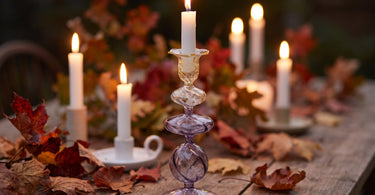
All Saints' Day is the day we remember our loved ones who have passed away. In the Danish national church, All Saints' Day is always the first Sunday of November, and All Saints' Eve is the evening before.
Dims Studio's own figures: If you're considering a crystal candlestick or an LED candle for All Saints' Eve, half of the crystal candlesticks sold cost under DKK 180, and half of the LED candles sold cost under DKK 170 (more than 40 and more than 150 items sold, from November 2025 to October 2026).
Contents
- The short answer
- Dates: All Saints' Eve and All Saints' Day 2026, 2027 and 2028
- Who we remember on All Saints' Day
- Candles on the grave: the tradition and its meaning
- The history behind All Saints' Day
- All Saints' Eve and Halloween: what's the difference
- How you can mark All Saints' Day
- Frequently asked questions
- Summary
Every year in November, many Danes gather in church to remember those they have lost. For some, All Saints' Day is a quiet evening with a candle and a name, for others a church service together with family. But the dates are often confused with Halloween, and many are unsure what the day is actually about.
Here you'll find answers to when All Saints' Eve and All Saints' Day fall in the coming years, what the tradition of lighting candles and reading out names means, and how you can choose to mark the day if you'd like to.
The short answer
All Saints' Day is a church day of remembrance for the dead. In the Danish national church, All Saints' Day is fixed as the first Sunday of November, regardless of which date that gives in the calendar. All Saints' Eve is the evening before, in other words the Saturday, and it's this evening that folklore says witches and ghosts are at work.
The day shouldn't be confused with Halloween, which always falls on 31 October. The two traditions share the same linguistic root, but follow different calendars and have developed in their own directions.
Dates: All Saints' Eve and All Saints' Day 2026, 2027 and 2028
Because All Saints' Day always falls on the first Sunday of November, the date shifts slightly from year to year. Here's an overview so you can easily see when to mark it in your calendar.
| Year | All Saints' Eve | All Saints' Day |
|---|---|---|
| 2026 | Saturday 31 October 2026 | Sunday 1 November 2026 |
| 2027 | Saturday 6 November 2027 | Sunday 7 November 2027 |
| 2028 | Saturday 4 November 2028 | Sunday 5 November 2028 |
In the Catholic church, on the other hand, All Saints' Day is always fixed on 1 November, regardless of the day of the week. This is one of the reasons why many confuse the Danish custom with the international one.
Who we remember on All Saints' Day
All Saints' Day, which used to also be called Hellemisse, was originally held in memory of all Christian saints and martyrs. Since Denmark became Protestant, the day has instead been a day of remembrance for all Christians, when we remember the dead in the light of the belief in the resurrection.
In many churches, the names of those who have died during the year are read aloud at the All Saints' Day service, and relatives are often given a special invitation to attend. This makes the day one of the most personal occasions of the church year, and the All Saints' Day service has today become the second most attended service, surpassed only by Christmas Eve.
Candles on the grave: the tradition and its meaning
In many churches, it has become customary to light candles for the dead during the All Saints' Day service, and in some places people carry the candles out to the graves afterwards. This is a relatively new tradition. Just 30 years ago, lighting candles in church was unheard of, but in recent years it has become common to remember the dead by lighting a candle on the grave on All Saints' Day itself.
In the Christian interpretation, the burning candle symbolises eternal life. In folk belief, however, the light is meant to keep evil spirits away, an idea that dates back to the belief that the powers of darkness are especially close on this particular evening.
Tip: If you'd like to know more about candles in general, you can read our guide to candles.
The history behind All Saints' Day
All Saints' Day came about because there weren't enough days in the calendar year to commemorate every saint on their individual day of death. So in the 800s, the Pope introduced a shared day for them all. When Christianity came to Denmark, All Saints' Day was celebrated on 1 November, and in the year 998, All Souls' Day was introduced on 2 November, when prayers were said for the dead.
Denmark became Protestant in 1536, after which the day changed character to become a day of remembrance for all Christians rather than a saints' day. With the holiday reform of 1770 under Christian VII, All Saints' Day was moved from the fixed date of 1 November to the first Sunday in November, as we know it today.
All Saints' Eve and Halloween: what's the difference
The name halloween comes from the Scottish form of All Hallows' Eve, meaning the evening before All Saints' Day. Because halloween follows the Catholic Church's dates, it's always celebrated on 31 October. In Denmark, however, All Saints' Eve is the evening before the first Sunday in November, so the two evenings only rarely coincide.
According to folk belief, All Saints' Eve is the evening when witches, ghosts and the powers of darkness are on the loose, a mood reminiscent of halloween's eeriness. But where halloween today is mostly about dressing up and partying, All Saints' Eve in Denmark has kept its quiet and reflective character.
How you can mark All Saints' Day
There's no single right way to mark All Saints' Day. Some choose to go to the All Saints' Day service and listen to the names being read aloud. Others visit the grave and light a candle as a quiet greeting. And some prefer to remember the person they've lost at home in the living room.
If you want to light a candle at home in memory of someone, a candlestick in glass or crystal can give the evening the right sense of calm, or you can choose an LED candle if you'd rather avoid an open flame.
Find a candlestick that can gather the light and the reflection when you remember someone at home.
Shop candlesticksFrequently asked questions
What is All Saints' Day?
All Saints' Day is a church day of remembrance for the dead. All Saints' Day was originally in memory of all Christian saints and martyrs, but since the Reformation it has become a day when all the dead are remembered in the light of the belief in resurrection.
When is All Saints' Eve?
All Saints' Eve is the evening before All Saints' Day, that is, the Saturday before the first Sunday in November. In 2027, All Saints' Eve falls on Saturday 6 November, and in 2028 it falls on Saturday 4 November.
When is All Saints' Day in 2027?
In 2027, All Saints' Eve falls on Saturday 6 November, and All Saints' Day is Sunday 7 November.
Why do people light candles on graves for All Saints' Day?
In many churches, candles are lit for the dead during the All Saints' Day service, and some people carry the candles out to the graves afterwards. In the Christian interpretation, the light symbolises eternal life, while in folk belief it's meant to keep evil spirits away.
What's the difference between All Saints' Eve and halloween?
Halloween comes from All Hallows' Eve and follows the Catholic Church's fixed date of 31 October. All Saints' Eve in Denmark, on the other hand, is the evening before the first Sunday in November, so the dates only rarely coincide.
What is All Souls' Day?
All Souls' Day is a Roman Catholic holy day on 2 November focused on deceased relatives. The tradition began in the year 998, when people started praying for the dead on this date.
Summary
All Saints' Day is a quiet day of remembrance, where All Saints' Day always falls on the first Sunday in November, and All Saints' Eve is the evening before. The custom of reading names aloud and lighting candles on graves has become a fixed part of the day, and it shouldn't be confused with halloween, which always falls on 31 October.
Read also
- St. Martin's Eve: date, history and table setting
- When do you put a candle in the window?
- Stearinlysguide: Typer, størrelser og brændetid
- Hvad er en lanterne? Og forskellen på en lanterne og et fyrfadsstage
- Candlemas: Hvad er det, og hvorfor fejrer vi lyset?
- Lucia-optog: Hvornår er Lucia-dag, og hvorfor fejrer vi den
- Trettendedag jul: dato, lys og traditioner
Skab plads til et stille lys derhjemme
Dinna har håndplukket lysestager og LED-lys, der kan skabe en rolig stund, uanset om det er til allehelgen eller en helt almindelig aften.
Se udvalget