
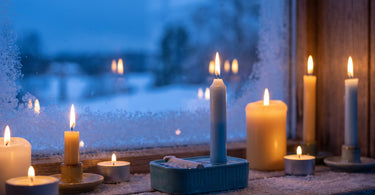
Candlemas is an old Christian feast day that always falls on 2 February, exactly 40 days after Christmas. The day marks the presentation of the infant Jesus in the temple and the blessing of the church's candles, but it also has a long folk history as a midwinter milestone.
Dims Studio's own figures: Coloured candlesticks are an obvious choice for Candlemas: half of the items sold cost under DKK 150, and the items have an average rating of 4.9 out of 5 stars across 31 reviews (more than 800 items sold, from November 2025 to October 2026).
Contents
Every year, right in the middle of the darkest time, the word Candlemas crops up, without many people quite knowing what it covers. It's neither a public holiday nor a feast day most people have marked in their calendar, but the name lives on in old sayings, winter songs and church traditions.
In this guide, you'll find out what Candlemas actually is, where the name comes from, and what the Christian background is about. You'll also get the old weather omens that farmers kept an eye on that day, along with some simple ideas for how to mark the festival of light yourself at home.
The short answer to what Candlemas is
Candlemas is a Christian feast day that falls 40 days after Christmas and therefore always lands on 2 February. Originally, it celebrated the presentation of the infant Jesus in the temple and Mary's purification after childbirth, but in Denmark the day is at least as well known for its folk traditions.
In the countryside, people used Candlemas to take stock in the middle of winter. The farmer checked whether there was enough fodder left for the animals, and the day was celebrated with kjørmesgilder (Candlemas feasts), while people also watched the weather to predict the coming spring. That's why Candlemas can be understood both as a church festival of light and as an old turning point in the farmer's winter calendar.
When is Candlemas
Candlemas is fixed on the calendar every single year and always falls on 2 February, whatever day of the week that happens to be. That makes the day easy to keep track of, even though it's nowhere near as well known as Christmas or Easter.
| Year | Date | Day of the week |
|---|---|---|
| 2027 | 2 February | Tuesday |
| 2028 | 2 February | Wednesday |
The day hasn't been an official public holiday in Denmark since the holiday reform of 1770, when it was abolished along with, among others, the third day of Christmas, the third day of Easter and St John's Eve. Even so, many churches have in recent years started reviving the tradition and mark the day with candlelit services, even though there's no day off from school or work.
What does Candlemas mean
The name Candlemas (kyndelmisse) is made up of two old words. Kyndel is Old Danish for torch or flame, while misse means mass. Together, the word goes back to the Latin missa candelarum, meaning the mass of the candles. This was precisely the ceremony in which the church's candles were blessed for use throughout the year.
In popular speech, the day was also given another name, namely Kjørmes Knud, or Candlemas's knot. This relates to the idea that winter ties a kind of knot, a turning point, here before moving on towards lighter times.
The Christian background to Candlemas
Candlemas is linked to a story from the Gospel of Luke. According to the Law of Moses, a woman was considered unclean until 40 days after giving birth, and so Mary was purified in the temple exactly 40 days after the birth of Jesus. At the same time, the infant Jesus was presented to God in the temple, and it's this event that Candlemas originally celebrates. The day is therefore also known as the Feast of the Purification of Mary.
In the temple, Mary and Joseph met the elderly Simeon, who called Jesus a light of revelation to the Gentiles. This is one of the reasons the day has since been celebrated with candles. The earliest accounts of the celebration date from around the year 385 in Jerusalem, and since the early Middle Ages, Candlemas has been a fixed festival of light in the Christian church. In the Middle Ages, the candles to be used in church for the rest of the year were blessed at Candlemas, and in the Catholic Church, candlelit processions are still held on the day.
Candlemas ties its knot: omens and old customs
Besides its religious background, Candlemas has always had a practical meaning in the countryside. According to popular tradition, the day marks that winter is halfway over, namely half of the winter half-year between 1 November and 1 May. That's why Candlemas was also a status check, when the farmer tallied up supplies and checked whether there was still enough feed for the animals. The ideal was that half the feed should still be left.
It was celebrated with 'kjørmesgilder', a kind of potluck feast, where people ate soup, pork, sausages and pancakes together with neighbours and family. At the same time, people kept a close eye on the weather, as many old omens were tied to this particular day.
| Omen | Meaning |
|---|---|
| It blows so hard that 18 old women can't hold the 19th down to the ground | Spring is on its way soon |
| The lark is heard for the first time | Milder times are coming |
| Candlemas thaw | A thaw foretells a hundred loads of hay, meaning a good harvest |
In some places, people also whipped fruit trees with twigs on Candlemas, hoping for a richer fruit harvest later in the year.
Tip: Keep an eye on the weather yourself on 2 February. If it's windy, or a thaw sets in, you can have fun comparing it with the old omens while you wait for spring.
Candlemas today
Although Candlemas isn't a public holiday in Denmark, the tradition lives on in many places. Many churches hold candlelit services around 2 February, and there's a tendency to use the day to mark the baptism of upcoming confirmands. In the Catholic Church, the day is still celebrated with candlelit processions, where the congregation carries lit candles through the church.
In France and Belgium, the tradition goes in a completely different direction. Here, the day is called La Chandeleur and has become pancake day, where families gather round the frying pan, much like the Danish 'kjørmesgilder'.
Candlemas has also left its mark on Danish song. Both 'Det er hvidt herude' by Steen Steensen Blicher from 1838 and 'Sneflokke kommer vrimlende' mention Candlemas and Kjørmes Knud, and they're still sung when winter is at its peak.
Make dinner on Candlemas a little more festive with a new candlestick on the table.
See candlesticksCelebrate Candlemas at home
You don't need to go to church to feel a bit of the Candlemas atmosphere. Light a couple of candles at dinner on 2 February, and feel free to use the occasion to gather the family round the table, just as people did at the old 'kjørmesgilder'.
- Make pancakes for dinner, as a modern-day version of the 'kjørmesgilde'.
- Light candles in the living room or at the dining table while you eat.
- Sing or read one of the winter songs that mention Candlemas, as a little nod to the tradition.
If your candles need a new place to stand, a candlestick from Coloured candlesticks is an easy way to add a touch of colour to the table in the middle of the grey winter.
Frequently asked questions
What is Candlemas?
Candlemas is an old Christian feast day on 2 February, marking that Jesus as an infant was presented in the temple, and that the church's candles were blessed. The day is also called the Feast of the Purification of the Virgin Mary.
When is Candlemas in 2027?
Candlemas 2027 falls on Tuesday 2 February. In 2028, it falls on Wednesday 2 February, as the day is always fixed on this date.
What does it mean that Candlemas 'ties its knot'?
The expression is linked to the popular name Kjørmes Knud, where the knot symbolises a turning point in winter. It marks that half of the winter half-year has passed.
Is Candlemas a public holiday?
No, Candlemas is not a public holiday in Denmark and hasn't been since the holiday reform of 1770. Many churches still hold candlelit services on the day, though.
Why do people light candles for Candlemas?
The tradition goes back to the church's candles for the whole year being blessed on this day, and to the story of Simeon, who called Jesus a light. That's why light is the key symbol of the day.
How do you celebrate Candlemas?
In church, the day is often celebrated with candlelit services and, in some places, candle processions. At home, you can light candles at dinner and make pancakes, just like at the old Kjørmes gatherings.
Summary
Candlemas is an old festival of light on 2 February, 40 days after Christmas, rooted in the story of the presentation of Jesus in the temple and the purification of Mary. The name means the mass of lights, and in popular speech the day has also been called Kjørmes Knud. Although it's no longer a public holiday, the tradition lives on through candlelit services, old weather lore and cosy pancake dinners, where you can feel that winter is halfway through.
Read also
- When do you put a candle in the window?
- Candle guide: types, sizes and burn time
- How to create cosiness with real candles
- Winter decor: turn your home into a warm haven
- Guide to colourful candlesticks: from glass to ceramic
- Lucia procession: when is St. Lucy's Day, and why do we celebrate it
- Epiphany: date, light and traditions
- All Hallows' Eve: date and why we light candles
Find the right candlestick for Candlemas
Dinna has hand-picked a selection of candlesticks in glass, ceramic, stoneware and crystal, so you can easily find a holder that suits your celebration of the festival of light.
See the selection