
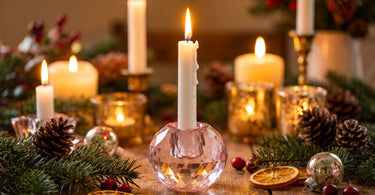
Epiphany falls on 6 January, the church's twelfth and final day of Christmas, and Epiphany Eve is the evening before, 5 January. The day marks the moment the wise men from the East reached the baby Jesus with their gifts, and traditionally that Christmas has now come to an end.
Contents
While Christmas ends just after New Year for many, an old custom holds that Christmas isn't truly over until Epiphany. Below, you can see exactly when the day falls in the coming years, why it's linked to three wise men and three gifts, and what an Epiphany candle actually is. You'll also get a few tips on how to hold your own little Epiphany Eve celebration at home, when the last Christmas biscuits need eating up.
When is Epiphany?
Epiphany Day is a church feast day that always falls on 6 January, regardless of the day of the week. Epiphany Eve is the evening before, that is 5 January, and it's typically that evening when the family gathers for the last remnants of Christmas. The day counts as the church's twelfth and final day of Christmas, and it thus rounds off the twelve days of Christmas that begin on Christmas Eve.
Although the date is always the same, the day of the week varies from year to year. It can be handy to know in advance, especially if you want to finish off the last Christmas biscuits before the decorations come down.
Dates for Epiphany in the coming years
Here you can see Epiphany Eve and Epiphany Day for the next two years, so you can plan when the last Christmas biscuits should come out and the candles should be lit.
| Year | Epiphany Eve | Epiphany Day |
|---|---|---|
| 2027 | Tuesday 5 January 2027 | Wednesday 6 January 2027 |
| 2028 | Wednesday 5 January 2028 | Thursday 6 January 2028 |
In 2027, Epiphany Sunday, the first Sunday after New Year, falls on Sunday 3 January 2027. Although the day is still marked in the Danish national church with its own Sundays after Epiphany, it hasn't been a public holiday since the holiday reform of 1770.
Who were the three wise men?
The story of the three wise men comes from the Gospel of Matthew, which tells of wise men from the East who followed a star to Bethlehem to find the baby Jesus. There, they offered three gifts: gold, frankincense and myrrh. It's actually worth noting that the gospel doesn't call them holy, three, or kings. The idea that there were exactly three comes from the three gifts, and over time they've come to be referred to as kings because of the precious gifts.
The names Kasper, Melchior and Balthasar come from a medieval legend, in which each of them also hailed from a different continent. The tradition of the wise men wasn't interrupted by the Reformation in 1536, and it still lives on in the Danish national church, among other things through the Sundays known as Sundays after Epiphany, during a period when the liturgical colour is green, symbolising hope and growth.
What is an Epiphany candle?
An Epiphany candle is either a single candle with three arms or three candles placed in a three-part candlestick. Each arm or candle represents one of the three wise men. The idea is that when the candles have burned down to the point where the arms meet, Christmas is officially over for that season.
In the past, it was customary to embed a small bit of gunpowder in the candle, so that a little bang would sound exactly when Christmas ended, a small reminder that it was now over. The custom of lighting candles for the kings is also known from Hans Christian Andersen's tale Little Peter's Christmas Eve from 1866, where the family lights three candles on Epiphany Eve, and Christmas isn't considered over until the candles have burned out.
Tip:Use a candlestick you already have lying around, and put three candles together in it instead of a three-armed candle. The effect is the same, and you can blow them out one by one as Christmas comes to a close.
When does Christmas officially end?
The twelve days of Christmas stretch from Christmas Eve to the 6th of January, which is counted as the church's twelfth and last day of Christmas. That's why, in many homes, this is also the day when the Christmas decorations are finally taken down and the Christmas tree is carried out.
The Danish national church points to an older custom where people wait to decorate until just before Christmas Eve and, in return, wait until Epiphany Eve to bring the festive season to a proper close. According to this idea, Epiphany Eve is the time to finish off the last Christmas biscuits and light the three-armed Epiphany candle, before Christmas is packed away for the year. If you've got biscuits sitting in a biscuit tin, the evening is a good excuse to empty it completely.
Find a biscuit tin for the last Christmas biscuits while you wait for Epiphany Eve.
See biscuit tinsCustoms around Denmark for Epiphany
Around the country, Epiphany Eve has gained its own local traditions over time. In some places it's about dressing up and visiting, in others it's about processions and special dishes.
| Place | Custom |
|---|---|
| Agersø and Omø | Epiphany run, a visiting tour with masks from house to house |
| Ærø (western part) | Dressing up from head to toe to visit each other's houses |
| Als | Dressing up on Epiphany Eve |
| Rønne | Procession led by a glass star, carried by the star bearer |
| Lolland and Falster | Tartlets, a custom described as far back as around 1930 |
In France, the day is celebrated with galette des rois, a cake with a small figure baked into it, where whoever finds the figure is king for a day. According to Lex, the tradition is believed to be a forerunner of the Danish almond gift.
How to celebrate Epiphany Eve at home
If you'd like to mark Epiphany Eve yourself, it doesn't have to be elaborate. Light an Epiphany candle or three ordinary candles placed together, and let them burn while you eat the last Christmas biscuits from the cupboard. In many homes, the candles look lovely in calm candlesticks or on a dish to gather the last biscuits and sweets in, for example a Caramella sweet dish in ceramic.
Another nice tradition is to end the evening by singing N.F.S. Grundtvig's Dejlig er den himmel blå from 1810, a song originally written as a children's song for Epiphany. Once the candles have burnt out and the last biscuit has been eaten, the Christmas decorations can be packed away for the year.
Frequently asked questions
When is Epiphany?
Epiphany Day falls on the 6th of January every year, regardless of which day of the week it lands on, and is counted as the church's twelfth and last day of Christmas.
When is Epiphany Eve?
Epiphany Eve is the evening before Epiphany Day, so the 5th of January.
What is an Epiphany candle?
An Epiphany candle is a candle with three arms, or three candles in a three-part candlestick, where each arm represents one of the Three Wise Men. Once the candle has burnt down to where the arms meet, Christmas is traditionally considered over.
Why are they called the Three Wise Men?
The term comes from the fact that the wise men in the Gospel of Matthew brought three precious gifts, gold, frankincense and myrrh, and over time they have therefore been called kings, even though the gospel itself doesn't describe them that way.
Is Epiphany a public holiday?
No, Epiphany hasn't been a public holiday since the holiday reform of 1770, but the day is still marked in the Danish national church.
When should the Christmas decorations come down?
According to old custom, people wait until Epiphany on 6 January to fully put Christmas away, and many therefore take down Christmas decorations and the Christmas tree around that date.
Summary
Epiphany falls on 6 January, with Epiphany Eve on 5 January, and the day brings together the story of the wise men, their gifts and the old custom of lighting a three-armed candle, before Christmas is finally put away for the year.
Read also
- Christmas decorations for the home: Create the perfect festive atmosphere
- How long can a Christmas tree keep indoors?
- When do you put candles in the window?
- What is Advent? Meaning, dates and traditions
- Candlemas: What is it, and why do we celebrate the light?
- Lucia procession: When is St Lucia's Day, and why do we celebrate it
- All Hallows' Eve: date and why we light candles
Get ready for Epiphany Eve
Find candlesticks, cake tins and dishes for the last days of Christmas. All the products in the shop are handpicked by Dinna.
See the range