
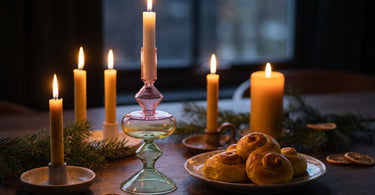
The short answer: St. Lucia's Day is on 13 December, when the Lucia procession is celebrated. A white-clad Lucia bride with a crown of candles on her head leads the way, followed by attendants carrying candles, while everyone sings the song about Santa Lucia. The tradition originates from Sweden and is today a firm part of the Danish Advent season.
Dims Studio's own figures: From November 2025 to October 2026, more than 150 LED lights were sold, where 44% had green, 44% pink and 42% yellow as one of the colours. Half of these LED lights cost under 170 DKK.
Contents
In the darkest time of the year, children and adults come together around candlelight and song as the Lucia procession makes its way through schools, churches and care homes. Behind this atmospheric tradition lies an old legend about a Christian martyr from Sicily, who over the centuries has been given new life as a warm December tradition.
In this guide, you can read about the date of St. Lucia's Day, the story behind St. Lucia, how the procession itself is structured, and how the custom found its way from Sweden to Danish nurseries and churches.
The short answer about the Lucia procession
The Lucia procession is a candlelit procession held on St. Lucia's Day on 13 December in memory of the Christian martyr St. Lucia. The procession is led by a Lucia bride in a white dress with a crown of candles on her head, and she is followed by attendants walking two by two, each carrying a candle, while the whole group sings the song about Santa Lucia.
The custom is originally Swedish, but was adopted in Denmark during the occupation and has since become a firm part of the Advent season in schools, nurseries, churches and care homes across the country.
When is St. Lucia's Day
St. Lucia's Day always falls on 13 December, regardless of which day of the week it falls on. The date is firmly linked to St. Lucia, who according to the Church of Denmark died as a martyr on this very day in the year 304.
Below you can see which day of the week St. Lucia's Day falls on in the coming years:
| Year | Date | Day of the week |
|---|---|---|
| 2026 | 13 December | Sunday |
| 2027 | 13 December | Monday |
| 2028 | 13 December | Wednesday |
Because St. Lucia's Day has a fixed place in the calendar, you can always plan your procession, breakfast or visit to your grandparents well in advance, whether the day falls on a weekday or at the weekend.
Who was Lucia
St. Lucia was a Christian virgin from Syracuse in Sicily. She lived from around the year 283 to 304 and died as a martyr during Emperor Diocletian's persecution of Christians. The name Lucia comes from the Latin word lux, meaning light, and it is precisely this light that lies at the heart of the whole tradition.
Legend has it that Lucia, under cover of darkness, brought food to poor and persecuted Christians who were hiding in the catacombs underground. To be able to see in the dark whilst keeping both hands free for the food, she tied a wreath with lit candles around her head. This simple, practical solution has today become the very image of the Lucia procession: light on the head and free hands to carry more candles or sing.
Lucia became the patron saint of her home town of Syracuse and of the blind, and her name and story bring light and hope together in the midst of darkness.
Because the Julian calendar gradually became more and more inaccurate, St Lucy's Day ended up, by the late Middle Ages, falling on what was then thought to be the shortest and darkest day of the year. This is one of the explanations for why this particular date became a fixed point for festivals of light, long before anyone spoke of Lucia processions as we know them today.
How a Lucia procession works
A traditional Lucia procession has a set structure that recurs in schools, nurseries, churches and care homes. At the front walks the Lucia bride in a white dress with a red sash around her waist and a wreath of candles on her head. She often also carries a small bouquet of candles in her hand. Behind her follow the attendants, who walk two by two, each carrying their own candle, and the procession can be rounded off by star boys.
| Role | Symbol |
|---|---|
| Lucia bride | White dress as a christening gown, red sash as a symbol of martyrdom, wreath of candles on the head |
| Attendants | Carry candles two by two |
| Star boys | Follow the procession |
The white dress symbolises the christening gown, while the red sash around the waist is a symbol of Lucia's martyrdom. The wreath of candles on the head is a direct reference to the legend of how she carried light so she could see whilst keeping her hands free. The youngest children often carry electric candles instead of real flames, so the procession can take place safely, even when it's the littlest ones in the nursery who have to carry the candles.
If the littlest ones are to carry candles safely in the procession, electric candles are a good choice.
See LED candlesFrom Sweden to Denmark
The Lucia tradition as we know it today has its roots in Sweden. After the Reformation in 1536, Denmark stopped celebrating Lucia as a saint's day, but in Sweden the tradition was kept alive. In the 1600s and 1700s, St Lucy's Day at manor houses in western Sweden was opened by a girl dressed in white, who walked through the courtyard carrying a candle.
The first modern Lucia procession, in the form we know today, was arranged by the newspaper Stockholms Dagblad on 13 December 1927. A young girl was chosen to be Lucia and led through the streets of Stockholm, and this laid the foundation for the public, visible celebration that has since spread widely.
The custom came to Denmark during the occupation. According to Danish Wikipedia, a Lucia procession was already held in 1943 at the Th. Langs schools in Silkeborg. According to the reference work Lex, the first Lucia procession in Copenhagen was arranged at National-Scala in 1944 following lobbying by the Foreningen Norden, which during the occupation wanted to strengthen the shared Nordic traditions. The sources don't fully agree on where the first Danish procession took place, but both point to the war years as the starting point.
The tradition really took hold when Princesses Margrethe and Benedikte took part in a Lucia procession at the Swedish Embassy in Copenhagen in 1946. Since then, the Lucia procession has gradually become part of the Danish Advent season, where children in schools, nurseries, churches and care homes walk in procession with candles and song. In Sweden, the Lucia celebration is still kept separate from Christmas, but in Denmark it has merged with the rest of December's traditions. You can read more about the other customs of Advent in the article about what Advent is.
The song and the lussekatter
At the Lucia procession, the song about Santa Lucia is sung, which was originally a tribute to the area of Santa Lucia by the Bay of Naples in Italy. The Italian original was printed in Naples in 1849, and the Danish lyrics, sung at processions across the country, were written by Alex Garff.
Besides the song, lussekatter are among St Lucy's Day's fixed traditions. Lussekatter are Swedish buns, coloured a vivid yellow with saffron, and they're usually shaped like an S with a raisin in each curl. In Sweden, it's traditional for the eldest daughter in the household to play Lucia and wake the rest of the family with a tray of coffee, lit candles and lussekatter, a custom many Danish families have also adopted in their own way.
Celebrate St. Lucia's Day at home
You don't need to wait for the nursery or school procession to feel a bit of the Lucia atmosphere. A breakfast table with coffee, saffron buns and lit candles can easily take place at the kitchen table before the rest of the day gets going. Set the saffron buns out on a platter, light candles on the table, and why not let one of the children carry in the first cup of coffee, just as tradition dictates in Sweden.
If you fancy a little procession game at home, one child can wear a wreath or a ribbon on their head and walk at the front, while the rest of the family follow in pairs, each carrying their own candle, just like the attendants in the real procession. For the little ones, electric candles are a safe option, so no one has to walk with an open flame. The shop's LED candles from Rice can be used both for the breakfast table and for a homemade procession game, and a cake platter makes it easy to gather the saffron buns for the whole family.
Tip: Let the youngest members of the family try a candle wreath or a ribbon on their head, and save the real candles for yourself, so the evening stays safe for everyone.
Frequently asked questions
When is Lucia Day?
Lucia Day is always on 13 December, no matter which day of the week it falls on.
What is Lucia?
Lucia was a Christian virgin and martyr from Syracuse in Sicily, whose name means light. Today, Lucia is also the name given to the girl dressed in white who leads the Lucia procession.
Why do we hold a Lucia procession?
The procession is a tribute to the legend of Saint Lucia, who wore candles on her head to help persecuted Christians in the dark, and today it's a fixed part of Advent.
When did the Lucia procession come to Denmark?
According to Danish Wikipedia, a Lucia procession was held in Silkeborg in 1943, while Lex points to National-Scala in Copenhagen in 1944 as the first one. The tradition really spread after the princesses took part in a procession in 1946.
What do you sing during the Lucia procession?
People sing the song about Santa Lucia to an Italian melody from Naples, with Danish lyrics written by Alex Garff.
Why does Lucia wear candles on her head?
According to the legend, Lucia wore a wreath with candles on her head so she could see in the dark while keeping her hands free to carry food to persecuted Christians in the catacombs.
Summary
Lucia Day always falls on 13 December and is about the legend of Saint Lucia, light in the darkness and the togetherness of the Lucia procession. The tradition came to Denmark from Sweden during the occupation and is today a warm part of Advent, whether you experience it at nursery, at church or at your own breakfast table.
Read also
- What is Advent? Meaning, dates and traditions
- When do you put a candle in the window?
- How to create cosiness with real candles
- Ceramic cups: from morning coffee to a cosy moment
- Candlemas: what is it, and why do we celebrate the light?
- Epiphany: date, candles and traditions
- All Hallows' Eve: date and why we light candles
Get ready for Lucia Day
Find candlesticks for the breakfast table and cake platters for the saffron buns, so you're ready when Lucia Day approaches.
See more in the shop