
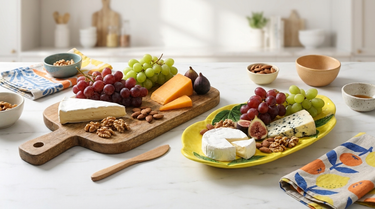
Osteanretning
Osteanretning – brætter i træ og marmor samt fade i keramik til ostebord og tapas
Læs mereVis mindre
Vores osteanretninger dækker både brætter i træ og marmor og fade i keramik. Materialerne kan bruges enkeltvis eller kombineres, når borddækningen til ostebord, tapas eller anden anretning skal sammensættes. Sortimentet giver mulighed for at variere udtryk og funktion efter anledning.


A good cheese board is just as much about the platter as it is about the cheese. At Dims Studio you'll find hand-painted cheese platters and serving platters in ceramic, stoneware and porcelain, shaped like lemons, fish, lobsters and mussels, plus resin cutting boards from EJA. Here's a guide to types, materials, sizes and use, so you can put together the right cheese board, whether it's for a weekday tapas table or a weekend cheese table.
Cheese board: how to choose the right platter
A cheese board can be anything from a single round platter to a combination of several platters and a cutting board. The most important thing is that the platter suits the amount of cheese, sides and cold cuts that need to fit, and that it works with the rest of the table. Our range of serving platters is characterised by hand-painted motifs where lemons, fish, shellfish and fruits recur, and where every platter has its own colour variations because it's handmade.
Think about whether the cheese board should stand alone as the centrepiece of the table, or be part of a larger tapas or lunch spread with several platters and bowls. If there needs to be room for several cheeses, bread and fruit, a large oval or round platter is often the best choice. If the platter is mainly for a single cheese or a bit of ham and olives, one of the smaller platters or a cutting board is enough.
Types of cheese platters and serving platters
The range at Dims Studio spans several types of platters, each suited to different spreads. Below is an overview of the types that recur in the collection of serving platters and cheese platters.
Round and oval ceramic platters
The round and oval ceramic platters are the most versatile and work well for everything from cheese and cold cuts to fruit and tapas. Here you'll find several lemon platters from Caja Company, with the largest measuring 40 x 35 cm, and smaller oval platters around 25 x 11 cm that are easy to place several of on the same table. What they have in common is that the shape gives plenty of room to arrange cheese, crackers and fruit in a natural curve.
Fish-shaped platters
Fish-shaped platters are a recurring theme in the range and work especially well when the spread should have a maritime feel. Here you'll find the Snapper fish platter, Rainbow fish platter, Flounder platter and Triggerfish platter, all hand-painted in stoneware or dolomite with detailed scales and fins. The fish platters are great for a cheese board with sides like smoked salmon, lemon and fresh herbs next to the cheese.
Shellfish-shaped platters
Shellfish-shaped platters such as lobster, crab, mussel, shrimp and jellyfish give the spread a festive look and work well for a spread combining cheese with seafood or tapas. Kersten is behind several hand-painted lobster platters, while Caja Company and &Klevering offer crab, mussel, shrimp and jellyfish platters in various sizes.
Fruit and vegetable-shaped platters
Platters shaped like lemon, orange, grape, strawberry, pomegranate, artichoke, garlic, plum and pumpkin recur throughout the range, mainly from Caja Company. They work well as part of a cheese board where fresh fruit, nuts or olives should have their own platter next to the cheese, and they often double as a spoon rest by the stove when not in use at the table.
Resin cutting boards
Beyond the ceramic platters, the range includes hand-cast resin cutting boards from Danish EJA, in sizes from 26 x 20 cm to 45 x 15 cm. Each board has its own pattern and colour play because the resin is cast individually, and the board works both as a base for the cheese and as a serving board for the whole cheese spread.
Types compared
| Type | Shape | Good for | Examples in the range |
|---|---|---|---|
| Round and oval ceramic platters | Classic, versatile | Cheese, cold cuts, fruit, tapas | Lemon platter, Forest berry platter, Pomegranate platter |
| Fish-shaped platters | Elongated, detailed relief | Maritime spread, fish, smoked salmon | Snapper fish platter, Flounder platter, Triggerfish platter |
| Shellfish-shaped platters | Figurative, festive | Seafood, tapas, celebrations | Lobster platter, Crab platter, Mussel platter |
| Fruit and vegetable-shaped platters | Figurative, colourful | Fruit, olives, nuts next to the cheese | Lemon platter, Grape platter, Artichoke platter |
| Resin cutting boards | Elongated or rectangular board | Base and serving board | Cutting board 29.5x23 cm, Cutting board 45x15 cm |
Materials: ceramic, stoneware, porcelain and resin
Material has a big impact on how a cheese board both looks and performs. Below is a rundown of the materials found in the range and what characterises each of them.
Ceramic and faience
Most of the platters in the range are made from ceramic or Italian faience, often hand-painted piece by piece. This means no two platters are exactly alike, and colours can vary slightly from the photo to the platter you receive. Faience is a glazed type of ceramic common in Italian tableware, and many of Caja Company's platters are made from it.
Stoneware and dolomite
Stoneware and dolomite are denser, sturdier types of ceramic, used by brands such as &Klevering and Bloomingville for their fish and serving platters. These materials hold up well to daily use and suit platters that get handled both at the table and the somewhat rougher treatment in the kitchen.
Porcelain
A few platters, such as the Shrimp platter and Lobster platter from &Klevering, are made from porcelain. Porcelain is thinner and finer than stoneware, giving the platters a more elegant look while still being dishwasher safe.
Resin
The cutting boards from EJA are cast in resin, where colour pigments are mixed into the material before it hardens. This creates a marbled look, where every board is unique. Resin is a hard-wearing material that's easy to keep clean and well suited as a permanent serving board for cheese, olives and figs.
How to care for your cheese board
- Always check the product description for each platter, as some hand-painted platters should be hand washed to best preserve the glaze and colours.
- Avoid placing hot pots or pans directly on ceramic and resin, as sudden temperature changes can damage both the glaze and the surface.
- Wipe resin cutting boards with a damp cloth and let them air dry completely before storing.
- Store hand-painted platters so they don't knock against each other in the cupboard, as the glaze can chip or wear at points of hard contact.
Cheese board for everyday and celebrations
A cheese board can be adapted for anything from an ordinary Friday night in to a bigger gathering. A single platter with one cheese, a few crackers and grapes is enough for everyday use, while a party or weekend table often benefits from combining several platters in different sizes and shapes.
If the cheese board is to be part of a larger tapas spread, it's a good idea to choose several smaller platters so guests can help themselves to the different cheeses, olives and sides without having to share a single large platter. Also check out our range of tapas platters if you often host tapas nights.
If the spread is for a single cheese or a smaller lunch, one of the smaller ceramic platters or one of EJA's cutting boards may be enough. Feel free to combine a cutting board with a couple of smaller ceramic platters, leaving room for cheese, olives and pickled vegetables.
For a gift occasion, a single cheese platter often works better than a full set, because the platter stands alone as a decorative object when not in use. A hand-painted platter from &Klevering or Caja Company can therefore work as both a gift and a piece that brightens up the kitchen counter between meals.
Sizes: from the small platter to the large serving board
The size of the platter determines how much room there is and how many guests the spread will stretch to. Below is an overview of the sizes that recur in the range of cheese platters and cutting boards.
Small platters, up to around 20 cm
The smallest platters, such as several of Caja Company's spoon rests and fruit-shaped platters, are well suited for a single cheese, a few olives or nuts. They also work well as part of a larger table where several small platters are complemented by a central main platter.
Medium platters, around 25 to 30 cm
Medium-sized platters, such as several of the oval ceramic platters and the 29.5 x 23 cm cutting board, suit two to four people and are often the most versatile choice for an everyday cheese board with a few different cheeses and some sides.
Large platters, from around 33 cm and up
The largest platters in the range, such as the large lemon platter at 40 x 35 cm and the shellfish platter at 33 cm, give room for a really big spread with several cheeses, fruit and cold cuts. They work well as the centrepiece of a table where several guests eat from the same platter.
Sizes compared
| Size | Typical measurement | Suits | Best as |
|---|---|---|---|
| Small | Up to around 20 cm | 1 person or extra platter | Single cheese, olives or nuts |
| Medium | Around 25 to 30 cm | 2 to 4 people | Everyday cheese board |
| Large | From around 33 cm | 4 people or more | Parties and bigger gatherings |
A rule of thumb is to allow room for two to three cheeses per medium platter, if there also needs to be room for crackers, grapes and other sides on the same platter.
Brands behind the cheese boards
The range of serving platters and cheese platters at Dims Studio brings together several brands, each with their own craftsmanship and style.
&Klevering
The Dutch brand &Klevering is behind a large part of the fish platters and a number of the smaller lemon and candy platters. The brand often works with maritime motifs in the De la mer series, where lobster and crab, among others, recur in stoneware and porcelain.
Caja Company
The Italian brand Caja Company is known for hand-painted faience with fruit, vegetable and seafood motifs. Many of their platters have a dual function as both a spoon rest by the stove and a serving platter at the table.
Kersten
The Dutch brand Kersten delivers the hand-painted lobster platters with detailed relief that make a great eye-catcher on a cheese board with seafood.
Bloomingville and Creative Collection
Bloomingville and Creative Collection contribute hand-painted stoneware platters such as the Soline platter and Florita tealight holders, where the glaze and shape give a more understated, Nordic look than the Italian and Dutch platters.
EJA
The Danish brand EJA is behind the cutting boards in hand-cast resin. Each board is cast individually, so the colour play and pattern always vary from board to board.
Which cheese board should you choose?
| Situation | Our recommendation |
|---|---|
| Everyday comfort with a single cheese | A small or medium ceramic platter, e.g. a lemon or fruit-shaped platter |
| Tapas night with several dishes | Several smaller platters in different shapes, combined with a tapas platter |
| Party or large cheese table | A large oval or round platter from 33 cm and up, ideally paired with a cutting board |
| Maritime theme | Fish or shellfish-shaped platters such as the Lobster platter, Crab platter or Flounder platter |
| A permanent serving board for daily use | One of EJA's resin cutting boards |
| A gift for someone who loves cheese and good company | One of the large, colourful platters from Caja Company or &Klevering |
Frequently asked questions about cheese boards
Which platter is best for a cheese board?
It depends on the amount of cheese and sides. For a single cheese, a small or medium platter is enough, while a large oval or round platter from around 33 cm and up suits a bigger spread with several cheeses and sides better.
Can you use the same platter for both cheese and tapas?
Yes, most of the serving platters in the range are designed to be versatile and can be used for cheese, tapas, fruit and olives, depending on how you put the spread together.
Which material is easiest to maintain?
Stoneware, porcelain and resin are generally easy to clean and hold up well to daily use. For hand-painted platters in ceramic and faience, always check the product description, as some should be hand washed for the sake of the glaze.
How many cheeses should I plan per person?
There's no fixed rule, but a medium platter typically gives room for two to three cheeses if there also needs to be room for crackers and fruit on the same platter.
Can you combine several platters on the same table?
Yes, it's one of the best ways to add variety to a cheese board. Feel free to combine a large platter as the main platter with a couple of smaller fruit or shellfish-shaped platters for sides.
What's the difference between a cheese platter and a cutting board?
A cheese platter is typically made from ceramic, stoneware or porcelain and is mainly used for serving, while a resin cutting board can be used both as a base when cutting the cheese and as a serving board at the table.
Do ceramic platters and resin cutting boards work together on the same table?
Yes, the materials can easily be combined and often give a more varied and personal look than if all the platters were the same material.
Can the figurative platters be used for anything other than cheese?
Yes, many of the fruit and vegetable-shaped platters also work as a spoon rest by the stove or as a bowl for keys and jewellery when not in use at the table.
Are the platters hand-painted, and does that mean they vary?
Yes, most of the platters from &Klevering, Caja Company and Kersten are hand-painted, which means colours and patterns can vary slightly from platter to platter, even within the same model.
Which size should I choose for four people?
For four people, a medium to large platter from around 25 to 33 cm is often the right choice, ideally combined with an extra smaller platter for fruit or olives.
Can the platters be used for hot food?
The platters are designed for serving cheese, tapas, fruit and similar at room temperature. Avoid placing very hot dishes directly on ceramic or resin, as sudden temperature changes can damage the surface.
Where can you buy a cheese board?
You'll find a wide range of cheese platters, serving platters and cutting boards for your cheese board at Dims Studio, where the range spans hand-painted platters in ceramic and stoneware to resin cutting boards from EJA.