
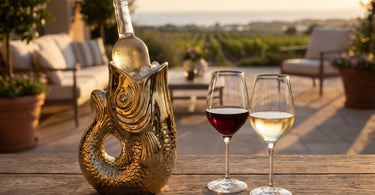
The short answer: full-bodied red wines are best drunk at 15-18 degrees, while light red wines such as beaujolais are best at around 13 degrees. White wines range from 7 to 13 degrees depending on body, and sparkling wines should be well chilled at 6-10 degrees. Champagne is best drunk at 7-9 degrees.
Contents
- What temperature should wine be?
- Serving temperatures for wine: table according to WSET
- Why temperature matters for the taste
- Red wine and room temperature: what does it actually mean
- White wine and champagne: how to chill them properly
- How to keep the temperature right at the table
- Decanting: when and how it makes sense
- Frequently asked questions
- Summary
The same bottle of wine can taste completely different depending on whether it's served cold or at room temperature. Red wine, white wine and champagne each have their own ideal temperature, and getting it right means you get more out of both the aroma and the taste.
In this guide, you'll find a table of serving temperatures according to WSET, an explanation of why temperature matters, and good tips for chilling your wine properly and keeping the temperature right at the table.
What temperature should wine be?
The temperature determines how much you taste of acidity, tannins and fruit in the glass. As a rule, full-bodied, powerful red wines should be served warmest, at room temperature, around 15-18 degrees, while light red wines such as beaujolais, valpolicella and bardolino are best served slightly chilled at around 13 degrees. White wines cover a broader range: light and medium-bodied white wines should be well chilled, while full-bodied, oak-aged white wines only need to be lightly chilled and are therefore higher in temperature. Sparkling wines and sweet wines should be the coldest of all, and champagne is best drunk at 7-9 degrees. In the table below, you can see the recommended temperature for each wine style.
Serving temperatures for wine: table according to WSET
The table is based on recommendations from the Wine & Spirit Education Trust (WSET). The wine styles are examples of temperature ranges, not a complete overview of grapes and types.
| Wine style | Examples | Temperature |
|---|---|---|
| Sweet wines | Sweet muscat, late harvest wines | 6-8 degrees |
| Sparkling wines | Prosecco, champagne | 6-10 degrees |
| Light and medium-bodied white wines | Fino sherry, muscadet | 7-10 degrees |
| Medium-bodied and full-bodied oak-aged white wines | White Burgundy | 10-13 degrees |
| Light red wines | Beaujolais, Valpolicella, Bardolino | 13 degrees |
| Medium-bodied and full-bodied red wines | Vintage port, Rioja, Bordeaux, Burgundy | 15-18 degrees |
If you'd rather know how many glasses there actually are in a bottle, you can read more in the article How many glasses are there in a bottle of wine and in champagne.
Why temperature matters for the taste
When wine is cold, the acidity and tannins are emphasised, while the aroma is muted. That's why a red wine served too cold can seem tight and closed in its aroma. Conversely, warmth reduces acidity and tannins, while the aromas open up and become clearer. This is why full-bodied red wines with lots of tannins are allowed to be warmer, while white wines with a fresher acidity are served colder, so the acidity doesn't become too dominant.
Red wine and room temperature: what does it actually mean
In an ordinary home, room temperature is 20-22 degrees, but when it comes to red wine, room temperature means a lower temperature, namely 16-18 degrees, and for lighter styles such as certain Beaujolais, as low as 12-14 degrees. So it's not the same temperature as in your living room in winter with the heating on.
Full-bodied red wines actually taste best just below the classic room temperature. That's why it's a good rule of thumb that the bottle would rather be a touch too cold than too warm when it comes to the table. The wine's temperature rises quickly as soon as it's poured into the glass, and a red wine that's too warm can't be cooled down again at the table.
White wine and champagne: how to chill them properly
Just as it's a problem if the red wine is left too long at room temperature, it's also a problem if the white wine comes straight from the fridge. Both are an issue, because the wine never reaches the temperature at which it tastes best.
Champagne should always be served cold, and the ideal drinking temperature is between 7 and 9 degrees. A good method is to put the bottle in a bucket of ice and water for about half an hour before opening it. This makes the champagne less lively, so it's easier and calmer to open without spraying all over the table. At the same time, a cold bottle loses less carbonation when poured, so the bubbles last longer in the glass.
Tip: A wine cooler on the table is a practical solution for ice water, so the champagne or white wine can stand ready without taking up space in the freezer.
How to keep the temperature right at the table
Once the bottle has reached the right temperature, it's all about keeping it there for as long as possible. A wine cooler on the table is a simple solution, for example Hot Moms wine cooler from GiftCompany or Fiske wine cooler in stoneware, silver, from GiftCompany, which makes it easy to have the bottle standing ready between pourings.
Always hold the glass by the stem, whether it's a wine glass or a champagne glass like a flute or a tulip glass. This way, the glass doesn't get marked, and the warmth of your hand doesn't warm the wine. Also, only pour a little at a time, as the wine's temperature rises quickly as soon as it's poured. You can also read more about how glasses should be arranged on the table, so they're easy to reach during dinner.
Find a wine cooler that can keep the bottle ready at the table all evening.
See wine coolersDecanting: when and how it makes sense
As a general rule, it's not necessary to decant wine, but in two cases it can make sense. Older wines may have developed sediment that you'll want to keep out of the glass, and young, powerful wines can benefit from being aerated, so they become less overpowering and develop more aroma.
At home, you can stand the bottle up the day before, so the sediment has time to settle at the bottom. When you decant, the clear wine is carefully poured into a carafe or another clean, odour-free container, while the sediment stays behind in the bottle.
Several wine writers recommend decanting highly tannic wines such as barolo, bordeaux, cabernet sauvignon and port, but advise against it for more delicate wines like chianti and pinot noir. However, the effect is debated among experts, so think of it as a tool you can experiment with, not a fixed rule.
Frequently asked questions
What temperature should red wine be?
Full-bodied red wines such as rioja, bordeaux and burgundy should be at room temperature, around 15-18 degrees, while light red wines like beaujolais are best at around 13 degrees.
What temperature should white wine be?
It depends on the body. Light and medium-bodied white wines such as muscadet should be well chilled at 7-10 degrees, while full-bodied, oak-aged white wines like white burgundy only need to be lightly chilled at 10-13 degrees.
How cold should champagne be?
Champagne is best enjoyed at a temperature of 7-9 degrees, and it should always be served cold.
What does room temperature mean when talking about red wine?
It doesn't mean the usual room temperature of 20-22 degrees, but 16-18 degrees, and for lighter styles such as certain beaujolais, as low as 12-14 degrees.
How long should champagne sit in an ice bucket?
The bottle is typically chilled in a bucket of ice and water for about half an hour before it's opened.
Should you decant red wine?
As a rule, it's not necessary, but it can make sense to remove sediment from older wines or to aerate young, powerful wines so they develop more aroma.
Summary
Temperature makes a real difference to what you taste in the glass. Use the WSET table as a guideline, remember that the bottle is better off being a little too cold than too warm, and consider a wine cooler on the table so the temperature stays steady throughout the meal.
Read also
- How many glasses are there in a bottle of wine, and champagne?
- How should glasses be arranged on the table?
- Ceramic wine stoppers: Give the bottle a new lease of life
- How do you remove red wine stains from a tablecloth?
- Wine tasting at home: how to hold a great wine tasting
- Sangria: ingredients, method and serving
- What is prosecco? The difference between champagne, cava and sparkling wine
Find the right kit for your wine
From wine coolers to glasses that suit the style, Dinna makes it easy to serve wine at the right temperature.
See the selection