
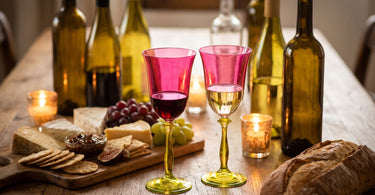
Would you like to host a wine tasting at home, the formula is simple: choose a theme and 4-6 wines, give each guest a glass per wine, and set the glasses out in an arc or in a row. Taste from left to right in three steps: look at the wine, smell it, and finally taste it. Write down your impressions as you go, and compare notes once all the glasses have been tasted.
Dims Studio's own figures: Half of the wine glasses sold at Dims Studio cost under 190 DKK, and among the jugs sold, 64% were stoneware and 58% were ceramic, materials that are perfect for blind tasting (more than 150 and 300 items sold, November 2025 to October 2026).
Contents
- The short answer
- Choose a theme for your wine tasting
- What you'll need for the wine tasting
- Setup and order: how to arrange the glasses
- Taste in three steps: appearance, smell and taste
- Blind tasting and semi-blind tasting
- Notes, scores and food for the wine tasting
- Frequently asked questions
- Summary
A wine tasting at home doesn't need to be complicated. With a theme, a few bottles of wine and the right glasses, you and your guests can have an evening where you really notice what's in the glass. It's about turning the tasting into a shared experience, where everyone contributes their own impressions, and where you can afterwards compare what you've concluded.
In this guide, you'll get the concrete steps: how to choose a theme and number of wines, what equipment you'll need, how to set up the glasses, and how to taste systematically in three steps. You'll also get inspiration for blind tasting and for what you can serve as food along the way.
The short answer
Choose a theme and 4-6 wines, and give each guest a glass per wine. Set the glasses out in a row or in an arc, and taste from left to right in three steps: look at the colour, smell the wine, and finally taste it. Write down your impressions as you taste, and compare notes once all the wines have been tasted.
Choose a theme for your wine tasting
The first choice is the theme. A theme gives the tasting a common thread and makes it easier to compare the wines afterwards. Popular themes include:
- Different grapes, so you can feel the difference between grape varieties.
- The same grape from different countries or regions.
- Different price ranges of the same type of wine.
- Wines from the same district.
- Food and wine, for example cheese and wine or chocolate and wine.
You can also choose a vertical tasting, where you taste different vintages of the same wine from the same producer, or a horizontal tasting, where the wines are from the same vintage but from different producers. A tasting line-up is typically between three and eight glasses, but for a wine tasting at home, 4-6 wines is a good rule of thumb. More than ten to twelve wines isn't common, as both the nose and the sense of taste get tired along the way.
What you'll need for the wine tasting
Before your guests arrive, you need to sort out the practical details. Systembolaget recommends 4-6 different wines and 4-6 glasses per person for a wine tasting at home, meaning one glass per wine for each guest. In addition, you'll need:
- A glass with a stem and foot for each wine, so the bowl doesn't get smudged or warmed by your hand. The glass should have a bowl that's large enough to gather the aroma, and this applies to white wine too.
- A spittoon and water glass for those who want to rinse their mouth between wines.
- Bread, typically plain white bread, and still water.
- Paper and pencil or a tasting chart, so you can jot down your impressions.
If you need more glasses for the evening, you can find wine glasses in the shop, for example Gardenia wine glasses in crystal glass or Petunia wine glasses, both in sets of 2 from Anna + Nina. If you'd like to know how many glasses you can pour from a single bottle, you can read more in the article about how many glasses there are in a bottle of wine.
Here's an overview of the practical equipment you'll need for a wine tasting at home.
| Equipment | Purpose |
|---|---|
| Glass with stem and base | Captures the aroma and prevents the bowl from getting stained or warmed |
| Spittoon and water glass | For rinsing your mouth between wines |
| Bread and still water | Cleanses the palate between wines |
| Paper and pencil or tasting chart | For noting down impressions along the way |
Setup and order: how to arrange the glasses
Arrange the glasses in an arc or a row in front of each guest, in the order the wines are to be tasted. Always taste from left to right, so you keep track of the order. Build up the tasting so you start with the simpler wines and finish with the more complex ones, for example by moving from light to full-bodied wines.
Avoid perfume and strongly scented hand cream for the tasting, and make sure the glasses are completely free of any smell that could disturb the impression. A glass that smells faintly of washing-up liquid can ruin the experience of an otherwise good wine.
If you'd like an overview of how glasses and plates are arranged for the rest of the evening, you can also take a look at the article about how glasses should be placed on the table.
Find beautiful wine glasses for the whole party, so each guest has their own glass for each wine.
See wine glassesTaste in three steps: appearance, smell and taste
The tasting itself takes place in three steps, which echo what's known in English as the five S-steps: see, swirl, sniff, sip and savour.
Appearance. Hold the glass at an angle against a white background, and look at the colour. Is it dense or more transparent? Red wine goes from blue-red when young to red or brick-coloured when mature, while white wine goes from light and pale to yellow or golden yellow. If it's a sparkling wine, don't swirl the glass so much that the bubbles disappear.
Aroma. First smell the glass without swirling it, as some of the most volatile aromas disappear after the first swirl. Then swirl the glass, and smell again. Is the aroma strong or faint? Young wines often smell of fresh fruit and berries, while mature red wines can smell of mushrooms and leather, and mature white wines can smell of nuts and honey.
Taste. Take a sip, and notice whether the wine is light or full-bodied, tannic or soft, and whether it has a fresh fruit acidity. Do the aroma impressions recur in the taste? Once everyone has tasted, compare your descriptions. Remember that everyone smells and tastes differently, so there's no single right answer.
Tip: Because intoxication affects judgement, many wine tasters spit the wine out at a formal tasting. It's not considered rude, and with a spittoon to hand, everyone can taste their way through several wines without losing track.
Blind tasting and semi-blind tasting
If you want to make the tasting extra exciting, you can try a blind tasting. Here, no one knows which wine is in which glass, for example because the wine has been poured into a jug, or because the bottle is wrapped up. The shop's jugs in ceramic and stoneware are great for this purpose, because the wine can't be seen through them. You can also use a black glass, which hides the colour completely.
In a semi-blind tasting, you know which wines are included in the tasting, but not which wine is in which glass. It's a slightly milder variant, where you can still try to guess which wine is which.
Blind tasting reveals something interesting about how much expectations affect the taste experience. In a 2011 experiment with 400 participants, ordinary consumers couldn't distinguish expensive wines from cheap ones. In another experiment, researcher Frédéric Brochet served the same white wine, but coloured red, and participants described it using typical red wine words, even though it was the same wine in the glass the whole time. It says something about how much our eyes and expectations govern what we think we're tasting.
Notes, scores and food for the wine tasting
Write down your impressions of each wine as you taste, so you can remember and compare afterwards. Some choose to give points, just like the professionals do. Wine critic Jancis Robinson uses a scale from 1 to 20, while Robert Parker uses a scale from 1 to 100. You can make your own simple scale or use one of these if you want to make it a bit more serious.
If you're serving food with the tasting, it's worth remembering that sweetness in the food makes the wine seem less sweet. If you're serving a dessert wine, it should therefore be just as sweet as the dessert, or preferably sweeter, otherwise the wine can seem flat and sharp by comparison.
A cheese board is an obvious choice for a wine tasting, and you can find inspiration for the spread in the article on cheese board ideas. If you'd rather serve small dishes along the way, you can take a look at tapas ideas for the evening. For the cheese spread, you can use dishes for cheese platters or one of the shop's cheese boards.
Frequently asked questions
How do you hold a wine tasting at home?
Choose a theme, set out 4-6 wines, and give each guest a glass per wine. Place the glasses in an arc or in a row, and taste from left to right in three steps: look, smell and taste. Write down your impressions, and compare afterwards.
How many wines do you need for a wine tasting?
Systembolaget recommends 4-6 different wines for a wine tasting at home. More than ten to twelve wines isn't common, as the nose and sense of taste become tired along the way.
How many glasses do you need for a wine tasting?
Count on 4-6 glasses per person, in other words one glass for each of the wines you're tasting. The glasses should have a stem and a bowl that's big enough to capture the aroma.
How do you do a blind tasting of wine?
Pour the wine into a jug, so it can't be seen, or wrap up the bottle. A black glass can also be used to hide the colour. In a semi-blind tasting, you know which wines are included, but not which wine is in which glass.
What do you eat at a wine tasting?
Serve plain white bread and still water between the wines. If you're putting together a whole spread, a cheese board or tapas work well for a wine tasting.
Should you spit out the wine at a wine tasting?
Many choose to spit out the wine, because intoxication affects judgement along the way during the tasting. It's not considered rude, and a spittoon makes it easy for those who want to.
Summary
A good wine tasting at home is about preparation: choose a theme, set out 4-6 wines, and make sure there are enough glasses for each guest. Line up the glasses in order, and taste your way through them in three steps, ideally supplemented with a blind tasting and notes along the way. Finish with a cheese board or other dishes, and remember that sweetness in the food affects how sweet the wine tastes.
Read also
- Cheese board ideas: how to arrange a lovely cheese board
- Tapas ideas: dishes, spread and drinks for the evening
- How many glasses are there in a bottle of wine, and champagne?
- How do you remove red wine stains from a tablecloth?
- Wine temperature: how to serve red wine, white wine and champagne
- Sangria: ingredients, method and serving
- What is prosecco? The difference between champagne, cava and sparkling wine
Ready to host your own wine tasting?
Find glasses, jugs and cheese boards that make the evening both beautiful and practical, from the first glass right through to the cheese on the table.
See the range