
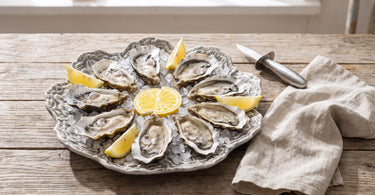
The short answer: hold the oyster with the flat side up in a tea towel, and insert an oyster knife at the end between the shells. Twist the knife, cut the adductor muscle along the edge, and release the meat from the bottom shell. Then the oyster is ready to be eaten raw or cooked.
Dims Studio's own figures: In the category Fish and seafood bowls and plates, 43% of the items sold were wholly or partly made of ceramic, and half of the items cost under 310 DKK (more than 60 items sold, from November 2025 to October 2026).
Contents
- How to open oysters: the short answer
- What you'll need
- Step by step: how to open oysters
- Is the oyster good or bad?
- Season and species: when are oysters in season?
- Serving and accessories for oysters
- Safety: advice from the Danish Veterinary and Food Administration
- Frequently asked questions
- Summary
Oysters can seem like a closed book, quite literally, when you're faced with a whole box and no experience. The shell is hard, the knife has to be used correctly, and it's hard to know if the oyster is even good to eat.
This guide walks you through the method from Destination Limfjorden's instructions, so you can open oysters safely, tell the difference between a good and a bad oyster, and know when they're at their best during the year. At the end, you'll get ideas for serving and accessories, as well as the Danish Veterinary and Food Administration's safety advice.
How to open oysters: the short answer
Get a good grip on the oyster with the flat side up, preferably using a tea towel, so you have a secure hold and protect your hand. Find the end of the oyster, and insert the oyster knife between the shells. Twist the knife on its edge, so the shells open slightly. Then run the knife around the edge of the shell to cut the adductor muscle, lift off the top shell, and release the meat from the bottom shell. Pour off any excess water, and remove any shell fragments before serving the oyster.
What you'll need
- An oyster knife with a short, sturdy blade of around 5 cm, preferably with a guard on the handle that stops the knife and your hand from slipping too far in.
- A tea towel or a pair of sturdy gloves that give a good grip and protect your hand.
- A firm surface to hold the oyster on.
The reason the right equipment matters is that beginners often use too much force. If the blade slips, you can cut yourself, and the shell itself can also be sharp. That's why a good grip on the oyster and a knife that doesn't slip are an important part of safety, not just a convenience.
Step by step: how to open oysters
Before you get started, it helps to understand how the oyster is built. The two shells are joined by a hinge, which in elongated oysters sits at the pointed end. The hinge pushes the shells apart, while the adductor muscle is what keeps the oyster closed. The muscle is so strong that a healthy oyster can't be opened without a tool, and that's exactly what the knife needs to cut through.
- Get a good grip on the oyster with the flat side up.
- Find the end of the oyster, insert the knife between the shells, and twist the knife on its edge.
- Run the knife around the edge of the shell to cut the adductor muscle, and then lift off the top shell.
- Release the meat from the bottom shell, pour off any excess water, and remove any shell fragments.
With the European oyster, one shell is domed and bowl-shaped, while the other is flat and acts as a lid. That's why you should look for the flat side and turn it upwards when holding the oyster.
Tip: Always use a tea towel or gloves, even once you're experienced. The shell can be just as sharp as the blade, and a few extra seconds of caution make all the difference.
Is the oyster good or bad?
A good oyster is closed, and when you open it, the liquid is still in the shell. It smells fresh of the sea. A bad oyster, on the other hand, is open, the liquid has leaked out, and it has a strong, unpleasant smell.
If you're faced with an oyster that's already open, you can test it with a light tap on the shell. If it closes, it's alive and good to eat. If it doesn't react at all, it's dead and should be discarded. Fresh oysters should be alive right up until they're eaten or cooked.
Season and species: when are oysters in season?
Oysters are found in the Limfjord all year round, but it's only recommended to gather them from September to April. The rule of thumb is months with an R in the name. The reason is that oysters filter the water for algae, and in summer the water can contain toxic algae that thrive in warm water. In the other months, the oysters are breeding, and you should leave them in peace. January is considered the best month for oysters.
In Denmark, a distinction is typically made between two species. The European oyster, also called the Limfjord oyster or flat oyster, has round shells and typically tastes less salty, with a slight sweetness, nutty notes and firm flesh. In Denmark, larger stocks of it are only found in the Limfjord. The invasive Pacific oyster has oblong shells, is saltier and has softer flesh, and anyone is free to gather it for their own use.
The two oyster species you typically come across in Denmark differ in several ways.
| Characteristic | European oyster | Pacific oyster |
|---|---|---|
| Shell shape | Round | Oblong |
| Taste | Less salty, slight sweetness, nutty | Saltier |
| Flesh | Firm | Soft |
| Distribution | Larger stocks only in the Limfjord | Free to gather anywhere for your own use |
Serving and accessories for oysters
The classic way to eat oysters is raw, with a little lemon and maybe a drop of Tabasco. Many restaurants also serve them with mignonette, a dressing made from chopped shallots, pepper, dry white wine and lemon juice or sherry vinegar. If you'd like them warm, oysters can be gratinated in the oven with breadcrumbs, Parmesan, salt and pepper, or boiled whole in their shells for about 5 minutes, after which they're easy to open.
For serving, the opened oysters are best placed on a dish with ice, so they stay cold and fresh while you eat. An oyster platter in ceramic or an oyster bowl in ceramic can be used for this at home, and an oyster salt and pepper set in stoneware makes it easy to season them right before eating. The best drinks to have with oysters are champagne, white wine or dark beer.
Find a dish that can keep the oysters cold and ready for serving.
See oyster plattersSafety: advice from the Danish Veterinary and Food Administration
Every year, consumers fall ill with winter vomiting disease, norovirus, after gathering and eating raw oysters or mussels. The Danish Veterinary and Food Administration therefore recommends only gathering oysters in monitored areas where you check for any warnings, and avoiding river and wastewater outlets, harbours, towns, and periods right after storms and flooding.
Only buy or gather live oysters from approved, open areas, and only serve oysters that are fresh and smell fresh of the sea. If you want to be completely safe, oysters can be heated to 100 degrees for a minute, which kills viruses and bacteria, but it doesn't remove any algae toxins.
Frequently asked questions
How do you open oysters?
Hold the oyster flat-side up in a tea towel, insert the knife at the hinge between the shells, twist the knife, and cut the adductor muscle along the edge. Then lift off the top shell and release the meat from the bottom one.
How can you tell if an oyster is good?
A good oyster is closed, and the liquid is still inside when it's opened, and it smells fresh of the sea. A bad oyster is open, has leaked its liquid, and smells bad.
When is oyster season?
The rule of thumb is months with an R in the name, so from September to April, because oysters can contain toxic algae in summer and spawn during the other months. January is considered the best month.
What do you serve with oysters?
Oysters are classically served raw with lemon and perhaps Tabasco, or with mignonette, and can also be gratinated or boiled. Champagne, white wine or dark beer go well with them, and the opened oysters can be placed on a platter of ice.
How do you eat oysters?
Raw oysters are typically eaten plain or with lemon juice, vinegar or cocktail sauce, while gratinated or boiled oysters are eaten hot with a fork or straight from the shell.
Can you get ill from raw oysters?
Yes, every year people get ill with norovirus after eating raw oysters, so the Danish Veterinary and Food Administration recommends only gathering or buying them from approved, monitored areas and serving them fresh. Heating to 100 degrees for one minute kills viruses and bacteria, but doesn't remove algal toxins.
Summary
Opening oysters is mostly about a good grip and patience: a tea towel, a short sturdy knife, and then twist and cut along the edge following Destination Limfjorden's four steps. Keep an eye on whether the oyster is closed and fresh, respect the season from September to April, and follow the advice of the Danish Veterinary and Food Administration, so your evening with oysters becomes both enjoyable and safe.
Read also
- Fish and shellfish in interior design: Maritime charm
- Tapas ideas: dishes, presentation and drinks for the evening
- How to store lemons so they last longer
- New Year's table: how to set the table for New Year's Eve
- New Year's menu: ideas and plan for New Year's Eve
- New Year's reception: what is it, and how do you hold one?
- What is prosecco? The difference between champagne, cava and sparkling wine
Ready to set the table for oysters?
Find more platters and bowls that turn the presentation into an experience, from raw oysters to warm shellfish.
See the selection