
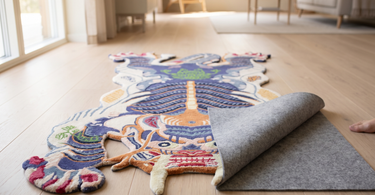
A rug underlay sits between the floor and the rug and solves three things: it keeps the rug in place, it reduces wear, because the rug doesn't rub against the floor, and it makes the rug softer to walk on. You especially need one under flat-woven and thin rugs on smooth floors. Thick, hand-tufted wool rugs often stay put on their own.
Contents
A rug underlay isn't the most exciting thing you can buy for your home, but it's one of the cheapest ways to get more out of a rug you already have. Here's when it makes sense, and when you can skip it.
What is a rug underlay?
A rug underlay is a mat you place between the floor and the rug. It comes in several types: thin nets of rubber or latex, which mainly provide grip, and thicker felt or foam underlays, which also cushion. Some combine the two, with felt on top and rubber underneath.
The underlay is usually cut so it's a couple of centimetres smaller than the rug all the way round. That way it doesn't stick out at the edge.
Three reasons to use one
The rug stays put. The most obvious one. Flat-woven rugs are thin and have little weight, and on a varnished or tiled floor, they slide every time you walk on them. Besides being annoying, it's also a trip hazard, especially in the hallway and entrance.
The rug lasts longer. Without an underlay, the back of the rug rubs against the floor every time it's stepped on. This wears down the backing and, over time, loosens the binding in woven and tufted rugs. The underlay removes that friction.
It feels better. A thicker underlay gives the rug more bulk and makes it softer to walk on. It's the same effect as laying a thin rug on top of a bigger jute one — just without it being visible.
The underlay also protects the floor. On wooden floors, colour from a damp rug can transfer, and grit trapped under the rug can scratch it. An underlay keeps the two surfaces apart.
When do you need one?
Short answer: almost always on smooth floors, less often on carpeted floors.
- Yes, definitely — flat-woven rugs, cotton rugs, runners and anything thin and light, on wood, tile or vinyl flooring.
- Yes, but mainly for the sake of wear — hand-tufted wool rugs, which lie still under their own weight, but still get worn on the underside.
- No — small rugs that sit under a piece of furniture, which keeps them in place, or rugs that lie on top of another rug.
Which type for which floor?
Rubber and latex give the best grip, but on some lacquered wooden floors, plasticisers from cheap rubber can, over time, leave marks or discolour the lacquer. Choose an underlay marked as suitable for wooden floors if you're in doubt. Felt underlay gives less grip but the most cushioning and is gentle on the floor — the combination of felt and natural rubber is therefore the most versatile choice for wooden floors.
On tiles and vinyl, you have a freer choice, because the surface can handle more. If the rug lies on a fitted carpet, slipping is rarely the issue, but a thin underlay can still stop the top rug from rippling.
If you don't want to buy an underlay
There are middle-ground solutions. Double-sided rug tape in the corners keeps a small rug in place, but it can leave sticky residue on the floor and needs replacing. Anti-slip strips work in the same way. Both solve slipping, but neither protects the underside of the rug from wear.
The free solution is placement: lay the rug so a piece of furniture stands with at least two legs on it. The weight of the sofa or armchair holds the rug down, and it also visually ties the furniture together better. We've written more about that in which size rug you should choose for the living room.
Maintenance
- Lift the underlay and vacuum both it and the floor a couple of times a year. Grit collects underneath the rug.
- Turn the rug while you're at it — that way the pile wears evenly, and the light doesn't only fade one side.
- Replace the underlay once it starts to crumble or lose its grip. Rubber hardens over the years.
For the rug itself, see how to care for a hand-tufted rug and how to wash wool.
Frequently asked questions
What does a rug underlay do?
It keeps the rug in place, reduces wear on the underside by removing friction against the floor, and makes the rug softer to walk on.
Do I need underlay under a wool rug?
A thick hand-tufted wool rug typically lies still under its own weight, but an underlay still extends its lifespan, because the underside doesn't rub against the floor.
Can a rug underlay damage the wooden floor?
Cheap rubber can leave marks in the lacquer over time. Choose an underlay marked as suitable for wooden floors, typically felt combined with natural rubber.
What size should the underlay be?
A couple of centimetres smaller than the rug all the way round, so it doesn't stick out at the edge. Most underlays can be cut to size with an ordinary pair of scissors.
Why does my rug keep slipping?
Flat-woven rugs are thin and light, so they have nothing to grip with on a smooth floor. An underlay or a piece of furniture with two legs on the rug solves it.
Summary
A rug underlay keeps the rug in place, extends its lifespan by removing friction against the floor, and makes it softer to walk on. It's especially relevant under flat-woven and thin rugs, runners and cotton rugs on smooth floors, while thick hand-tufted wool rugs often lie still under their own weight. Choose felt combined with natural rubber for wooden floors, cut the underlay a couple of centimetres smaller than the rug, and vacuum underneath the rug a couple of times a year.
Read also
- What size rug should you choose for the living room?
- How do you care for your hand-tufted rug?
- What is a hand-tufted rug?
- How do you store blankets and throws in the summer?
- How big should the rug under the dining table be?
- How to clean a rug yourself
- What is a chindi rug?
Does your floor need something new? Take a look at our rugs, wool blankets and cotton blankets.