
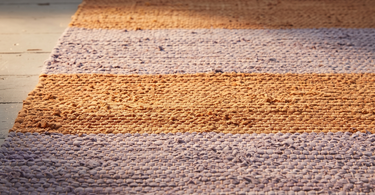
A chindi rug is woven from strips of cotton fabric instead of freshly spun yarn, giving it a mottled surface and a flat-woven, thin rug without pile. This makes it easy to wash, roll up and use in the hallway and kitchen — but also easier to push around on a smooth floor.
Contents
The word chindi appears on rugs at Dims Studio, and it refers to a particular weaving method rather than a specific pattern. Here's what the technique means for look, weight and care.
What does chindi mean?
Chindi is the term for rugs woven from strips of leftover fabric rather than freshly spun yarn. The method stems from a recycling tradition, where discarded textiles are cut into narrow strips, which then serve as weaving weft in the same way yarn would.
Because the strips come from different fabrics, colour and texture vary from strip to strip. That's the very principle behind the technique — and the reason the surface looks mottled once the rug is finished. At Dims Studio, Bongusta's chindi rugs are woven from strips of cotton fabric.
The mottled look
Up close, you can see the individual strips and their shades of colour. Seen from a distance, the same colours blend together into one overall tone, because the eye merges the many small patches of colour into an average. The result is a surface that appears almost neutral in a room, even though it's actually made up of many different colours.
It's this quality that makes chindi rugs useful under furniture and in rooms with plenty of colour already — the rug adds life without dominating. Bongusta's textiles are built on precisely that combination of colour and reuse.
Flat-woven means thin
Chindi rugs are flat-woven, meaning without pile. This has some practical consequences: the rug is thin enough to lie under a door without it catching, and it can be rolled up and put away when not in use.
That same thinness also means the rug is lighter than a rug with pile, and lighter rugs tend to slide on smooth floors like wood or tiles. A rug underlay beneath the chindi rug solves that problem and keeps it in place.
Sizes and where they fit
Chindi rugs come in the sizes 45 x 60, 60 x 90, 60 x 120, 60 x 200 and 140 x 200 cm, and in practice, the size determines where the rug makes the most sense:
- 45 x 60 cm works as a mat in front of a door or by the bed.
- 60 x 90 and 60 x 120 cm suit the hallway and kitchen, where you need a rug you walk past or stand on for short periods.
- 60 x 200 cm is a runner, suitable for a hallway or a narrow floor area.
- 140 x 200 cm is large enough to bring together a furniture arrangement in the living room.
See the whole range under cotton rugs or under living room rugs, if it's the larger sizes that are relevant.
For everyday use: hallway, kitchen and children's room
A flatwoven cotton rug is well suited to rooms with lots of traffic, for several reasons:
- Cotton can often be machine washed, so stains from shoes, food or coffee don't stick around.
- The flat weave withstands daily use without flattening or matting together the way pile does.
- Cotton dries faster than wool, meaning less time before the rug can go back on the floor.
- The rug is easy to roll up or lift off the floor when it's time to hoover or wash the floor underneath it.
That makes chindi rugs a natural choice in the hallway, kitchen and children's room, where wear and tear is greatest.
Washing and care
Several of the cotton rugs can be machine washed at a low temperature — this is stated in the washing instructions for each individual product, and these should always be followed rather than a general assumption. After washing, the rug should be dried flat so it doesn't pull out of shape or warp.
Frequent washing wears on the colours over time, so it's worth washing as needed rather than on a routine. Always check the label or the product page for the specific rug before it goes in the machine.
Chindi or wool?
Wool is more hard-wearing and elastic than cotton — it springs back better underfoot and lasts longer under constant use. Chindi rugs in cotton, on the other hand, are lighter, thinner and in many cases can be washed, which wool can less often.
The choice between the two is therefore mostly about what the rug will be used for: a spot with a lot of wear and a need for washing points towards chindi, while a calm floor area, where the rug needs to last a long time without washing, points towards wool. See the difference explained in more detail in the difference between cotton, jute and wool, or compare directly in wool rugs and rugs.
Frequently asked questions
What is a chindi rug?
It's a rug woven from strips of leftover fabric instead of freshly spun yarn, a recycling technique that gives a flatwoven, mottled surface.
Why does a chindi rug look mottled?
Because the strips come from different fabric with different colours, and the many small patches of colour blend together into one tone when you look at the rug from a distance.
Can a chindi rug be machine washed?
Several models can, at a low temperature, but this should always be checked on the washing instructions for the individual product.
Why does my chindi rug slip?
Because it's flatwoven and thus lighter than a rug with pile, it slips more easily on smooth floors — a rug underlay solves the problem.
Is chindi or wool best?
Neither is generally best: wool is more hard-wearing and elastic, while cotton chindi is lighter and can often be washed, so the choice depends on the room and the use.
Summary
Chindi is a weaving method where strips of cotton fabric replace yarn, giving rugs a flatwoven structure without pile as well as a mottled, colourful look. The flat weave makes the rugs thin, easy to roll up and well suited to the hallway, kitchen and children's room, but also more prone to slipping without an underlay. Sizes from 45 x 60 to 140 x 200 cm cover everything from doormat to living room rug, and several models can be machine washed at a low temperature according to the product's own instructions. Compared with wool, chindi is lighter and more washing-friendly, while wool wins on durability and elasticity — so the choice follows the room's needs, not the price.
Read also
- Forskellen på bomuld, hør og uld i boligtekstiler
- What are the benefits of hand-woven rugs?
- What is a hand-tufted rug?
- Bongusta: Colourful textile art from Portugal
- What is a quilted throw?
- How to clean a rug yourself
- Rug underlay: when do you need one?
See them at Dims Studio — cotton rugs, Bongusta rugs and all rugs.