
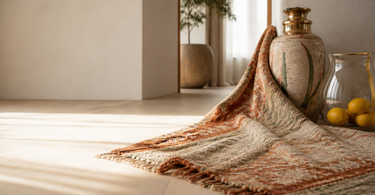
Hand-woven rugs differ from machine-made alternatives in three key ways: each piece is unique due to the manual process, materials such as wool and cotton offer a natural durability that can last for decades, and production draws on craft traditions that cannot be replicated industrially. The price is typically higher, but the longevity and unique character make them a long-term investment in your interior.
Not all rugs are created equal. A hand-woven rug is not just a floor covering — it is the result of a process in which a person has manually placed every single thread on a loom. This produces a textile with a structure, pattern and lifespan that machine-made rugs simply cannot match. Below we go through exactly what characterises hand-woven rugs, which materials are used, and what you should consider before buying.
What does it mean for a rug to be hand-woven?
The term "hand-woven" covers rugs made on a traditional loom, where the weaver controls every thread themselves — as opposed to machine-made rugs, where a computer program repeats patterns with millimetre precision. The manual process is slower and more labour-intensive, but it leaves traces in the finished product: microscopic variations in density, colour distributions that are never quite symmetrical, and a surface with a natural relief structure.
The technique is not new. Hand-weaving of rugs has roots in cultures from Central Asia, the Middle East and Latin America, and many of the patterns used today draw directly on these traditions. It is one of the reasons why hand-woven rugs often carry a cultural story beyond the purely aesthetic.
Kilim, tufted and flatweave — three fundamental techniques
Within hand-weaving there are several sub-types:
- Kilim — a flat-woven technique without pile fibres, producing a thin, lightweight rug with clear geometric patterns.
- Hand-tufted — the weaver uses a tufting tool to push yarn loops through a base fabric. Produces a softer surface and more sculptural design.
- Hand-knotted — the most time-consuming method, where each knot is tied individually. A medium-sized rug can have 100,000–500,000 knots, and the process can take months.
Tip: Want to check if a rug is genuinely hand-woven? Turn it over. On hand-woven rugs you can clearly see the pattern on the back — machine-woven rugs typically have a uniform backing of latex or jute that hides the construction.
Design and aesthetics — why no two are alike
The most striking characteristic of hand-woven rugs is that they vary — even within the same range. A human hand cannot repeat exactly the same movement twice, and that shows in the rug. Colours may vary slightly from batch to batch, lines are not always perfectly straight, and that is precisely what gives them their character.
Patterns in hand-woven rugs are often inspired by geographical and cultural traditions: Moroccan Berber rugs use coarse geometric shapes in unbleached wool; Anatolian kilim rugs have sharp, symmetrical motifs in strong colours; Latin American hand-woven textiles use a completely different colour palette and composition. What they all share is that the design emerges from the interplay between tradition and the individual weaver.
For more colourful and characterful interiors, a colourful hand-woven rug can serve as the room's focal point — a single piece that ties colours and textures together without the need to add more decoration.
Materials and durability
The material is crucial for how a hand-woven rug holds up over time. The most common are:
Wool
Wool is the classic rug material, and for good reason. The wool fibre is naturally elastic — it can bend up to 20,000 times before breaking. This gives excellent durability and a good ability to spring back after pressure. Wool also has natural dirt-repelling properties because its surface is lightly waxed. A good-quality wool rug can last 20–50 years with proper care.
Cotton
Cotton is often used in flat-woven rugs and as a base material in hand-tufted versions. It is easier to clean than wool, holds colours crisply, but is generally less durable. Cotton is a good choice for rooms with moderate traffic.
Jute and sisal
Natural fibres such as jute and sisal are used primarily in simple, structured rugs. They are very durable and sustainable to produce, but sensitive to moisture and not particularly comfortable to walk on barefoot. Best suited to hallways and rooms with low humidity.
| Material | Durability | Softness | Cleaning | Typical lifespan |
|---|---|---|---|---|
| Wool | Very high | High | Requires care | 20–50 years |
| Cotton | Medium | Medium | Machine wash possible | 10–20 years |
| Jute/sisal | High | Low | Dry cleaning | 15–25 years |
| Synthetic | Medium | Varies | Easy | 5–10 years |
Pros and cons at a glance
Hand-woven rugs are not the right solution in every situation. Here is an honest overview of what you get — and what you give up compared to machine-made alternatives:
| Pros | Cons |
|---|---|
| Unique design — no two rugs are alike | Higher price than machine-made rugs |
| High quality and durability | May require specialist cleaning |
| Sustainable production with natural materials | Longer delivery times for custom orders |
| Supports craftspeople and local traditions | More limited selection in standard sizes |
| Long lifespan — can be passed down as heirlooms | Colours may fade with direct sunlight over time |
If you are looking for high-quality rugs for a permanent position in the living room or bedroom, hand-woven rugs are generally the better long-term investment — even if the upfront price is higher.
Sustainability and craft tradition
A hand-woven rug is produced without heavy machinery and large factory installations. It is a craft process that typically takes place in smaller workshops or as part of a local craft tradition. The use of natural fibres — wool, cotton, jute — means the product is biodegradable and free from the synthetic polymers that characterise most industrial carpet.
Many hand-woven rugs are dyed with plant-based dyes that are less harmful to the aquatic environment than synthetic dyes. The lifespan is also far longer than that of machine-made alternatives, which in itself is the most effective form of sustainability: avoiding disposal and repurchase.
When you buy a hand-woven rug, you help sustain a craft tradition that is otherwise under pressure from industrial production. This applies, for example, to hand-woven rugs from Central America and the Middle East, where weaving is part of the local cultural heritage and an important source of income for artisan families.
Tip: To preserve the colours and structure of a hand-woven wool rug, rotate it 180° approximately twice a year so that wear is distributed evenly. Vacuum along the direction of the fibres — never across them — and avoid direct sunlight for prolonged periods.
How to choose the right hand-woven rug
Choosing a hand-woven rug is about matching technique, material and size to the specific room and the use the rug needs to withstand.
Think about the load
A rug in an entrance hall or under a dining table needs high durability and easy cleaning. Here a dense, flat-woven cotton or jute rug is a better choice than a soft, hand-tufted wool rug. In the living room, bedroom or children's room you can prioritise soft surfaces and visual expression more highly.
Size and placement
A rule of thumb in interior design: choose a rug large enough for the front legs of the sofa to sit on it. A rug of 160 × 230 cm is the minimum size for a standard three-seater sofa. Under a dining table the rug should be at least 60 cm wider than the table on all sides, so the chairs do not "fall off" the rug when pulled out.
Colours and patterns
Hand-woven rugs with strong colours and patterns work best in rooms with relatively neutral surfaces — white walls, light floors, simple furniture. A hand-woven wall hanging is an alternative if you want the textile's character without sacrificing floor space. Also consider whether your room already has other patterns in play — curtains, cushions, upholstered furniture — and choose the rug in relation to these, not in isolation.
If your room features animal motifs or organic shapes, an animal head rug or a rug with an animal motif can serve as a natural extension of that theme.
Frequently asked questions
How long does a hand-woven rug last?
A good-quality hand-woven wool rug can last 20–50 years with proper care. Hand-knotted rugs with a high knot density can last even longer — it is not uncommon for such rugs to be passed down through generations. Lifespan depends on material, use and cleaning routines.
Can hand-woven rugs be machine washed?
Most hand-woven rugs — especially those in wool — should not be machine washed. Wool can felt and shrink at high temperatures or under mechanical agitation. Cotton rugs can in some cases tolerate a gentle machine cycle at 30°C. Always check the manufacturer's instructions, and consider professional cleaning for larger rugs.
What is the difference between hand-woven and hand-tufted?
Hand-woven refers to rugs made on a traditional loom, where threads are crossed manually. Hand-tufted means that a person uses a tufting tool to push yarn loops through a base fabric — a faster process. Both are handmade, but hand-woven rugs typically require more time and craft skill.
Are hand-woven rugs more expensive than machine-made ones?
Yes, usually significantly more expensive. The manual production process is slower, and materials such as wool are more expensive than synthetic fibres. A hand-woven rug in 200 × 300 cm can cost 2–10 times more than a comparable machine-made one. On the other hand, the lifespan is correspondingly longer, which can make it better value over time.
Can hand-woven rugs be used with underfloor heating?
Many hand-woven rugs can be used with underfloor heating, but be mindful of the materials. Wool is insulating and may reduce heat transfer slightly. Avoid rugs with a latex backing over underfloor heating, as latex can degrade with sustained heat. Always check whether the manufacturer indicates suitability for underfloor heating.
How do I remove stains from a hand-woven rug?
Absorb the excess as quickly as possible by blotting — never rubbing. Use cold water and, if necessary, a mild soap solution. For wool rugs: avoid hot water, as it can cause felting. Allow the rug to dry flat and not in direct sunlight. For larger damage, professional cleaning is recommended.
Summary
Hand-woven rugs are one of the few home textiles where you can actually feel the difference in craftsmanship in your hands — and see it in the surface. The manual process creates variations that are impossible to replicate industrially, and materials such as wool and cotton deliver a durability that is rarely matched by synthetic alternatives. The price is higher, but the lifespan is correspondingly longer. If you want a rug that does not look like everyone else's, and that can last for decades — perhaps into the next generation — a hand-woven rug is the right choice. Consider technique, material and the demands of the specific room, and follow the practical maintenance guidelines to get the most out of your investment.
Explore our selection of hand-woven rugs — from flat-woven kilim pieces to colourful floor rugs with character.