
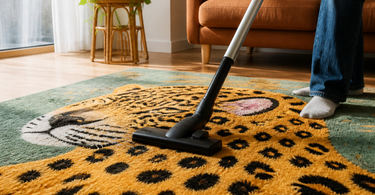
A hand-tufted rug needs vacuuming on low suction 1-2 times a week, quick local spot treatment with cold water and mild soap, and a six-monthly turn for even wear and protection against direct sunlight. Avoid damp and heat, and the rug will keep its shape and texture for many years. Read on for concrete steps and practical tips.
Hand-tufted rugs are made with a tufting gun that shoots yarn loops down into a base fabric. The result is a dense, soft textile with a backing of latex or glue that holds the fibres in place. It's precisely this construction that calls for specific care: too strong suction, the wrong cleaning product or prolonged damp can loosen the fibres and ruin the backing. This guide gives you the exact methods to keep your hand-tufted rug in good condition throughout its lifetime.
What is a hand-tufted rug?
Hand-tufting differs from hand-knotting and machine-making in one crucial way: the yarn is shot through a base fabric and held in place by a layer of latex or glue, not by a knot. This means the surface is typically very soft and even, but the backing construction is sensitive to water and mechanical stress.
Materials and fibres
Hand-tufted rugs are typically made from:
- Wool – natural bounce, good moisture regulation, but slow to dry
- Viscose and silk – high sheen, but extremely sensitive to water and friction
- Synthetic fibres (polyester, polypropylene) – robust and stain-resistant
- Blended yarn – a combination of the properties above
Once you know your rug's fibre material, you can tailor the care and cleaning precisely. Always check the manufacturer's label, and be especially careful with viscose, which can shrink and lose its shape on contact with water.
Expensive hand-tufted rugs made of wool or natural silk need extra care. You'll find examples of pricier rugs in our range, where the product descriptions state fibre-specific care instructions.
Daily vacuuming on low suction
Vacuuming is the most critical daily maintenance task for a hand-tufted rug. Done incorrectly, it can pull fibres out of the tufting and damage the backing over time.
Setting and technique
Always use your vacuum cleaner's lowest suction setting — typically marked as "low" or with a rug icon without a rotating brush. A rotating brush roll (beater bar) is directly harmful: it tears at the fibres and loosens the yarn loops from the latex backing. Turn the brush roll off, or use a smooth nozzle.
Always vacuum along the pile direction, i.e. the direction the fibres naturally lie in. Vacuuming against the pile increases friction and encourages unravelling. You can find the pile direction by running your hand across the rug: the direction that feels smooth is with the pile.
Frequency
- Low-traffic rooms (bedroom, study): once a week
- Medium traffic (living room, office): twice a week
- High-traffic rooms (hallway, kitchen): 3-4 times a week
New rugs shed loose fluff for the first 4-8 weeks. This is normal and a sign that excess fibres are being released — not a sign of poor quality.
Tip: Turn the vacuum nozzle over so the suction opening faces upward, and run it lightly over the rug without pressing down. This significantly reduces mechanical pull on the fibres.
Local spot treatment step by step
Stains are best treated within the first 5-10 minutes. The longer a substance soaks into the fibres, the harder it is to remove without leaving discolouration or rings.
Step 1 – Absorb the excess
Use a clean, white cloth or kitchen roll. Press — don't rub — against the stain from the outside in towards the centre. Rubbing spreads the stain and pushes the substance deeper into the filaments.
Step 2 – Cold water + mild soap
Mix 1 tsp. washing-up liquid (pH-neutral, without bleach or softening agents) into 250 ml cold water. Dip a clean cloth in the solution, wring it out until just damp, and gently dab the stain. Repeat with clean cold water to rinse out any soap residue.
Step 3 – Drying
Place a dry towel over the treated area and press. Let the rug air-dry at room temperature — never use a hairdryer, as heat deforms the latex backing and can shrink wool and viscose fibres.
Products to avoid
| Product | Problem | Alternative |
|---|---|---|
| Bleach | Breaks down dye and fibres | pH-neutral soap solution |
| Hot water | Sets protein stains (blood, milk) | Cold water |
| Harsh abrasives | Damages filament surface | Soft cloth, dabbing |
| Alcohol (high concentration) | Removes dye on certain yarns | Isopropanol 30% max. on synthetics |
What should you do if the rug gets soaked?
Flooding, spilt water from a vase or moisture from a leaking pipe — whatever the cause, acting within the first 30 minutes is crucial. Moisture that seeps down to the latex backing weakens the binder and can cause fibre separation, mould and lingering odours.
Immediate action
- Lift the rug off the floor and turn it so the backing faces upwards.
- Use dry towels to absorb the water by pressing — not rubbing.
- Place the rug flat on a clean, dry surface with good air circulation, preferably outdoors in the shade.
- Use a fan to promote air circulation. Avoid direct heat.
- Check that the backing is completely dry before putting the rug back — typically 24-48 hours.
If the rug smells musty after drying, the latex backing has likely been compromised. Contact a professional rug cleaner experienced with hand-tufted textiles.
Whether you have a leopard print rug or a plain design, the same principles apply: fibre and latex react the same way to moisture regardless of pattern.
Six-monthly turning for even wear
All rugs are exposed to uneven wear. Furniture legs, traffic zones and frequently used spots wear down the fibres faster than the periphery and covered areas. A biannual 180-degree rotation distributes the wear and significantly extends the rug's lifespan.
Practical approach
- Temporarily move furniture off the rug.
- Clear the rug of dust by vacuuming both sides (the backing can be vacuumed more firmly, as there are no fibres to damage).
- Rotate the rug 180 degrees, so the side that previously faced the light or the main traffic route now faces the opposite way.
- Put the furniture back and check that the rug lies flat without folds or ripples.
Furniture feet leave indentations in the fibres. You can usually revive the fibres by holding a steaming kettle (not touching the rug, at least 10 cm away) over the sunken area and then gently brushing the fibres up with a soft cloth or rug brush.
Fancy swapping a worn-out rug for something new? Take a look at the range of rugs in all categories for inspiration for your next choice.
Protection against sunlight and UV
Ultraviolet radiation breaks down dye over time. The process is cumulative and irreversible: areas exposed to direct sunlight gradually fade, while covered areas keep their original colour. The result is a rug with uneven, permanent discolouration.
Risk assessment of your location
South-facing rooms with large windows are the most critical. Even overcast daylight contains UV rays that slowly break down the dyes. Curtains or UV-filtering window film reduce exposure by up to 99% without darkening the room.
Concrete measures
- Use sun-blocking curtains or roller blinds in rooms with direct sun.
- Install UV-filtering window film (available at DIY stores, 60-200 DKK/m²).
- Turn the rug every six months (see the section above) to spread out any fading effect.
- Avoid placing rugs directly under skylights without sun protection.
Patterned rugs such as tiger rugs with high contrast between dark and light shades are especially vulnerable, as the fading effect is clearly visible when the dark pigment fades relative to the light one.
Frequently asked questions
Can you machine wash a hand-tufted rug?
No. Machine washing dissolves the latex backing and causes fibre separation. Hand-tufted rugs should only be cleaned with local spot treatment or professional dry cleaning. Water and mechanical agitation are the two factors that damage the construction fastest.
How often should a hand-tufted rug be professionally cleaned?
Every 2-3 years is sufficient for an average household. If the rug is in a room with lots of visitors, pets or children, professional cleaning every 12-18 months is recommended. A professional clean with low water pressure and specialised equipment removes deep-seated dirt that vacuuming can't reach.
My rug is shedding fluff — is that normal?
Yes. During the first 4-8 weeks, a new hand-tufted rug releases excess loose fibres left over from the tufting process. The amount gradually decreases. Vacuum regularly during this period. If the shedding continues after 8 weeks, it may indicate that too-strong vacuuming is pulling fibres out — reduce the suction power.
What do you do about pet hair on a hand-tufted rug?
Use a rubber brush or a lint roller to pick up hair before vacuuming. Pet hair gets tangled into the fibres and can significantly reduce your vacuum's effectiveness. Sticky roller tools remove surface fibres without putting mechanical strain on the rug.
Can you use rug spray or protective treatments on hand-tufted rugs?
Yes, but with caution. Fluorine-based protective sprays (e.g. Scotchgard for textiles) can reduce stain absorption on synthetic and wool fibres. Never spray directly onto viscose or silk — it can leave rings and distort the fibres. Always test on a hidden area and let it dry for 24 hours before use.
What is the typical lifespan of a hand-tufted rug with proper care?
With correct vacuuming, regular rotation and proper spot treatment, a hand-tufted wool rug can last 15-25 years in low- to medium-traffic rooms. Viscose and silk rugs are more delicate and typically last 8-15 years. Synthetic fibres are the most durable and can exceed 25 years with minimal care.
Summary
Caring for a hand-tufted rug is about understanding its construction: fibres held in place by latex, which is sensitive to moisture, heat and mechanical stress. The five key principles are vacuuming on low suction with a smooth nozzle, prompt local spot treatment with cold water and pH-neutral soap, immediate handling of moisture, six-monthly rotation and consistent sunlight protection. Stick to these simple routines, and your rug will keep its structure, colour and texture for decades rather than years. Investing in proper care is the cheapest insurance against premature replacement.
Explore our range of hand-tufted and handmade rugs — from classic designs to bold leopard patterns.