
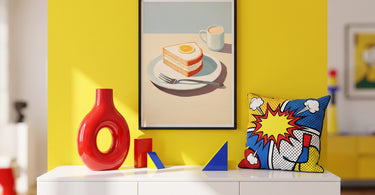
Pop art is an art movement that arose in Britain and the USA in the mid to late 1950s, and which drew its motifs from adverts, comic strips, packaging and everyday goods. At home, it's about bold motifs, repetition and humour rather than about owning original art.
Contents
Pop art often crops up when people talk about colourful posters, comic-like motifs or a vase that looks like something else entirely. But what does the term actually cover, and where does it come from? In this guide, you'll get the history in brief, the traits that define the style, and the artists who made it famous. Afterwards, you can use the same eye at home, without needing a budget for original art.
The short answer: what is pop art?
Pop art, also known in Danish as popkunst, is an art movement that arose in Britain and the USA in the mid to late 1950s. The movement challenged traditional art by using images from popular and mass culture: adverts, comic strips, packaging, celebrities and ordinary consumer goods became motifs in painting, sculpture and graphic art.
What's special about pop art is that the banal and mass-produced was elevated to fine art, so the line between high and low culture was blurred. The artists also liked to use mechanical reproduction techniques, and motifs were sometimes taken out of their familiar context or mixed with something completely different. That's why pop art isn't just colourful and fun to look at, it's also a commentary on consumer culture, where some works celebrate the abundance while others question it.
The history behind pop art
Pop art's roots lie in London, where The Independent Group was founded in 1952 and is regarded as the movement's forerunner. As early as 1947, the British artist Eduardo Paolozzi used the word pop in his collage I was a Rich Man's Plaything, which is thought to be the first use of the word in that context. Together with artists such as Richard Hamilton, Paolozzi helped develop the British branch of the movement.
The term pop art itself first appeared in print in 1956 in an article by Alison and Peter Smithson, but it is often credited to the British critic Lawrence Alloway. In the early 1960s, Andy Warhol, Roy Lichtenstein and Tom Wesselmann made the movement internationally known in the USA, and in December 1962 the term pop art was officially introduced at a symposium at the Museum of Modern Art.
Characteristics of pop art
Pop art can be recognised by a few recurring techniques, which you can also draw inspiration from at home without copying the art directly.
| Techniques in pop art | How you can use it at home |
|---|---|
| Everyday images elevated to art | Let a completely ordinary object, such as a tin or a piece of fruit, take pride of place as decoration |
| Irony and ambiguity | Choose motifs or objects with a twinkle in the eye rather than the serious and muted |
| Mechanical techniques such as screen printing | Go for graphic, flat poster motifs with sharp outlines and clean blocks of colour |
| Repetition of motifs | Hang up several identical or near-identical posters, or line up several matching items in a row |
| Ben Day dots from comic strips | Look for posters or objects with dot patterns or comic-strip visuals |
Tip: You don't need to choose between all the tricks at once. Start with repetition, either on the wall or on the shelf, it's the quickest pop art trick to bring into play.
The famous names behind pop art
Andy Warhol, who lived from 1928 to 1987, is probably the name most people associate with pop art. Throughout the 1960s, he painted well-known American products, including Coca-Cola products and Campbell's soup tins, and in July 1962 he showed as many as 32 Campbell's Soup Cans at his first solo exhibition at the Ferus Gallery in Los Angeles. Warhol later moved on to silkscreen printing, because he wanted to mass-produce the art itself in the same way as the goods he painted. This took place in his studio, which was called The Factory, and a recurring feature in his paintings was the repetition of the same motif on large canvases.
Roy Lichtenstein, who lived from 1923 to 1997, is known for his enlarged comic-strip cut-outs, in which he exaggerated the small coloured Ben Day dots from the cheap printing technique of the time used for colour comics. The Louisiana Museum of Modern Art held a major exhibition of his works in 2004.
Pop art wasn't just about images on canvas. In December 1961, the artist Oldenburg opened the installation The Store in New York with handmade sculptures resembling ordinary consumer goods, and in 1964 the exhibition The American Supermarket transformed a gallery into a working grocery shop with artist-made goods by, among others, Warhol, Lichtenstein, Oldenburg and Wesselmann. It's a great illustration of what pop art is all about: seeing art in what we'd normally just put in our shopping basket.
Everyday objects as decoration
Just as pop art turned ordinary consumer goods into art, you can play with that same idea at home without having to paint anything. It's about letting an object make more of itself than you'd initially expect, because it mimics something completely different.
A Lemonade can vase or a Striped can vase in stoneware are great examples of this trick: a vase that looks like a tin can gives the same cheeky wink as Warhol's paintings of cans and bottles. In the same way, a Sardine candlestick or a Croissant candlestick can create a playful look, because they resemble something you'd normally find in the fridge or on the bread board, rather than on a shelf as decoration.
If you want to boost the effect, you can do as the pop art artists did and repeat the motif. Place several can vases or candlesticks next to each other, so the repetition itself becomes part of the look.
Find more fun vases that can give the same pop art-inspired cheeky wink.
See fun vasesPosters on the wall in pop art style
Posters are the most obvious way into a pop art-inspired look. Go for graphic motifs in strong, pure colours rather than muted or naturalistic images. Comic-like lines, flat blocks of colour or motifs of completely ordinary objects, such as a bottle or a food item, fit well into the style.
If you want an extra effect, you can hang the same motif up several times side by side, so the repetition itself becomes part of the image, in the same way as Warhol's paintings of soup tins. Or you can gather several different but colour-related posters into a whole wall.
If you're unsure about sizes or the actual hanging, we go in depth with that in Poster size: guide to the right formats and How to hang posters. If it's meant to be a whole gallery wall, you can also take a look at Create a personal gallery wall.
Frequently asked questions
What is pop art?
Pop art is an art movement that emerged in Britain and the USA in the mid to late 1950s, and which used images from adverts, comics, packaging and everyday goods in art.
When did pop art emerge?
The movement emerged in the mid to late 1950s, with The Independent Group in London from 1952 as an early forerunner, and it had its international breakthrough in the USA in the early 1960s.
Who are the most famous pop art artists?
Andy Warhol, Roy Lichtenstein and Tom Wesselmann are considered among the most famous names, and in Britain, Eduardo Paolozzi and Richard Hamilton were key figures.
What characterises pop art?
Pop art is characterised by everyday images elevated to art, irony, mechanical techniques such as silkscreen printing, repetition of motifs and, in Lichtenstein's case, the small Ben Day dots from comics.
How do you use pop art in interior design?
You can choose graphic posters in strong colours, repeat a motif several times, or let everyday items such as a can vase or a food-shaped candlestick create the same playful look.
What's the difference between pop art and kitsch?
Pop art er en anerkendt kunstretning med en kritisk eller ironisk vinkel på forbrugerkulturen, mens ordet popkunst på dansk også bruges nedsættende om kunst, der opfattes som overfladisk.
Summary
Pop art emerged in Britain and the US in the mid to late 1950s and turned adverts, comic strips and everyday goods into fine art. You can borrow the same tricks at home with graphic posters, repetition of a motif and everyday things that get to be fun rather than practical.
Read also
- Fruit ceramics: why food has become a motif
- Wall decor: here's how to style your walls
- Create a personal gallery wall
- How to hang posters
- Kitsch: what is it, and how do you use it?
- Memphis design: colours, shapes and how to use it
- Mid-century modern: the style and how to use it
Give your home a pop art-inspired look
Dinna has hand-picked posters, vases and candlesticks that can give the same playful look as pop art, without you having to go out and buy original art.
See all posters