
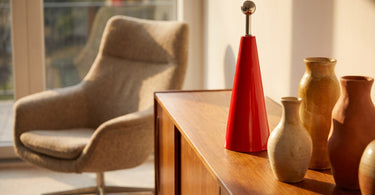
Mid century modern is a design style from around 1945 to 1970, known for clean, simple lines and an absence of ornamentation. You can create the look at home with a few, well-chosen pieces such as a lamp, some glassware or ceramic vases and a graphic poster, without swapping out your furniture.
Dims Studio's own figures: At Dims Studio, products in the Lamps category have an average of 4.9 out of 5 stars across 18 reviews, while Ceramic vases have 5.0 out of 5 stars across 43 reviews, two of the product types the article points to for the mid century modern look.
Contents
Have you seen pictures of a room with a round lamp, soft ceramic vases and a graphic poster on the wall and thought it reminded you of something from the middle of the last century? Then you've probably seen mid century modern, a style that still leaves its mark on new homes today.
Here you'll get the history behind the style, its characteristics and concrete ways to use it in your own home, with a focus on homeware rather than furniture.
What is mid century modern?
Mid century modern is a design style that was most widespread in North America, Brazil and Europe from around 1945 to 1970. The style is recognised by clean, simple lines, an honest use of materials and an absence of ornamentation, where function carries as much weight as form. You'll find it in interior design, product design, graphic design, architecture and urban planning.
You don't need a flat full of design classics to bring the mood home. With homeware such as lamps, glassware, ceramics and posters, you can create the same calm, honest expression the style is known for.
The history behind the style
Mid century modern grew out of the period after the Second World War and is closely linked to the modernism of the era. In the US, the style reflected the Bauhaus movement and the international style, and American companies began making products that looked streamlined and futuristic, inspired by space and military technology. In Brazil, the entire capital city of Brasília was built in the style and inaugurated in 1961.
Scandinavian design played a major part in spreading the style. The exhibition Design in Scandinavia at the Brooklyn Museum in 1954 helped bring Scandinavian design to the US, and the term mid century modern was already being used in the mid 1950s. It wasn't until 1984 that the style was defined as a proper design movement, when Cara Greenberg published the book Mid-Century Modern: Furniture of the 1950s. Since the late 1990s, the style has seen a major revival that can still be felt today.
Characteristics of mid century modern
Mid century modern is characterised by a simple, honest design language. Here you can see how the classic characteristics can be translated into homeware for your own home.
| Characteristic | What it looks like in homeware |
|---|---|
| Clean, simple lines | Lamps and vases without unnecessary details, where the shape speaks for itself |
| Honest use of materials | Glass, ceramics and metal shown as they are, without hiding the material |
| No decorative ornamentation | Accessories with calm surfaces rather than patterns and decoration |
| Function just as important as form | A lamp that both lights well and looks simple |
| Open spaces and large windows | A few, airily placed things that give the room space to breathe |
| Streamlined, futuristic products | Soft, curved shapes in glass and ceramics rather than sharp edges |
Tip: Rather choose one lamp and a couple of vases in calm shapes than lots of small things, and the room will get the air that the style is known for.
Denmark's role in mid century modern
Denmark plays a big role in the story of mid-century modern. From the 1940s to the 1960s, a flourishing Danish furniture industry grew up under the name Danish modern, with designers such as Arne Jacobsen, Hans Wegner, Finn Juhl and Børge Mogensen leading the way. The style was minimalist and was about furniture and homeware that was simple in form, without compromising on function.
The same thinking spread to homeware in teak and stainless steel, which extended the style beyond the furniture itself to cutlery, trays and other everyday things. Poul Henningsen also left his mark on the period, when in 1926 he succeeded in creating the PH lamp. The lamp's three shades were meant to prevent glare from the bulb, and the curve of the shades let the light reach both the table and the rest of the room, a solution that is still a good example of function and form in the same product.
If you want to read more about the overall Danish and Scandinavian style, you can find it in the article on Scandinavian interior design.
Ceramics, glass and lighting in the period
While the furniture took up a lot of space in mid-century modern, the homeware was just as important for the overall look. During the period, glass came from Iittala and ceramics from Arabia, both from Finland, as well as tableware from Georg Jensen and lighting from Poul Henningsen, both from Denmark, which all contributed to the overall expression in the home.
At the same time, the Americans Russel and Mary Wright and the Hungarian-born Eva Zeisel worked with ceramics in free, flowing shapes, as part of a broader trend with soft, organic contours in tableware. The ceramicist Edith Heath founded Heath Ceramics in 1948, and the company Tamac Pottery made biomorphic tableware and homeware with the same soft design language from 1946 to 1972.
What you can take with you from the period is simple: one good lamp as a fixed point in the room, and glass and ceramics with organic, soft shapes rather than sharp edges and lots of pattern.
How to get the look without new furniture
You don't need to replace the furniture to bring the mood home. Start by choosing homeware with clean, simple shapes, and let the material, whether it's glass, ceramics or metal, speak for itself rather than covering it up with pattern and decoration.
Give things air. Mid-century modern is just as much about what you don't put out as what you choose. A few, well-chosen things on a shelf or table do more for the mood than lots of small details.
Let a lamp be the eye-catcher in the room, for example with a table lamp like The Audrey Lampefod together with The Audrey Lampeskærm, which together give a calm, simple expression. Put out a couple of glass vases, such as a Bred gradient evening vase or a Stor gradient vase, where the soft transition in the glass does the work without extra decoration. Finish with a graphic poster on the wall that sticks to simple shapes and lines rather than busy patterns.
Find a lamp that can carry the whole room's mid-century modern expression.
See lampsMid century modern isn't the same as retro
Mid-century modern is often mixed up with other styles, but covers precisely the period from around 1945 to 1970. 70s retro is another, later style with its own colour and form language, which you can find in the shop's retro interior design. Art deco belongs to an earlier period with its own history of geometry and glamour, which you can read more about in the article on art deco interior design or find in the collection art deco interior design.
If you're more into a broader, contemporary approach to the simple expression, you can instead look in the article on minimalist interior design.
Frequently asked questions
What is mid century modern?
Mid-century modern is a design style from around 1945 to 1970 with clean, simple lines, honest use of materials and no decorative ornamentation. It can be seen in interior design, product design, graphic design, architecture and urban planning.
What does mid century mean?
Mid century means the middle of the last century and is used as a short term for the style mid-century modern. The term was already in use by the mid-1950s.
Which period does mid-century modern cover?
The style was most widespread in North America, Brazil and Europe from around 1945 to 1970.
What characterises the mid-century modern style?
Clean, simple lines, honest use of materials and no decoration, where function carries as much weight as form. In architecture, it's also seen in open spaces and large windows.
Is mid-century modern the same as retro?
No. Mid-century modern covers the period from around 1945 to 1970, while 70s retro and art deco are other styles from other periods with their own history and expression.
How do you get mid-century style without new furniture?
Choose homeware with clean shapes, let the materials speak for themselves, give things room to breathe and use a lamp, a couple of glass vases and a graphic poster as key elements.
Summary
Mid-century modern is all about a simple, honest design language from the period around 1945 to 1970, where function and form go hand in hand. You don't need new furniture to bring the style home, you can do it with a good lamp, glass and ceramics in soft shapes and a graphic poster on the wall.
Read also
- Scandinavian decor: Minimalism with personality
- Art deco decor: geometry, brass and glamour
- Minimalist decor: Less is more
- How to style a shelf with personality
- Lamps for the home: From table lamps to pendants
- Kitsch: what is it, and how do you use it?
- Memphis design: colours, shapes and how to use it
- Pop art in your decor: how to use the style
Build the look further
Explore more types of homeware that suit the calm, honest expression of mid-century modern.
See glass vases