
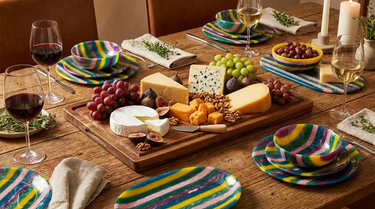
Ostebrætter
Ostebrætter i træ og marmor — til ostebordet, tapas og alt det, der skal skæres på bordet.
Læs mereVis mindre
Et ostebræt er et skærebræt, der må komme på bordet. Brætterne her er i træ og marmor og kan begge dele — skære i køkkenet og servere i stuen.


All reviews
A good cheese board is about more than just having something to put the cheese on. At Dims Studio you'll find cheese boards and cutting boards from EJA, hand-cast in coloured resin, where every board has its own unique pattern. Here's a guide to material, sizes, use and care, so you can choose the board that suits your cheese spread.
Why choose a cheese board from EJA?
A cheese board often comes out when there are guests, which makes it one of those kitchen items where the look matters almost as much as the function. The boards from EJA are made with both in mind: they can be used for cutting in everyday life, but they're also colourful and well-shaped enough to work as part of the table's decor, without you needing to style around them further. Because every board is hand-cast and unique, you also get an item that differs from all others, unlike a mass-produced board where the pattern and finish are the same from piece to piece.
Cheese boards in hand-cast resin from EJA
All the boards in the range are from EJA and cast by hand in coloured resin. The pigments are poured and mixed by hand into the resin before it cures, so the pattern is never quite the same from board to board. The result is a smooth, marbled surface that feels almost fluid, making each individual board a unique piece you won't find the same twice.
Why resin over wood?
Resin differs from the classic wooden board in several ways. The surface is dense and non-porous, so it doesn't absorb moisture or odours from food the way wood can over time. It also means resin doesn't need to be oiled, unlike a wooden board, which needs it regularly. On the other hand, the material is more sensitive to heat, so it isn't intended to sit directly under hot pots or dishes.
Marbled patterns and colours
Because each board is cast individually, colour distribution and pattern vary from board to board. The range spans from boards in multicoloured, marbled resin to a board in a striking orange and pink colour combination. This variation means two boards from EJA never look quite the same, even when they're the same size.
Sizes: from the small serving board to the long platter board
The range covers several sizes, so you can choose a board that suits both everyday use and the guest table.
26x20 cm
The smallest format in the range is compact enough to go straight from the kitchen counter to the dining table with cheese, cold cuts or tapas, while still being large enough to cut vegetables and bread on.
29.5x23 cm
This size is the most common format in the range and comes in several colour variants, from multicolour to calmer patterns. The format is versatile and works both as a surface on the kitchen counter between meals and as a serving board for cheese, charcuterie or tapas at the table.
38x16 cm
The elongated format is well suited as a serving board, where several small elements such as cheese, olives and figs need space side by side. The narrow shape makes it a natural choice to place in the middle of the table for a casual gathering.
45x15 cm
The longest board in the range comes in a bold orange and pink combination, where the colours shift direction along the length of the board. This format is suited to gathering several elements of the cheese spread on one long board.
Sizes compared
| Measurements | Shape | Best for |
|---|---|---|
| 26x20 cm | Compact | Small serving, everyday cutting |
| 29.5x23 cm | Versatile | Both cutting and serving |
| 38x16 cm | Elongated | Serving board with several elements |
| 45x15 cm | Long | Large cheese spread for several guests |
How to put together a cheese spread
A good cheese spread is about variety, in taste, texture and appearance alike. A rule of thumb is to choose three to four different cheeses spanning several types: a soft cheese, a firm aged cheese, a blue cheese, and preferably a milder cheese too, so there's something for most tastes. Place the cheese with good spacing on the board so guests can see and reach every type, and take the cheese out of the fridge about half an hour before serving, so the taste and texture unfold best at room temperature.
Choose cheese by season and occasion
Which cheeses suit best also depends on the occasion. For a relaxed evening, a few familiar favourites can be enough, while a party or a larger gathering is a good opportunity to introduce one or two cheeses your guests may not know already. When it's cold outside, stronger, aged cheeses work well with red wine, while lighter, fresher cheeses suit a summer evening with white wine or sparkling wine better.
Accompaniments for the cheese board
Besides the cheese itself, it's the accompaniments that complete a cheese spread. Nuts, dried fruit, fresh grapes or figs, honey and jam are classic pairings that go well with both mild and sharp cheeses. Bread or crackers give something to put the cheese on, and a few olives or some charcuterie can make the spread more filling if it's meant to work as a light meal in itself.
How to arrange the elements on the board
Start by placing the fixed elements, such as the cheese, with good spacing between them, then fill the gaps with smaller items like nuts, grapes and dried fruit. On the elongated formats such as 38x16 and 45x15 cm, you can work in a long line across the board, while the more compact formats, 26x20 and 29.5x23 cm, suit a tighter, more gathered arrangement. Whatever the format, it's a good idea to leave some of the board's marbled surface visible between the elements, so the colours in the resin also get to play a part in the spread's overall look.
Use: from cutting board to serving board
The boards from EJA are designed for several purposes in the kitchen and at the table.
As a serving board for cheese
The boards' smooth surface and marbled pattern make them well suited for serving cheese, charcuterie, olives and tapas directly on them. The colours in the resin become part of the table's look, so the board works as decoration while also holding the food.
As a cutting board
The boards can be used to cut bread, fruit, vegetables and cold cuts. Resin tolerates cutting with ordinary kitchen knives, but because the material is harder than wood, very sharp or heavy knives can leave marks on the surface over time. If you need to chop hard or use a heavy knife for meat, it can be a good idea to have a separate, sturdier cutting board on hand. See our full range of cutting boards.
As a permanent eye-catcher on the kitchen counter
Between meals, the board can lean against the tiles on the kitchen counter as a colourful detail, or be used as a base for a bread basket or a bottle of olive oil.
Resin as a material: strengths and considerations
Resin is a synthetic material that's cast in liquid form and cures into a solid, smooth surface. In kitchen items like cheese boards, it offers some clear benefits: the surface is non-porous, meaning it doesn't absorb moisture, colour or odours from food the way wood can over time. This makes the board easy to keep clean and means it doesn't need to be oiled or treated regularly to stay looking good. At the same time, resin is harder than most types of wood, which means the surface stays smooth, but also that very sharp knives can dull a little faster with daily use. On the other hand, the material is more sensitive to high temperatures than wood, which is why the board shouldn't be used as a base for hot pots or go in the dishwasher.
Caring for your resin board
Resin requires a different kind of care than a wooden board, but less ongoing maintenance.
- Wash the board by hand with lukewarm water and mild washing-up liquid.
- Avoid the dishwasher, as high temperatures can affect the resin's surface and colours.
- Dry the board immediately after washing, so it doesn't sit and absorb moisture.
- Avoid placing hot pots or pans directly on the board, as resin is sensitive to high heat.
- Don't leave the board sitting in water for extended periods.
Cheese board for the guest table
If you're putting together a cheese spread for guests, the board's size is key to how much you can fit. For a smaller spread with two to three cheeses, 26x20 cm or 29.5x23 cm is often enough, while 38x16 or 45x15 cm gives room for more cheeses, olives, figs and bread on the same board. Feel free to supplement with bowls or platters from our serving platters, if the spread needs more elements, or see our full category cheese spreads for more inspiration.
The boards as functional art
Because the boards from EJA are hand-cast with a marbled, almost fluid pattern, they sit somewhere between a functional item and a decorative object. Many therefore choose to leave the board out on the kitchen counter or an open shelf between uses, rather than tucking it away in a cupboard. This also gives a practical advantage, as the board is right at hand the next time bread needs cutting or a cheese spread needs putting together for unexpected guests.
Cheese board as a gift
Because every board is unique in colour and pattern, it's a personal gift rather than a standard kitchen item. A board from EJA makes a great birthday, hostess or housewarming gift for someone who cooks or appreciates handmade items for the kitchen. Feel free to choose one of the larger formats, such as 38x16 or 45x15 cm, if the gift should work as a striking centrepiece on the table.
Cheese board all year round
A cheese spread isn't just for Christmas or summer garden parties. In winter, the cheese board works well for a cosy evening with red wine and rich, aged cheeses, while in summer it can be set up lighter, with fresh figs, grapes and a white or rosé wine alongside. Because the boards from EJA have a colourful, decorative look in themselves, they also work well as part of the table setting at parties and private gatherings, without you needing to style around them further.
See also: the rest of the kitchen
Looking for more for the kitchen, you'll find more cutting boards, platters and utensils in our full category kitchen.
Compare patterns and colours
Because every board is unique, it can be hard to picture exactly how the colours will fall on your particular piece, but the boards in the range broadly fall into a couple of styles. Some boards have a calmer, more muted marbled pattern in a few colours, which fits well into an already colourful kitchen without taking over. Other boards, like the orange and pink variant, have a distinctly bold look that works as the room's eye-catcher in itself. If you're choosing a board as a gift, it can therefore be a good idea to consider whether the recipient's kitchen needs a calm or a bold addition.
Which cheese board should you choose? Our recommendations
| Situation | Our recommendation |
|---|---|
| Everyday cutting and small servings | 26x20 cm or 29.5x23 cm |
| Spread with several elements | 38x16 cm |
| Large cheese spread for guests | 45x15 cm |
| Gift for the food lover | One of the larger formats in a colour that matches the recipient's kitchen |
| Colourful eye-catcher on the kitchen counter | A board in multicolour or orange and pink |
Frequently asked questions about cheese boards
What are the boards made of?
All cheese boards in the range are from EJA and hand-cast in coloured resin, where the pigments are mixed by hand before curing.
Why do two boards from EJA never look quite the same?
Because each board is individually cast by hand, where colour pigments are poured into the liquid resin and flow together randomly during curing. This makes the colour distribution and pattern unique to each individual board.
Can you cut directly on a resin board?
Yes, the boards tolerate cutting with ordinary kitchen knives. However, very sharp or heavy knives can leave marks on the surface over time, as with most cutting boards.
Can the resin board go in the dishwasher?
No, the boards should be washed by hand with lukewarm water and mild washing-up liquid. The dishwasher's high temperatures can affect the resin's surface and colours.
What sizes are the cheese boards available in?
The range covers four sizes: 26x20 cm, 29.5x23 cm, 38x16 cm and 45x15 cm.
Can the board be used for anything besides cheese?
Yes, the boards also work well for serving charcuterie, olives, tapas, bread and fruit, and they can be used as an everyday cutting board.
Can the resin board withstand heat?
No, resin is sensitive to high temperatures and shouldn't come into contact with hot pots or pans straight from the stove.
What's the difference between a resin board and a wooden board?
Resin has a smooth, dense surface that doesn't absorb moisture or odours like wood, and doesn't need to be oiled. On the other hand, resin doesn't withstand heat as well as wood and should always be washed by hand.
Is a cheese board a good gift idea?
Yes, because every board is unique in colour and pattern, it's a personal gift that works well as a birthday, hostess or housewarming gift for someone who cooks or appreciates handmade items.
Which board suits a large cheese spread with guests best?
The larger formats, 38x16 cm and 45x15 cm, give the most room to gather several cheeses, olives and bread on the same board.
How many cheeses should a cheese spread have?
A rule of thumb is three to four different cheeses covering several types, for example a soft cheese, a firm aged cheese and a blue cheese, so there's something for most tastes.
Can the board be used as a permanent decoration in the kitchen?
Yes, because the pattern is marbled and colourful, many choose to leave the board out on the kitchen counter or a shelf between uses, where it works as a decorative detail.
Where can you buy resin cheese boards online?
You can buy cheese boards and cutting boards in hand-cast resin from EJA online at Dims Studio. See also our range of cutting boards and cheese spreads.