
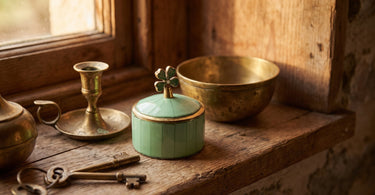
The short answer: patina is the signs of ageing on a surface, in other words the change that happens over time. On brass it's called verdigris, on silver tarnish, and many choose to keep it because it gives a softer, more lived-in shine.
Contents
Do you have a piece of brass, an old bowl or a piece of furniture where the surface has taken on a different tone than when it was new? Then you've seen patina in practice. The word often comes up when talking about antiques, metal objects and paintings, but what does it actually mean, and why does it happen?
In this guide, you'll get a simple explanation of patina, the chemistry behind it, and why patina, for many, is part of the charm rather than something to be removed. If you want to know exactly how to polish or care for brass, you'll find the practical steps in the articles on polishing and caring for brass.
The short answer: what is patina
Patina is the signs of ageing on a surface, whether it's metal, a painting or a wooden antique. On brass, these signs of ageing are called verdigris, while on silver it's referred to as tarnish. Both are names for the same basic thing: that a surface changes chemically over time.
The processes that create this change are collectively called patination. In some cases it happens entirely on its own through air and use, in others it's a deliberate choice to achieve a particular surface.
What is patina: metal, paintings and antiques
In Danish, patina is used to describe the signs of ageing that appear on the surface of works of art, both metal and paintings, as well as on wooden antiques. So it's not just a term for brass and silver, but a broad word for the change a surface undergoes over time, regardless of material.
What all types have in common is that the change rarely happens overnight. It builds up layer by layer, and it's precisely this slow process that gives patina its special character compared to a surface that has simply become dirty or scratched.
The chemistry: verdigris, tarnish and the green bronze
Chemically, different types of patina are distinguished depending on the material in question. For copper, bronze and brass, we talk about verdigris. For silver, we use the word tarnish. Both are expressions of the metal's surface reacting with its surroundings and forming a new layer, which changes its colour and shine.
The most common patina most people know is the greenish surface seen on bronze statues. It occurs as a copper carbonate formed by oxidation, in other words the metal's reaction with the air over time.
- Verdigris: occurs on copper, bronze and brass.
- Tarnish: occurs on silver.
- Green patina on bronze: a copper carbonate formed by oxidation.
Tip: If you need to assess whether a surface has verdigris or tarnish, look at the material first. Copper, bronze and brass develop verdigris, while silver tarnishes.
Patina as style: the soft shine many love
In the world of antiques, patina is far from a problem to be solved. Here, patina is the extra soft shine that comes slowly with the years, along with the wear marks and scratches that years of use leave behind. It's precisely that mix of shine and unevenness that makes an old object different from a factory-new one.
In fact, many works of art are deliberately given patina. This is done both to protect the surface and to achieve a particular look that the artist or craftsperson wants from the start. So patina isn't just something that happens over time, it can also be a deliberate technique.
Keeping or removing patina: your choice
Whether you should keep or remove patina is ultimately a personal decision. Some prefer the shiny, even surface you know from new things. Others would rather see the small nuances and the story that the patina tells.
If you have brass at home and want to make it shine again, you can read more in the article on how to polish brass. If you'd rather keep the shine without removing too much of the character, the article on how to care for brass in everyday lifea good place to start. Brass is, by the way, an alloy of copper and zinc, which explains why it reacts in the same way as other copper-containing metals when it comes to tarnishing.
If you'd like to see brass that can develop its own patina over time, take a look at the selection of brass jars.
See brass jarsPatina in interiors: where it looks its best
Patinated brass can give a room a warmth and depth that new, shiny metal doesn't always have. This is clearly seen on things that are used and touched daily, such as brass jars, hooks and cabinet knobs.
A jar like the Kløver jar from Doing Goods or a Bailey circus jar from Doing Goods can develop its own patina over time, if it's simply allowed to stand and live alongside you in everyday life. The same goes for smaller details like a Skildpadde hook in brass in a small size or a Musling cabinet knob, where the patina often highlights the shape rather than hiding it.
If you'd like to see more examples of how brass can be used in a room, the article on brass in interior design can give you inspiration on where a patinated surface works best.
Frequently asked questions
What is patina?
Patina is the signs of ageing that appear on the surface of metal, paintings and wooden antiques over time. The process behind it is called patination.
What does patina mean?
The word covers the change a surface goes through when it reacts with its surroundings, for example through oxidation, use or age.
What is patinated brass?
It's brass where the surface has developed tarnish, that is, the chemical reaction that occurs on copper, bronze and brass over time.
Is patina harmful to brass?
Patina isn't harmful in itself, it's a natural chemical process. Whether you want to keep it or remove it is a matter of taste.
How do you remove patina from brass?
It requires polishing the surface. You can find the specific steps in the article on how to polish brass.
What's the difference between tarnish and tarnishing on silver?
Tarnish is the term for patina on copper, bronze and brass, while tarnishing is used for the equivalent process on silver.
Summary
Patina is a broad term for the signs of ageing that appear on metal, paintings and antiques, and on brass and similar metals the process is called tarnish, while on silver it's called tarnishing. Whether you choose to keep the patina for its soft glow and history, or remove it to get a shiny surface back, is up to you, and you can go either way with brass in the home.
Read also
- How do you polish brass?
- How do you care for brass? Polishing and everyday maintenance
- Brass in interior design: timeless and elegant
- What is glaze on ceramics?
Find your next piece of brass
All items in the shop are hand-picked by Dinna, so you can find brass that suits your home, whether you want to keep it shiny or let the patina come through.
See hooks and knobs