
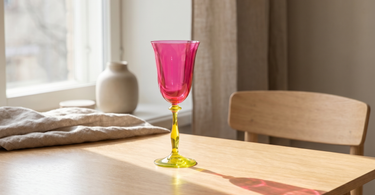
Glass is primarily made from sand (quartz/silica), which is melted at a very high temperature together with Soda and lime. The glowing mass is shaped by blowing, pressing or casting, and cooled down slowly. Adding potassium, for example, gives crystal glass extra clarity and weight. Glass can be melted down again and again – which is why it's 100% recyclable.
Glass is one of the most beautiful things on a laid table – and at the same time one of the oldest man-made materials. But what is it actually made of, and why are some glasses clearer and heavier than others? Here's the short, clear explanation.
The raw materials
Glass is built on three main ingredients: Sand (quartz sand, which contains silica), Soda, which lowers the melting point, and lime, which makes the glass stable and durable. Small amounts of metal oxides are added to give colour – for example, cobalt gives blue and iron gives greenish tones.
How glass is made
- The raw materials are mixed and melted at around 1,500°C into a glowing, viscous mass.
- The mass is shaped while hot – by blowing, pressing or casting it.
- The glass is cooled down slowly (annealing), so it doesn't crack from internal stress.
- Finally, the glass is ground, polished or decorated as needed.
Tip: The slow cooling is crucial. If glass is cooled too quickly, internal stresses build up, which can cause it to crack later.
Glass vs. crystal glass
Crystal glass isn't actually crystals, but glass with added potassium (and traditionally lead, which is often replaced today). This gives a heavier, clearer glass that refracts light beautifully and "sings" when you flick it. Ordinary everyday glass is lighter and more robust for daily use.
Hand-blown vs. machine-made glass
Hand-blown glass is shaped by hand with a glassblower's breath and often has small, charming irregularities and air bubbles – every piece is unique. Machine-made glass is uniform and produced in large series. Both are "real" glass; the difference lies in expression and finish.
Overview
| Ingredient | Function |
|---|---|
| Sand (silica) | The glass mass itself |
| Soda | Lowers the melting point |
| Lime | Makes the glass stable and durable |
| Potassium/metal oxides | Clarity (crystal) and colour |
Care and reuse
Glass doesn't cope well with scratches from abrasive cleaners, and thin or mouth-blown glass is best washed by hand. One of glass's great strengths is that it can be melted down and reused an infinite number of times without losing quality – which makes it one of the most sustainable materials you can choose for your table.
Frequently asked questions
What is glass made of?
Mainly sand (silica), soda and lime, melted together at very high temperatures and then shaped and cooled slowly.
How is glass made?
The raw materials are melted into a molten mass at around 1,500°C, shaped by blowing, pressing or casting, and then cooled slowly.
What's the difference between glass and crystal glass?
Crystal glass is glass with additions such as potassium, which makes it heavier, clearer and more light-refracting. Ordinary glass is lighter and more robust.
Why does mouth-blown glass have bubbles?
Because it's shaped by hand. The tiny air bubbles and irregularities are a sign of the craftsmanship and make each piece unique.
Can glass be recycled?
Yes. Glass can be melted down again and again without losing quality, making it 100% recyclable.
Summary
Glass is sand, soda and lime, melted at high heat, shaped and cooled slowly. Additions such as potassium give crystal glass its clarity and weight, while mouth-blown glass carries the small irregularities of craftsmanship. And best of all: glass can be recycled endlessly.
Read also
- The difference between ceramics, porcelain and stoneware
- How do you remove limescale from glass?
- Can glass and ceramics go in the microwave and dishwasher?
Check out our handmade glass and drinking glasses – ready to catch the light on your table.