
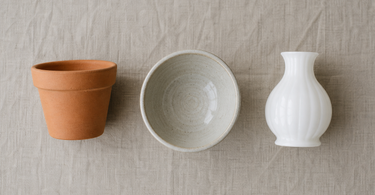
Ceramics is a general term for anything shaped from clay and fired. The difference lies in the temperature and the clay mixture. Earthenware is fired at 950-1,100°C and is porous. Stoneware is fired at 1,200-1,300°C and is dense and hard-wearing. Porcelain is fired at 1,350-1,400°C using fine white clay — it's thin, hard and light. At Dims Studio we use all three types across our product range, and the choice depends on both function and aesthetics.
When you're standing in a homeware shop looking at a vase or a dish, you'll usually see the words "ceramic" or "stoneware" or "porcelain" on the label — but what's the actual difference? It's not just a marketing question. The firing temperature and the clay mixture determine how durable the object is, how it behaves in the dishwasher, and how it feels in your hand. Here's the simple, full comparison.
Ceramics is the general term
First, the most important thing: ceramic is a general term for anything shaped from clay and fired. It's not a specific type. Both stoneware and porcelain are types of ceramic. When a manufacturer writes "ceramic" on the label, it usually means earthenware or stoneware — rarely porcelain (that would be explicitly stated).
The difference between ceramic types depends on two things: which clay and at what temperature it's fired. Higher temperature = denser and harder material. Lower temperature = more porous and softer.
Earthenware
Earthenware is the oldest and most basic ceramic type. It's fired at 950-1,100°C — the lowest of the three. The clay is typically coloured (orange-red, brown) and porous, meaning it can absorb water if left unglazed. Earthenware is usually cheap to produce and is used for plant pots, terracotta figures, simple serving dishes and decoration.
Earthenware is the most fragile of the three — it can crack if dropped or exposed to sudden temperature changes. It shouldn't go in the dishwasher if unglazed, and it's not suitable for the microwave.
Stoneware
Stoneware is fired at 1,200-1,300°C — significantly higher than earthenware. The higher temperature partially fuses the clay's minerals together, creating a dense, glassy material. Stoneware is dense enough to hold liquid without glaze and is resistant to wear, knocks and temperature changes.
Stoneware is the most practical ceramic type for everyday use. It balances durability, aesthetics and price — heavier than porcelain, more robust than earthenware, and considerably cheaper than porcelain. At Dims Studio you'll find stoneware in stoneware vases, dishes and bowls, cups and jugs.
Porcelain
Porcelain is fired at 1,350-1,400°C — the highest temperature of the three. The clay is fine and white (originally kaolin), and the result is an extremely dense, hard and light material. Porcelain is known for its white colour, light weight and — when thin — its translucency.
Porcelain is typically used for fine dinnerware, figurines, jewellery and especially delicate objects. At Dims Studio you'll find porcelain in porcelain figurines, fine cups and Testa di Moro vases. Even though it's hard, it can chip if dropped — so porcelain is often reserved for more careful use.
Comparison table
| Property | Earthenware | Stoneware | Porcelain |
|---|---|---|---|
| Firing temperature | 950-1,100°C | 1,200-1,300°C | 1,350-1,400°C |
| Density | Porous | Dense | Very dense |
| Weight | Heavy | Medium | Light |
| Durability | Fragile | Hard-wearing | Hard but can chip |
| Colour of the clay | Reddish/brown | Light grey/sand | White |
| Translucency | No | No | Yes (when thin) |
| Typical use | Plant pots, terracotta | Everyday tableware, vases | Party tableware, figurines |
| Dishwasher | No (unglazed) | Yes (glazed) | Yes |
| Microwave | No | Yes | Yes |
| Price level | Low | Medium | High |
Which should I choose?
- For everyday use: Stoneware. It withstands daily life without losing character.
- For parties and special occasions: Porcelain. It feels exclusive and suits refined taste.
- For outdoor or practical use: Earthenware. It's cheap to replace if it breaks, and terracotta is classic for plant pots.
- For art and decoration: All three can work, but porcelain figurines and hand-painted stoneware vases dominate in the design segment.
Frequently asked questions
Which type of ceramic is most durable?
Porcelain is technically the hardest and most scratch-resistant. Stoneware is more resistant to knocks and temperature changes. Earthenware is the most fragile of the three. For everyday use, stoneware is often the best choice — it balances durability with weight.
Which is best for everyday use?
Stoneware. It's solid, dishwasher-safe, can go in the microwave (without metallic details), and is heavy enough to feel "high quality" without being unreasonably fragile. Porcelain is lovely but can chip if dropped; earthenware is typically porous and shouldn't go in the dishwasher.
Which is most environmentally friendly?
Earthenware is technically the most environmentally friendly because it's fired at the lowest temperature and uses less energy. But it also lasts less long than stoneware and porcelain. If you're thinking about the environment: choose durable products in stoneware or porcelain, so you rarely need to replace them.
Can you tell the difference between ceramic types with the naked eye?
Yes. Earthenware typically has a darker, slightly orange-red or brown tone in the clay itself (when you look at the base). Stoneware has a lighter grey or sand-coloured clay. Porcelain is completely white and often shows a thin, translucent glow when thin. The weight also gives it away: porcelain is light, stoneware heavier.
Can all ceramic types go in the dishwasher?
Glazed stoneware and porcelain are typically dishwasher-safe. Earthenware should be hand-washed, as it's porous and can absorb water. Hand-painted models — regardless of type — should be washed by hand to preserve the paintwork and glaze for longer. Always check the manufacturer's instructions.
Summary
The difference between ceramic, stoneware and porcelain comes down to temperature and clay. Earthenware is the easiest to produce but the most fragile. Porcelain is the hardest and finest but also the most expensive. Stoneware sits in the middle and, for most everyday purposes, offers the best balance of aesthetics, durability and price. When you're choosing between a stoneware dish and a porcelain dish for everyday use, stoneware is almost always the smart choice.
Explore our range of stoneware and ceramics across categories — from vases to dishes and candlesticks.