
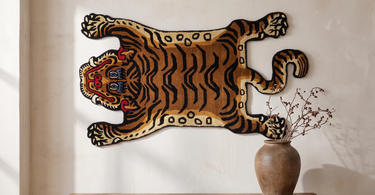
A wall hanging can be hung up in four ways: hidden loops, velcro tape, a rod through a channel or a clamp rail. Always check the product first — many hand-tufted rugs already have loops or cords sewn on the back. The clamp rail is the gentlest solution, because nothing needs to be sewn or glued onto the rug.
Contents
A hand-tufted wool wall hanging doesn't just hang itself up — choose the wrong method, and it can bend at the edges or end up hanging skewed. Here are the four common ways to do it, and what to watch out for with each one.
First check if the rug has loops
Before you start looking at screws and battens, it's worth checking whether the rug already has a built-in solution. Several hand-tufted wall hangings — including from Doing Goods and Bongusta — have hidden loops or cords sewn onto the back, ready to hang directly on a couple of nails or hooks.
It always says on the individual product whether loops or cords are included. If that's the case, it's the easiest route to a straight and stable hang, without you having to sew or fit anything extra yourself. The four common methods are otherwise:
- Hidden loops or cords on the back
- Velcro tape on a wooden batten
- A rod through a channel
- A clamp rail across the entire top edge
See more about the different types in Wall hangings or read the background in What is a hand-tufted rug?.
Velcro — the most invisible solution
Velcro is the most invisible solution, because the entire top edge is held by a strip instead of a few individual points. One piece of tape is sewn or glued onto the back of the rug, the other is screwed onto a wooden batten on the wall, and the two parts are pressed together.
The advantage is an even weight distribution along the entire width, so the rug doesn't bend or form waves in the middle. The downside is that it requires fitting something directly onto the rug itself — something to consider if you ever want to move it or sell it on without marks on the back.
A rod through a channel
If the rug has a channel sewn into the top, you can thread a rod through it and hang the rod on two hooks or brackets. The same principle can be used behind any loops, if they're positioned so a rod can be threaded through them.
The method works well for wide rugs, because the weight is distributed along the entire length of the rod instead of at individual points. The crucial thing is that the rod is stiff enough — if it's too thin or flexible, it bends in the middle under the weight of the rug, and then the rug still won't hang straight.
Clamp rail
A clamp rail is a profile, typically in wood or metal, that clamps around the entire top edge of the rug between two rail sections. The rail is then screwed onto the wall.
The advantage is that it's the gentlest method for the rug itself — nothing needs to be sewn or glued onto the back, and the rug can be taken out of the rail again without a trace. On the other hand, it requires having a rail of the right width, and it must be fitted completely level, otherwise the skewness is transferred directly to the rug.
Height and placement
There's no fixed rule, but a good rule of thumb is to place the middle of the rug at eye height for a standing person. This makes the design naturally meet the eye, without having to look up or down to see it.
If the rug hangs above a piece of furniture, for example a sofa, it's typically lowered relative to the eye-height rule, so there's enough space between the top of the furniture and the bottom of the rug. How much space depends on the size of the furniture and the rug, but a good test is to stand a couple of metres away and see if it looks balanced in the room. More on that in Wall decoration: How to style your walls.
Five mistakes that make the rug hang skewed
Most crooked hangings are down to the same recognisable mistakes. Here are five to watch out for:
- Too few hanging points, so the rug hangs heaviest in the middle
- Hanging only in the corners, which pulls the edges skew over time
- Rugs that are too heavy hung on a plasterboard wall without wall plugs
- Direct sunlight over a longer period, which can fade the colours unevenly
- Forgetting that wool stretches slightly during the first few weeks after hanging
The last point is worth keeping in mind when assessing whether the hanging is straight right after mounting — give the rug a couple of weeks to settle before adjusting further. Also read about daily care in How do you care for your hand-tufted rug?.
Frequently asked questions
How do you hang a wall rug?
With one of four methods: hidden loops or cords on the back, velcro strips on a wooden batten, a rod through a channel, or a clamp rail that holds the entire top edge.
Do wall rugs have loops for hanging?
Many hand-tufted wall rugs have hidden loops or cords sewn on the back, but it varies from model to model and is stated on the individual product.
How high should a wall rug hang?
A good rule of thumb is to place the middle of the rug at eye height for a standing person, and a bit lower if it hangs above a piece of furniture such as a sofa.
Can you hang a wall rug without sewing or gluing anything to it?
Yes, a clamp rail clamps around the entire top edge without needing to attach anything to the rug itself, making it the gentlest solution.
Why is my wall rug hanging skew?
This is often down to too few hanging points, hanging only in the corners, or not giving the wool time to settle, as it stretches slightly during the first few weeks.
Summary
The right hanging method depends on the back and size of the rug: hidden loops are the easiest solution when available, velcro gives even weight distribution, a rigid rod suits wide rugs, and a clamp rail is gentlest on the rug itself. Placement should be based on eye height, adjusted downward if the rug hangs above a piece of furniture. Most crooked results can be traced back to too few hanging points, incorrect wall fixings, or impatience while the wool is still settling during the first few weeks. With the right method and a bit of patience, the rug will hang straight and keep its shape for a long time.
Read also
- Wall rugs: Textile art for your walls
- Wall decoration: How to style your walls
- What is a hand-tufted rug?
- Create a personal picture wall
- How to hang posters
- Decorate a small flat
See the range at Dims Studio — wall rugs, wool rugs and animal rugs.