
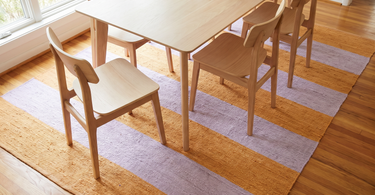
It's not the table but the chairs that determine the size of the rug — they need to stand on the rug, even when they're pulled out. The rule of thumb is 60-70 cm of clear rug edge on all sides of the table, and that often gives a measurement that's bigger than you'd expect. If you can't find that, there are real alternatives instead of compromising.
Contents
A rug under the dining table needs to do more than look nice under the tabletop — it needs to support the chairs, even when they're pushed back from the table. Here's the sum, and what to do if the answer turns out bigger than what you can find.
The rule: the chairs should stay on the rug
The deciding measurement isn't the table's four legs, but the space the chairs need when they're pulled out from the table. When you sit down at the table, you push the chair backwards, and the legs need to still be standing on the rug — not just outside the edge. Otherwise the rug tips up, or the chair ends up partly on the floor.
The rule of thumb from interior design is therefore 60-70 cm of clear rug edge on all sides of the table. It's not a fixed product standard, but a practical starting point that allows for a pulled-out chair and a bit of room to stand up.
Work it out
The sum is simple: the table's measurements plus the clear edge on each side, added twice (once for each dimension of the table).
- Table measurements: for example 90 x 180 cm
- Clear edge: 60-70 cm on each side
- Total rug size: approximately 210 x 300 cm
A table measuring 90 x 180 cm therefore ends up requiring a rug of around 210 x 300 cm — considerably bigger than the table itself. This is the kind of measurement that often comes as a surprise, because you tend to think in terms of the table's size rather than the chairs' range of movement.
Round table, oblong table
The rug's shape should follow the table's shape. For a round table, a round or square rug works best, because the clear edge then stays even all the way round the table and chairs. A rectangular rug under a round table typically leaves too much clear edge in the corners and too little along the sides.
For an oblong table, a rectangular rug in the same direction as the table is the right choice — it follows the table's proportions and gives even room for the chairs at both ends.
If the rug ends up too big
The rug size required under a dining table often ends up bigger than what you can actually find. Dims Studio's largest rugs measure up to 300 x 150 cm and 250 x 160 cm — narrower, that is, than a full dining table rug typically requires if the table is large or the clear-edge requirement is taken literally.
If that's the case, there are three real options:
- Choose a flatweave rug. It's easier to walk on and to slide chairs over than a high-pile rug, even if it doesn't meet the full clear-edge requirement.
- Place the rug somewhere else in the room instead — for example as a standalone feature away from the dining table.
- Skip the rug under the dining table entirely, and put it in the seating area instead, where the clear-edge requirement doesn't apply in the same way.
See our selection of rugs or find inspiration for other placements under living room rugs.
Material for under a dining table
Food and drink get spilled under a dining table, and the chairs are pushed across the rug repeatedly throughout the day. The material needs to withstand both.
Flatwoven cotton, as in the Chindi rugs, can often be washed and is easy to keep clean after little accidents. Wool is the most hard-wearing over time, but usually needs spot cleaning rather than a trip through the washing machine. Long-pile rugs are the worst choice for this particular room, because chair legs tend to get caught in it every time the chair is pulled out or pushed back.
See cotton rugs or wool rugs, or head over to rugs for the full overview.
Frequently asked questions
How big should the rug under the dining table be?
It depends on the table's dimensions plus 60-70 cm of clearance on all sides for the chairs. A table measuring 90 x 180 cm therefore needs a rug of roughly 210 x 300 cm.
Should the chairs stand on the rug?
Yes, that's the key requirement — the chairs should still be standing on the rug even when pulled out from the table, not just the table's legs.
What shape of rug suits a round dining table?
A round or square rug suits a round table best, because the clearance is even all the way around.
What do you do if the rug turns out to be too big to find?
Choose a flatwoven rug that's easier to slide chairs across, place the rug somewhere else in the room, or skip a rug under the dining table and put it in the seating area instead.
Which material is best under a dining table?
Flatwoven cotton is often the easiest to wash after spills, wool is the most hard-wearing but needs spot cleaning, while long-pile rugs should be avoided because chair legs get caught in them.
Summary
The rug under a dining table should be measured based on the chairs, not the table — they need to remain standing on the rug even when pulled out, which requires 60-70 cm of clearance on all sides. That quickly adds up to a bigger size than you'd expect, for example roughly 210 x 300 cm for a table measuring 90 x 180 cm. The shape should match the table: round for a round table, rectangular in the same direction for an oblong table. If you can't find the right size, a flatwoven rug, a different placement, or a rug in the seating area instead are all real solutions. As for the material itself, flatwoven cotton or wool are better choices than long-pile rugs, which chair legs easily get caught in.
Read also
- What size rug should you choose for the living room?
- What is a hand-tufted rug?
- What are the benefits of handwoven rugs?
- Rug underlay: when do you need one?
- How to clean a rug yourself
See the rugs at Dims Studio — rugs, rugs and cotton rugs.