
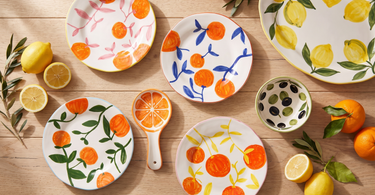
Fruit ceramics are functional ceramics where the motif itself is food — citrus, fruit, veg or shellfish — painted or moulded directly onto the piece. At Dims Studio, it mainly comes from Caja Company and &Klevering, and because the motif is hand-painted, no piece is quite like the next. The dishes are made to be used, but also work as decoration once the table has been cleared.
Contents
A dish with painted lemons looks right both filled and empty. That's the whole point of fruit ceramics, and that's why it's become a regular feature on Danish dining tables.
What is fruit ceramics?
Fruit ceramics is ceramics where the motif is food — fruit, veg or shellfish — painted onto or moulded into the piece itself. It's not decoration in the traditional sense, but functional items: dishes, bowls, plates, side plates, jugs, jars, spoon rests and egg cups, all of which have a food motif built into the design.
You'll find fruit ceramics among dishes and bowls, plates and jugs in the range, and what they all have in common is that they're meant to sit on the table — not in the cupboard.
This is why food works as a motif on a table
The mechanics behind fruit ceramics are simple: the motif is the same as what's meant to go on the dish. A dish with painted lemons looks right when there are lemons on it — and it still looks right when the dish is empty. Form and function point the same way.
That's why fruit ceramics can be left out between meals, when other serving ware is usually put away. A plain white dish looks empty without contents. A dish with painted strawberries or lemons already has its own motif to show off.
The motifs in the range
The motifs in the range fall into a few clear groups:
- Citrus: lemon, orange and lime — see lemons and citrus
- Fruit: grape, strawberry, plum, pear, apple, banana, pineapple, melon and cherry
- Veg: tomato, artichoke, asparagus, aubergine, courgette, mushroom, garlic, onion, corn and olives, as well as fennel
- Seafood and fish: lobster, crab, prawn, mussel, oyster and trout
Several of the fruit motifs can be seen together under fruit bowls.
Caja Company and &Klevering
The fruit ceramics at Dims Studio come mainly from two brands. Caja Company works with hand-painted motifs in a style that draws on Italian ceramics and citrus colours — you can read more about that in Caja Company: Danish design with citrus colours. &Klevering has a Dutch approach to the same motifs, described in Klevering: Dutch design with humour.
What both brands have in common is that the motifs are hand-painted. This means that two examples of the same dish will vary slightly in brushwork and shade. That variation is part of the character — not a flaw in the piece.
The Italian inspiration can be explored further in Italian ceramics and in the article about Italian interior design.
How to use it without going overboard
Fruit ceramics work best when they're given room to stand out clearly rather than getting lost among too many motifs at once. A few rules of thumb:
- Choose one large dish rather than several small ones — this gives the motif room to stand alone
- Keep the rest of the table calm, so the dish becomes the eye-catcher
- Feel free to mix motifs within the same colour family, for example citrus and green in the same yellow-green tones
- Use a spoon rest with the same motif to tie the dish and the rest of the table together
- Leave a dish out on display as decoration, even when there are no guests
See also how you mix ceramics on the table setting, if you want to combine several ranges on the same table. The whole setup can be explored under table setting.
Hand-painted ceramics in everyday life
Hand-painted details can be damaged by harsh dishwasher cycles and abrasive cleaning agents, so it's worth checking the individual product before putting it in the dishwasher. On the more everyday-friendly pieces, the motif often sits under the glaze, which protects it better in daily use.
If you're unsure how a particular piece of ceramics should be treated, you can read more in How do you clean ceramics?.
Frequently asked questions
What is fruit ceramics?
Fruit ceramics is functional ceramics — platters, bowls, plates, jugs and the like — where the motif is food: fruit, vegetables or seafood, painted or shaped directly onto the piece.
Why do food motifs work on serving platters?
Because the motif matches what's going on the platter. A lemon platter looks right with lemons on it, and it still looks right empty, so it can stay out on display between meals.
What motifs are available?
The range covers citrus such as lemon, orange and limone, fruits such as grapes, strawberries, apples and bananas, vegetables such as tomato, artichoke and garlic, plus seafood and fish such as lobster, crab, mussel and trout.
Can fruit ceramics go in the dishwasher?
It depends on the individual piece — hand-painted details can be damaged by harsh machine washing and abrasive agents, so it's worth checking the specific product first.
Why do two identical platters look different?
Because the motifs from both Caja Company and &Klevering are hand-painted, which gives a natural variation from piece to piece — it's part of the character, not a flaw.
Summary
Fruit ceramics is functional ceramics where the motif is food — citrus, fruit, vegetables and seafood — painted or shaped directly onto the platter, bowl or jug. At Dims Studio, the motifs come mainly from Caja Company and &Klevering, and because they're hand-painted, each piece varies slightly. The strength of the motif is that it matches the contents, so a platter can stand out both filled and empty without looking out of place. For everyday use, it pays to style with fewer, larger pieces and check each product's dishwasher suitability, as hand-painted details don't always withstand rough treatment.
Read also
- Caja Company: Danish design with citrus colours
- Klevering: Dutch design with humour
- Italian interiors: Mediterranean style in the Danish home
- How to mix ceramics, colours and shapes on the table setting
- Table decorations: how to build the centrepiece
- Table setting for weddings
See the range at Dims Studio — fruit bowls, citrus and Italian ceramics.