
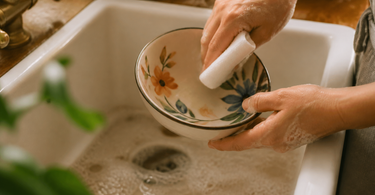
Ceramics are best cleaned with warm water and a mild washing-up liquid — this applies whether it's a vase, cup or candlestick. Hand-painted pieces should always be washed by hand, as the machine breaks down the paint layers over time. Abrasives, steel wool and bleach are forbidden on both glazed and unglazed ceramics. The dishwasher is only a realistic option for densely glazed, industrially made pieces without hand-painting or gold/silver detailing.
Ceramics are one of the materials that hold up really well to daily use — but only if you treat them correctly. An incorrectly cleaned cup gradually loses its glaze, a hand-painted vase loses its design, and a porous candlestick can absorb soap residue that's almost impossible to remove again. Fortunately, proper ceramic cleaning is neither complicated nor time-consuming once you know the basic rules. This guide covers everything from the daily routine to dealing with stubborn stains.
What is ceramic, and why does it need special care?
Ceramic is a broad term for fired clay bases — stoneware, earthenware, porcelain and terracotta all fall under this umbrella. The differences in surface, porosity and strength vary enormously depending on firing temperature and glaze type, and it's precisely these differences that determine how you should clean it.
Glazed vs. unglazed ceramics
A glaze is a thin layer of melted glass that seals the clay surface. Glazed ceramics are relatively easy to clean, because the surface is dense and non-absorbent. Unglazed ceramics — typically terracotta, raw stoneware or bisque porcelain — are porous and soak up liquids, including soap, grease and colourants from coffee and tea.
Stoneware vases are usually high-fired ceramics with a semi-matte or glossy glaze that's relatively robust. Even so, they still need the right care to preserve the glaze's integrity over time.
The importance of firing temperature
Stoneware is typically fired at 1200–1300°C and is dense and durable. Earthenware is fired lower (900–1150°C) and is more porous and sensitive to thermal shock — sudden temperature changes can cause cracks in the glaze (crazing). Porcelain is dense and hard, but glaze detailing and hand-painting are still vulnerable to mechanical wear.
Daily cleaning: warm water and mild washing-up liquid
By far the best method for cleaning ceramics day-to-day is simple: warm (not boiling) water combined with a mild washing-up liquid. This removes grease, food residue and dust without attacking the glaze, paint or the clay structure underneath.
Step by step: basic hand-washing
- Rinse the surface with warm water to loosen any loose dirt.
- Apply a few drops of mild washing-up liquid to a soft sponge or a microfibre cloth.
- Wash in circular motions — avoid heavy pressure, especially on painted or gilded details.
- Rinse thoroughly with warm water. Soap residue that dries can leave a matte film on the glaze.
- Dry off immediately with a soft cloth or let the piece air-dry on a clean tea towel.
This applies to everything from ceramic mugs for decorative pieces that just gather dust on a shelf.
Tip: Never use boiling water directly on cold ceramics. The sudden jump in temperature can create micro-cracks in the glaze, which over time develop into visible "crazing" — a web pattern of fine cracks in the surface. Let the piece come up to temperature a little, or use warm (not boiling) water from the tap.
Hand-washing vs. dishwasher – when is what allowed?
The dishwasher is handy, but it combines three factors that together are hard on ceramics: high temperature, strong alkaline detergents and mechanical vibration. The question is when the combination is actually a problem.
| Type of ceramic | Dishwasher | Recommended method |
|---|---|---|
| Tightly glazed industrial ceramics without decoration | ✅ Generally fine | Hand washing preferred for long life |
| Stoneware with matte or reactive glaze | ⚠️ Risky | Hand washing recommended |
| Hand-painted ceramics (over-glaze paint) | ❌ Not recommended | Hand wash only |
| Ceramics with gold or silver detailing | ❌ Not recommended | Hand wash only |
| Unglazed/terracotta | ❌ Not recommended | Hand wash only with minimal soap |
| Vintage or antique ceramics | ❌ Not recommended | Hand wash only |
What happens in the dishwasher?
Dishwasher detergent contains enzymes and alkaline salts (typically pH 10–12) that are highly effective at breaking down organic matter — but also gradually attack glazes, especially matte-glazed surfaces. Temperatures of 60–75°C combined with steam condensation increase the risk of thermal shock, and the mechanical vibrations can loosen over-glaze paint, which sits as an extra layer on top of the glaze rather than being fired into it.
Even if the manufacturer's label says "dishwasher safe", you should bear in mind that this usually just means the piece survives the dishwasher — not that it's the best treatment for preserving its appearance and durability over time.
Hand-painted pieces: how to preserve the paint
Hand-painted ceramic pieces — whether it's a decorative ceramic wall hanging or a cup with a painted motif — need special care. The durability of the paint depends on whether it's fired under the glaze (under-glaze) or on top of it (over-glaze).
Under-glaze vs. over-glaze paint
Under-glaze paint is applied to the clay surface and then covered with a layer of transparent glaze, which protects the design. This type is more robust and copes better with damp cleaning — but the dishwasher can still attack the protective glaze over time.
Over-glaze paint sits on top of the fired glaze and is fired at a lower temperature (700–900°C). It's sensitive to mechanical wear, alkalis and thermal shock. Even gentle hand washing can, over time, blur the sharp edges of the design. The dishwasher will visibly degrade the paint after typically 10–20 washes.
Practical rules for hand-painted pieces
- Always use lukewarm to warm water — never boiling.
- Choose the mildest soap you can find — pH-neutral is preferred.
- Wash with a soft sponge; never a scouring pad, even the "soft" side.
- Avoid prolonged soaking — the longer the ceramic sits in water, the more stress it puts on the glaze and paint.
- Dry the piece off immediately after washing.
Invest in hand-painted ceramic candleholders, and proper cleaning will double or triple the time the design stays clear and intact.
Stubborn stains and discolouration
Even with good care, stains sometimes appear that won't disappear with soap and water alone. Here are the most common types and the solutions that work without damaging the ceramic.
Limescale build-up
White, chalky build-up typically appears on the inside of vases and cups, particularly in hard-water areas. The solution is a mild acid-based mixture: combine white distilled vinegar and water in a 1:2 ratio and let it sit for 15–30 minutes. Rinse thoroughly afterwards. Avoid getting vinegar on metal details and hand-painted areas.
Tea and coffee stains
Tannins from tea and coffee can, over time, tint glazed interiors brown. A paste of baking powder and water (not baking soda) applied with a soft cloth acts as a very gentle abrasive that removes surface build-up without scratching the glaze. Leave the paste to work for 5 minutes, rub gently and rinse.
Candle wax residue from candleholders
Candle wax on ceramic candleholders is easiest to remove by placing the piece in the freezer for 30–60 minutes. Once the wax has hardened and shrunk slightly, it can usually be flaked off with your fingers or a plastic scraper. Avoid metal tools, which scratch the glaze. Any remaining greasy residue can be dealt with using lukewarm water and mild washing-up liquid.
Rust stains
These can occur if the ceramic has been in contact with metal surfaces or metal rings on the underside of stands. Citric acid (1 teaspoon dissolved in 200 ml warm water) usually removes rust discolouration. Leave it to work for 20 minutes and rinse thoroughly.
What you should never use on ceramics
Just as important as what you do is what you avoid doing. The following products and tools can cause damage that can't be repaired.
Scouring agents and abrasive cleaning products
Even "soft" scouring powder contains abrasive particles (often calcium carbonate or silicate) that leave micro-scratches on the glaze surface. These scratches collect dirt and speed up the breakdown of the glaze. The result is a surface that looks dull and grey, and is harder to keep clean.
Steel wool and hard scouring pads
Steel is harder than most glazes and scratches the surface effectively. This applies to both steel wool and the green scouring sides on conventional washing-up sponges — they're designed for cast-iron pans, not ceramics.
Bleach (sodium hypochlorite)
Chlorine-based bleach reacts chemically with many glazes and pigments and can cause discolouration that's irreversible. It also attacks any unfired layers of paint.
Acetone and solvents
Never use these on ceramics with over-glaze paint or hand-painted designs — acetone literally dissolves the paint.
For stoneware vases with reactive glazes (iron glaze, ash glaze), this is particularly important, as reactive glazes often have an irregular, partly porous surface that reacts more strongly to chemicals than conventional clear glazes.
Storage and ongoing maintenance
Cleaning is only one part of ceramic care. Correct storage reduces the need for intensive cleaning and significantly extends its lifespan.
Stacking
Never stack ceramics directly on top of each other without protection. The underside of a cup or bowl is typically unglazed and acts like sandpaper against the glaze of the piece below it. Use felt interlayers, paper towels or stacking rings (silicone discs) in between. This is the most common cause of scratches in ceramic glazes in ordinary kitchens.
Drying
Unglazed parts — undersides, insides of hollow decorative pieces — should dry completely before storage. Moisture trapped in a porous clay surface can, over time, cause mould or mineral deposits that are difficult to remove.
Regular dusting
Decorative pieces such as ceramic wall hangings collect dust on textured surfaces. A dry, soft paintbrush (size 4–6) or a brush intended for dusting electronics is ideal for removing dust from uneven surfaces without scratching the glaze. Washing with water once a month is sufficient for purely decorative pieces.
Frequently asked questions
Can I put my ceramic cup in the dishwasher?
It depends on the cup. A densely glazed, industrially manufactured cup without hand painting or metal details typically withstands the machine, but wears faster than with hand washing. Hand-painted cups should always be washed by hand, as the machine's alkaline detergent and high temperatures break down the paint over time — often visible after as few as 15–25 machine runs.
What is the best detergent for ceramics?
Choose a pH-neutral or mildly alkaline liquid washing-up liquid — most common liquid dishwashing detergents work fine. Avoid strong degreasing agents and concentrated products intended for industrial use. For hand-painted or delicate pieces, you can dilute the washing-up liquid further in water before use.
My ceramics have developed fine cracks in the glaze (crazing) – is it dangerous?
Crazing is fine cracks in the glaze and is typically an aesthetic issue rather than a structural one. For functional ceramics such as cups and plates, however, the cracks can harbour bacteria, as they give access to the porous clay body beneath the glaze. Crazing usually occurs due to thermal shock (sudden temperature changes) or uneven shrinkage during firing. Pieces with pronounced crazing should be used for decorative purposes rather than food and drink.
How do I remove limescale stains inside a ceramic vase?
Fill the vase with a mixture of white vinegar and water (1:2) and let it sit for 20–30 minutes. For heavier deposits, you can add a couple of teaspoons of rice and shake gently — the rice acts as a mechanical aid without scratching the glaze. Rinse thoroughly with warm water afterwards and let the vase dry completely before next use.
Can I use scouring powder on ceramic sinks?
No — scouring powder contains abrasive particles that scratch the glaze surface, even on robust ceramics. Over time, scratches create a greyish, matte patina that is permanent. For stubborn stains, baking soda paste (baking soda + water) is a much gentler alternative that cleans without scratching, as baking soda is softer than most glazes.
How do I best care for ceramic vases with flowers?
Change the water every 1–2 days to avoid a build-up of organic matter and algae on the inside. Rinse the vase with lukewarm water and mild washing-up liquid after each use with flowers. Let the vase dry completely with the opening facing down before storage — residual moisture in a closed vase promotes limescale and mould formation, especially in reactively glazed pieces with an uneven inner surface.
Summary
Ceramics are best cleaned with warm water and a mild washing-up liquid — that's the basic rule that applies to most types, from everyday cups to decorative stoneware vases. The dishwasher is only a real alternative for densely glazed, industrially produced pieces without hand painting or metal details. Hand-painted pieces always require hand washing, as the machine gradually breaks down both paint and glaze. Abrasives, steel wool and bleach have no place near ceramics, regardless of type. Stubborn stains such as limescale and candle wax residue can be removed with vinegar, lemon or freezing — without harsh chemicals. If you treat your ceramics properly from day one, they'll retain their surface, character and structural integrity for many years.
Explore our range of ceramic candlesticks, stoneware vases and ceramic mugs— all made with glazes and surfaces designed to last with proper care.