
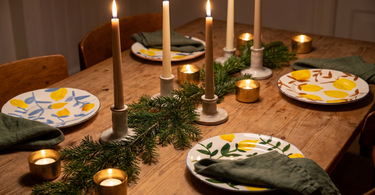
A Christmas table doesn't get better with more things, but with fewer things chosen deliberately. Start with the candlesticks down the middle of the table, choose two colours and stick to them, and let the plates be different rather than perfectly matching. Red and green aren't compulsory — green and brass or white and light grey give you a table that doesn't look like everyone else's.
Contents
Christmas dinner is the one evening of the year when it's completely fine to go all out. But there's a difference between a table with a lot on it and a table that actually works. Here's the approach we use ourselves, and the moves that make the biggest difference.
Start with the light
Candlesticks are the most important thing on the Christmas table. A row of candlesticks in varying heights down the middle of the table does more for the atmosphere than any other single thing — and because the flames sit above the decorations, they add height without taking up space.
Use several small ones rather than two large ones, and feel free to mix materials. Stoneware, ceramics, glass, brass and crystal can all stand side by side, as long as the colour scheme holds together. Keep the flames below eye level when guests are seated — otherwise everyone will be talking past each other all evening.
Reckon on roughly one candlestick for every 30-40 cm of table centre. Light them half an hour before guests arrive, so the wax is soft and the flame burns steadily.
Choose two colours — and not necessarily red and green
Classic red and green is just one option among many. Green and brass, white and light grey, muted purple and gold, or even pink and red, give a Christmas table with more personality. Two colours plus the tabletop or tablecloth as a third tone is plenty.
From three colours upwards, the table starts to look chaotic, no matter how beautiful the individual pieces are. If you want more colour, let it come from the food and the greenery rather than from more objects.
The place setting
On Christmas Eve there are typically more courses and more glasses than on an ordinary day, and it's worth setting it up correctly from the start, so there's room for everything. Cutlery is laid from the outside in, in the order it's used, and the glasses are placed to the right, above the knives.
We've covered it all in detail in how cutlery should be laid and how glasses should be arranged on the table.
Feel free to mix the plates. A table where everything matches looks contrived; a table where the plates vary within the same colour family looks coordinated but lively.
Christmas ornaments as table decorations
The ornaments don't have to hang on the tree. Placed by the setting, a single ornament can replace the place card, and gathered in a bowl in the middle of the table, they become an eye-catcher that can be packed away and used again next year — unlike fresh greenery, which has to be replaced.
Fir branches, pinecones and eucalyptus laid loosely down the middle of the table between the candlesticks ties it all together. Keep it low and let it be irregular; a tight garland looks more formal than cosy.
Tablecloth, runner or just the table
If you don't have a tablecloth in the right colour, use one or two tea towels laid as a runner down the middle of the table. It adds colour, keeps the candlesticks in place and doesn't cover the tabletop, if it's worth showing off.
One advantage of the bare tabletop: there's always wax on the Christmas table, and wood is easier to clean than fabric. If it ends up on the tablecloth, see how to remove wax from a tablecloth.
Set the table the day before
Everything except food and lit candles can be ready the day before. Besides giving you peace of mind on the day itself, it's the best way to see if the colours hold up — a table that looks great in lamplight in the evening can look completely different in daylight.
If you're in doubt about something, this is also when you can take it away. It's easier to remove one thing too many the day before than in the middle of serving.
After Christmas, the table is still standing
The candlesticks, plates, salt and pepper sets and butter dish aren't Christmas — they're just table settings. That's why the whole setup can stay in place for New Year's table and on into January, once the ornaments and the tree are packed away.
This is also the argument for investing in the basic table setting itself rather than in decorations that can only be used in December.
Frequently asked questions
How do you set a Christmas table?
Start with the candlesticks down the middle of the table, choose two colours and stick to them, and let the plates be different rather than all matching. Keep all decorations below eye level.
Which colours suit a Christmas table?
Two colours are enough. Green and brass, white and light grey, or muted purple and gold give a calmer table than classic red and green.
How many candlesticks should be on the Christmas table?
About one for every 30-40 cm of table centre. Several small ones at different heights work better than two large ones.
Should the plates match on the Christmas table?
No. Keep one element in common — the same material or the same colour family — and let the rest vary. A table where everything matches often looks too contrived.
What can you use instead of a Christmas tablecloth?
One or two tea towels laid as a runner down the middle of the table. It adds colour without covering the tabletop, and wax is easier to remove from wood than from fabric.
How early can you set the Christmas table?
Everything except food and lit candles can be ready the day before. This gives you peace of mind on the day and a chance to see if the colours hold up in daylight.
Summary
Setting a Christmas table is about choosing a few things deliberately. Build the table around candlesticks at different heights down the middle, keep the flames below the eye level of a seated guest, and limit yourself to two colours plus the tabletop — red and green isn't a requirement. Mix the plates within the same colour family, use Christmas ornaments by the place setting instead of place cards, and set the table the day before. The basic table setting can stay in place through New Year and on into January, once the tree is gone.
Read also
- How do you set a table? From everyday to celebration
- How many candlesticks should there be on the dining table?
- How do you remove wax from a tablecloth, candlestick and table?
- Christmas decorations with personality: how to build a unique Christmas collection
- Table decorations: how to build the centre of your table
- New Year's table: how to set the table for New Year
You'll find everything for the table at Dims Studio — see Christmas table, candlesticks and Christmas decorations.