
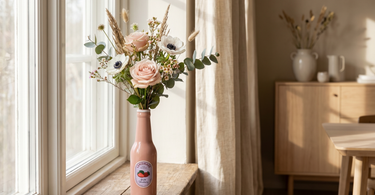
Match the vase's shape with the flowers: narrow neck for a few stems and tulips, wide opening for airy bouquets, tall cylinder for long branches, low bowl for short flowers and peonies, and a bottle vase for a single stem. A good rule of thumb: the vase's height should be around two thirds of the bouquet.
Contents
The right vase can make all the difference to how a bouquet looks. It's not just about taste – it's about matching the vase's shape and height with the type of flowers. Here's a simple guide so your flowers always look their best.
Height and proportions
Before you choose a shape, think about the proportions. A classic rule of thumb says the vase's height should be around two thirds of the total bouquet. That way the flowers stand steadily and look harmonious – neither too spindly nor too top-heavy.
Tip: If the bouquet is too tall for the vase, you can trim the stems a little shorter. This often helps the flowers last longer too, as they stand more steadily and can absorb water more easily.
Narrow neck: a few stems and tulips
A vase with a narrow neck keeps the stems gathered and upright. It's ideal for a few stems and for flowers that need a bit of support – like tulips, which otherwise tend to arch and flop outwards. The narrow neck gives a sleek, unified look.
Wide opening: airy bouquets
If you've got a big, airy bouquet with lots of different flowers, a vase with a wide opening works best. It gives the flowers room to spread out naturally and fall gently outwards in a full, rounded shape.
Tall cylinder: long branches
Long branches, flowering twigs and tall stems need a tall, heavy cylinder vase that can support the height without toppling over. It provides both stability and a striking, architectural look.
Low bowl: short flowers and peonies
Short stems and large, heavy flower heads like peonies look best in a low bowl or a small, round vase. Here, the flowers rest closely and fully, and you avoid a tall vase "swallowing" them.
Bottle vase: a single stem
A slim bottle vase is perfect for a single stem or just a few flowers. It's a simple, graphic way to highlight one beautiful flower or branch – and several bottle vases of different heights grouped together give a lovely, curated look.
| Flower type | Recommended vase shape |
|---|---|
| Tulips and a few stems | Vase with a narrow neck |
| Big, airy bouquets | Vase with a wide opening |
| Long branches and twigs | Tall cylinder vase |
| Peonies and short flowers | Low bowl or small round vase |
| A single stem | Narrow bottle vase |
Frequently asked questions
How tall should the vase be compared to the bouquet?
A good rule of thumb is that the vase's height should be about two-thirds of the total height of the bouquet. This way, the flowers stand stable and look harmonious.
Which vase suits tulips?
Tulips look lovely in a vase with a narrow neck, which keeps the stems together and upright, so they don't bend and flop too much to the sides.
Which vase is suitable for peonies?
Peonies have large, heavy heads and short stems and look their best in a low bowl or a small, round vase, where they can rest closely and fully.
What is a bottle vase used for?
A narrow bottle vase is ideal for a single stem or just a few flowers. Several bottle vases in different heights grouped together give a lovely, curated look.
Which vase suits a large bouquet?
A large, airy bouquet needs a vase with a wide opening, so the flowers can spread naturally and fall gently to the sides in a full shape.
Summary
The right vase matches the shape of the flowers: a narrow neck for tulips and a few stems, a wide opening for airy bouquets, a tall cylinder for long branches, a low bowl for peonies and short flowers, and a bottle vase for a single stem. Remember the proportions – the vase's height should be about two-thirds of the bouquet – so your flowers always look their best.
Read also
- How big should the vase be for my bouquet?
- How to make tulips & cut flowers last longer in the vase
- Vases for every room
Find the perfect vase for your flowers at Dims Studio – see our vases and flower vases.