
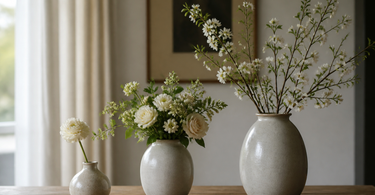
The rule of thumb is simple: the vase should make up roughly 1/3 to 1/2 of the bouquet's total height. If you've got wildflowers with long stems, you'll need a tall vase of 20–30 cm. Mini bouquets thrive in vases of 8–15 cm. If you want to display large branches or statement flowers, you'll need a floor vase of 40 cm or more. The proportion between vase and bouquet is the key factor.
You've bought a lovely bouquet – or picked one from the garden – and now you're standing there with a vase in hand, unsure if it's the right fit. It's about more than just looks: the wrong vase size can cause the flower stems to snap, the water to evaporate too quickly, or the bouquet to topple over. Here you'll find the exact measurements and principles that make it easy to choose correctly, whether you're working with three tulips or an armful of sunflowers.
The rule of thumb explained
In floristry, there's a simple rule of thumb that holds true across most flower types: the vase should make up 1/3 to 1/2 of the bouquet's total visible height. This means that if your bouquet including the vase is 60 cm tall from the table, the vase alone should account for 20–30 cm of that height.
The rule comes from classic floristry and is based on visual balance. The eye perceives a composition as harmonious when the lower mass (the vase) anchors the upper part (the crown of flowers) without overpowering it. If the vase is too short in relation to the stems, the bouquet looks unstable and "top-heavy". If the vase is too tall, the flower heads sink down into the vessel and can't be seen properly.
How to measure it in practice
- Hold the bouquet, untrimmed, up against the vase.
- Measure the total height from the base of the vase to the topmost flower.
- The vase should make up 33–50% of the total height.
- Adjust the stem length by trimming, not the vase size, if the proportion is off.
The rule is a starting point, not an absolute law. Loose, airy bouquets with lots of greenery may need a bit more vase as ballast, while dense, round bouquets (such as a bridesmaid's posy) work well with a lower, wider vase.
Tip: Always measure the stem length from the cutting point upwards, not from the vase's opening. It's the visible part above the vase that should make up 50–67% of the total height.
Bouquet type determines vase size
No two bouquets are alike, and the vase size should be tailored to the bouquet type rather than following a general rule alone. Here are the most common categories:
Wildflowers and loose, natural bouquets
Loosely arranged bouquets with flowers like cosmos, cornflowers, ammi or poppies typically have long, slender stems and an open, airy crown shape. They do best in tall, slender vases of 20–30 cm, which keep the stems together without compressing them. A narrow opening is preferable, as it gives natural support to the stems.
Round, dense bouquets
A classic round bouquet of roses, peonies or ranunculus has shorter visible stems and plenty of flower mass up top. Here, a low to medium-height vase of 12–18 cm works best. The vase should have a wide opening so the flower heads can spread out naturally without pressing against each other.
Tropical and exotic flowers
Strelitzia, anthurium and protea have heavy flower heads and stiff stems. They need a wide, heavy vase with good water depth – a minimum of 15 cm water depth – so the stems can drink enough. Vases in thick ceramic or concrete are ideal for counterbalancing the weight.
Single-stem presentations
Three tulips or a single orchid stem call for a narrow, small vase of 10–15 cm. If you use a large vase for just a few stems, they'll float around and lose all shape.
Height guide: from mini to floor vase
Here's a quick overview of which vase heights suit which bouquet types:
| Vase height | Bouquet type | Typical flowers | Placement |
|---|---|---|---|
| 8–15 cm | Mini bouquets, single flowers | Anemones, freesias, 3–5 tulips | Desk, bathroom, windowsill |
| 15–25 cm | Medium-sized, round bouquets | Roses, peonies, ranunculus | Dining table, kitchen table |
| 25–35 cm | Wildflowers, loose bouquets | Sunflowers, cosmos, dahlias | Hallway, sideboard, shelving |
| 35–50 cm | Long stems, structured bouquets | Agapanthus, delphiniums, gladioli | Floor, stairs, large tables |
| 50 cm+ | Branches, statement plants | Cherry blossom branches, eucalyptus, pampas grass | Floor placement in corners |
If you want to work with decorative branches or large structural arrangements, large vases and floor vases are the only category that provide the necessary stability and water depth. An 80 cm cherry blossom branch in a 20 cm vase is a sure way to end up with a toppled table.
Stem length and trimming
Vase size and stem length are inseparable variables. If you buy a bouquet with 45 cm stems, you can either find a vase to match, or trim the stems down to fit the vase you already have. Both approaches are valid – but there are biological factors to consider.
Trimming and water absorption
When you trim stems, do it with a sharp knife or florist's scissors at a 45-degree angle. This increases the surface area and significantly improves water absorption. Avoid using scissors on thick stems like roses – it crushes the vessel and hinders water transport.
Minimum water depth
Regardless of vase size, the stems should always stand in at least 10 cm of water. This means that a vase 12 cm tall should be filled almost to the brim. A vase 25 cm tall should have water at least halfway up. Shallow small vases require more frequent water changes precisely because the water volume is minimal.
When you should trim
- The bouquet looks "top-heavy" and unstable: trim 5–10 cm off the stems
- The flower heads hang down over the edge of the vase: trim until the stems are 2–3 cm below the rim of the vase
- The flower heads stick up too far: trim and use a taller vase, or accept that the bouquet is airy
Water volume and stability
An overlooked point is that the vase's weight and stability are just as important as its height. A tall, narrow vase with little water and heavy flowers is a disaster waiting to happen. Here are the factors that determine whether your arrangement stays upright:
The weight of the flowers vs. the weight of the vase
An empty 25 cm glass vase might weigh 300–400 grams. A bouquet of wet sunflowers with long stems can easily weigh the same. Always fill the vase with plenty of water – it's your most important ballast. A 30 cm vase filled to the brim with water is significantly more stable than the same vase half full.
The diameter of the opening
A wide opening gives more freedom for placing flowers, but less support for individual stems. A narrow opening naturally keeps the bouquet together. For loose wildflowers, a narrow opening is an advantage – for round bouquets, you'll want a wider vessel, possibly with floral foam or grid tape for support.
Tip: Place a cross of transparent tape across the vase opening if you want to keep lots of stems in place in a wide vase. It works as an invisible grid and holds the arrangement's shape.
Room size plays a part
Besides the relationship between vase and bouquet, you need to consider the room and the surface you're placing the arrangement on. An arrangement that works perfectly in its proportions can still look out of place.
For low surfaces and coffee tables
On a coffee table or a low sideboard, a flower arrangement shouldn't exceed 35–40 cm in total height, otherwise it will block sightlines and conversation. Here are low and wide vases ideal – ideally in groups of 2–3 vases in different sizes.
For tall tables and consoles
An entrance shelving unit or a tall sideboard can carry an arrangement of 50–70 cm without it feeling overwhelming. Here, wildflowers in a 25–30 cm vase are right in their element.
For walls and narrow niches
If you have limited table space, wall vases are a functional solution. They're suited to mini bouquets or single flowers, and a vase height of 10–20 cm is typically optimal here. Remember that wall vases usually have a narrower opening than table vases, so choose flowers with slender stems.
Floor vases for large rooms
In rooms with high ceilings and large floor areas, a floor vase of 40–60 cm with pampas grass, eucalyptus or decorative branches can work as a piece of furniture in its own right. These arrangements don't necessarily need water – dried branches keep for months.
If you want a particularly exclusive arrangement with unique materials and craftsmanship, it's worth exploring designer vases in the premium category, which combine weight, form and durability in a way that makes the big investment worthwhile for years to come.
Frequently asked questions
What's the rule of thumb for vase height?
The vase should make up roughly 1/3 to 1/2 of the bouquet's total visible height – that is, from the table up to the topmost flower. If the bouquet including the vase is 60 cm tall, the vase should account for 20–30 cm. The rule ensures visual balance and gives the stems adequate support.
Can I use a small vase for long stems?
You can trim the stems, but avoid cutting them so short that they can't reach the water properly. As a minimum, the stems should stand in 10 cm of water. If the flowers are wildflowers with long stems, a low vase will typically give an unstable and disproportionate arrangement.
Which type of vase suits tulips?
Tulips have flexible stems and continue to grow after they've been cut. A narrow, tall vase of 20–25 cm is ideal – it keeps the stems upright and gives them direction. Tulips in a wide, low vase will flop out to the sides within 24 hours.
What do I use a floor vase for?
Floor vases of 40 cm and above are suited to decorative branches, pampas grass, eucalyptus or large flowers such as gladioli and agapanthus. They're typically placed in corners, by staircases or in entrances and work as a decorative feature alongside furniture and art.
Does the width of the vase matter?
Yes. A narrow vase keeps loose stems together and is ideal for wildflowers. A wide vase gives room for dense, round bouquets, but requires tape or floral foam to hold the stems in place. The width should match the density of the bouquet and the number of stems.
How much water should be in the vase?
As a minimum, 10 cm of water depth – always. In low vases, that means nearly full water level. Change the water every other day and trim the stems slightly each time. This significantly extends the flowers' lifespan and reduces bacterial growth in the water.
Summary
Choosing the right vase size for your bouquet is primarily about proportion: the vase should account for 1/3 to 1/2 of the total height. For wildflowers with long stems, 20–30 cm is the right zone. Mini bouquets do best in vases of 8–15 cm. Statement branches and large compositions require floor vases of 40 cm and above. Besides height, the width of the opening, the amount of water and the scale of the room all play a role. Always trim the stems at a 45-degree angle, and make sure there's a minimum of 10 cm of water – this extends the flowers' lifespan regardless of vase size. Proportion is key; the rest can be adjusted.
Explore our range of vases in all sizes and find the one that fits your next bouquet perfectly.