
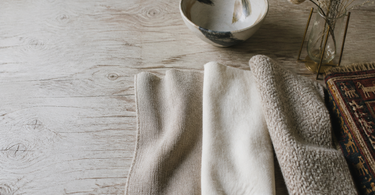
Cotton is soft, allergy-friendly and easy to wash — ideal for bed linen and pillowcases in everyday use. Linen has a firmer surface but is extremely durable and temperature-regulating, making it well suited to curtains and tablecloths. Wool insulates best and is naturally water-repellent and crease-resistant, but requires gentle washing. The choice depends on whether you prioritise comfort, durability or thermal regulation.
Cotton, linen and wool come up time and again when looking at natural materials for home textiles — and there are good reasons for that. The three materials share their origins in nature, but differ markedly in structure, function and care. A linen curtain behaves fundamentally differently from a wool rug, and a cotton pillowcase has entirely different properties from a linen cushion. Knowing the differences makes it far easier to choose the material that suits your room and your everyday life.
Cotton: softness and easy care
Cotton comes from the seed pods of the cotton plant (Gossypium) and is one of the world's most widely used textile fibres. The fibres are naturally hollow, giving cotton its characteristic softness and breathability — two qualities that make it the dominant choice for bed linen and clothing worn directly against the skin.
Properties and benefits
Cotton absorbs moisture up to around 27 times its own weight without feeling clammy to the touch, because the fibres transport moisture away from the skin. This makes it allergy-friendly and comfortable for most people — including children and those with sensitive skin. Cotton is also machine washable at temperatures up to 60°C (depending on weave and dye), and withstands frequent washing without quickly losing its shape.
Drawbacks to be aware of
Cotton typically shrinks 3–5% in the first wash if it has not been pre-treated. It also fades faster in direct sunlight than linen and wool — a relevant point if you are considering cotton curtains in a south- or west-facing room. Creasing is another characteristic: cotton is not naturally crease-resistant and requires ironing or steam treatment for a crisp finish.
Typical uses
Bed linen, pillowcases, curtains and tablecloths are the classic categories. For everyday textiles where you want softness, frequent washing and allergy-friendly properties, cotton is rarely a wrong choice. If you want to combine the softness of cotton with colourful details elsewhere in the room, you could pair it with colourful rugs or candleholders that create contrast.
Tip: Wash new cotton textiles once before use at 40°C to minimise shrinkage from the start. After that, most cotton products can be kept at 30–40°C for regular washes.
Linen: durability and natural texture
Linen is produced from the stalks of the flax plant (Linum usitatissimum) and is one of the oldest known textile fibres — archaeological finds date linen production to at least 30,000 years ago. It is a significantly stronger fibre than cotton: linen fibres are around 2–3 times stronger than cotton measured by tensile strength, and a linen product can last for decades with proper care.
Temperature regulation and sustainability
Linen fibres are hollow and smooth, which provides good air circulation. This means linen textiles have a cooling effect in summer — heat is conducted away from the body faster than with cotton. As a plant, linen is also remarkably resource-efficient: it generally requires far less water than cotton to grow and can be produced in Europe, primarily in France, Belgium and the Netherlands.
The characteristic surface
The natural, slightly coarse look is a central part of linen's appeal. The material has a visible, irregular texture with natural knots in the fibres, and it creases as soon as it is washed. Many see precisely this relaxed, uneven appearance as a strength — it gives an organic, rustic character to tablecloths, curtains and rugs and wall rugs. If you are new to linen, the stiffer surface on first touch may come as a surprise, but it softens with use and washing.
Care
Linen tolerates machine washing at 40°C, but creases heavily. Avoid the tumble dryer at high temperatures, as this accelerates fibre wear. Linen can be ironed, and steam helps smooth the surface if you prefer a more polished result.
Wool: warmth and insulation
Wool is a protein-based fibre that comes primarily from sheep — but also from alpacas, cashmere goats and merino sheep, all of which produce fibres with different properties. The spiral structure of the wool fibre is the reason for the material's unique ability to trap air and thus insulate: a wool rug or throw can retain body heat even when the material is 30% wet.
Natural properties that stand out
Wool is naturally water-repellent thanks to an outer layer of fatty substance called lanolin. This gives some resistance to spills and dirt, and means that wool products can in many cases be aired rather than washed when they smell. It is naturally crease-resistant — the fibres return to their natural shape after compression — and it is naturally flame-retardant without chemical treatment.
Does it scratch?
That depends entirely on fibre diameter measured in microns. Fibres above around 30 microns (coarser sheep's wool) will feel prickly against the skin for many people. Merino wool typically falls at 17–25 microns and is markedly softer. For home textiles such as floor rugs and throws, fibre quality is decisive in determining whether the product feels comfortable against the skin.
Care
Wool requires gentle washing — either by hand or on the machine's wool programme at a maximum of 30°C with a mild detergent. Heat and mechanical agitation cause wool to felt (shrink and compact), which is irreversible. Lay wool products flat to dry and avoid the tumble dryer. For premium rugs and wall rugs, professional cleaning is the safest choice for heavier soiling.
Comparison of the three materials
| Property | Cotton | Linen | Wool |
|---|---|---|---|
| Softness | Very soft | Medium (softens with use) | Medium to soft (depends on fibre type) |
| Thermal insulation | Low–medium | Medium | High |
| Durability | High | Very high | Very high |
| Care | Easy — tolerates washing up to 60°C | Easy, but creases heavily | Requires gentle washing, max. 30°C |
| Appearance | Smooth, even | Slight texture, natural crease | Varied texture, full-bodied |
| Temperature regulation | Good breathability | Cooling — good in summer | Insulating — good in winter |
| Environmental profile | Varies (water-intensive cultivation) | Low water use, European production | Renewable, naturally biodegradable |
How to choose the right material
There is no universal ranking — it is about matching the material's properties to the function of the room.
Think about season and function
In summer, linen offers the best comfort in bed and curtain materials, as its cooling properties remain actively effective. In winter, wool is the natural winner when you want warmth and cosiness in the living room — a wool rug on the sofa or a wool throw on the chair is hard to beat. Cotton works all year round and is particularly strong as bed linen and pillowcases in all seasons.
Think about the room's frequency of use
In high-activity rooms — such as the living room and dining room — durability is a key factor. Here linen and wool fare better than cotton over time, even though cotton is durable enough for most purposes. For children's rooms, cotton is typically the most practical choice as it tolerates frequent and hot washing.
Think about the aesthetics
Linen gives a relaxed, organic look that suits Nordic and rustic interiors. Wool has a full, tactile surface that works in both classic and more colourful interiors. Cotton is the most neutral and lets other elements in the room — such as colourful vases or decoration — express themselves without competition from the textile's texture.
Tip: You don't need to choose one material for the whole home. Many people use linen for curtains and tablecloths, cotton for bed linen and wool for rugs and throws — and the combination adds layered depth to the interior.
Frequently asked questions
Is linen better than cotton for curtains?
Linen is more durable than cotton and fades more slowly in sunlight, making it a good choice for curtains in south-facing rooms. On the other hand, linen is stiffer and creases easily, so it requires more maintenance for a neat hang. Cotton is easier to work with and washes more easily, but can lose colour faster.
Can you machine wash wool rugs?
Many wool rugs can be washed on the machine's gentle programme at a maximum of 30°C with wool detergent, but always check the manufacturer's instructions. The tumble dryer is a risk — heat and mechanical movement cause the wool to felt. Let the rug dry flat on a clean surface instead.
What is the most sustainable choice: cotton, linen or wool?
Linen is generally the most resource-efficient choice in cultivation, as the plant requires minimal water and pesticides and is typically grown in Europe. Wool is renewable and naturally biodegradable, but animal welfare and transport distance play a role. Conventional cotton requires a lot of water and pesticides — organic cotton is a better alternative.
Do wool rugs scratch bare feet?
That depends on the wool quality. Coarse wool fibres (above around 30 microns) will feel prickly to many people. Rugs made from merino wool or finer sheep's wool are typically soft enough for barefoot comfort. Always check the product description for fibre type if that is a criterion for you.
Does linen soften over time?
Yes. Linen fibres soften gradually with use and washing. A linen pillowcase or curtain that feels slightly stiff on first use will typically have a softer, more draped surface after 5–10 washes. This is part of the material's natural break-in period.
What is the difference between a cotton throw and a wool throw?
A wool throw insulates markedly better — wool retains heat even at lower thread densities. A cotton throw is lighter, easier to wash and better suited to summer and transitional periods. For cold winter evenings, wool delivers more warmth per gram than cotton.
Summary
Cotton, linen and wool solve different tasks in home textiles, and it is rarely a question of one material's superiority — it is about context. Cotton is your everyday all-rounder: soft, allergy-friendly and easy to maintain, but with a tendency to shrink and fade faster than the other two. Linen is the durability winner with an organic surface and cooling properties that make it ideal for curtains, tablecloths and light bed linen — especially in the summer months. Wool is the thermal specialist: no other natural fibre insulates better, and the natural lanolin layer provides passive water repellency and odour resistance that makes rugs and throws in wool a long-term investment. Use the three materials complementarily and you get an interior layer that is both sensorially and functionally well thought out.
Explore our range of rugs, floor rugs and wall rugs in natural materials — and find the one that suits your room.