
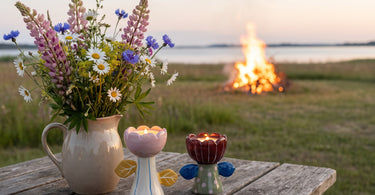
St. Hans Eve is always the evening of 23 June, the evening before St. Hans Day on 24 June. We celebrate with a bonfire, a bonfire speech and the Midsummer Song, and the tradition goes back to both a Christian feast day and a pagan midsummer festival. The next St. Hans Eve falls on a Wednesday.
Dims Studio's own figures: Among the LED lights sold from November 2025 to October 2026 (more than 150 items sold), 44% had green, 44% pink and 42% yellow as one of their colours, and half the items cost under 170 DKK.
Contents
- When is St. Hans
- St. Hans Eve in the coming years
- What do we celebrate at St. Hans
- The bonfire and the witch: where does the tradition come from
- The Midsummer Song: who wrote it
- Folklore and weather omens at St. Hans
- St. Hans Eve today: how it typically unfolds
- St. Hans in other countries
- Frequently asked questions
- Summary
Every year, Danes gather around bonfires on the beach, in the garden or at the local sports field when St. Hans Eve comes around. But what exactly are we celebrating, and how old is the tradition? Here you'll find the answers about the date, the history behind the bonfire and the witch, the Midsummer Song, and the folklore that still lingers over the evening.
When is St. Hans
St. Hans Eve always falls on the evening of 23 June, the day before St. Hans Day on 24 June, which is said to be the birthday of John the Baptist. This is linked to an old Danish tradition that festivities begin the evening before the actual day, just as we celebrate Christmas Eve the day before Christmas Day. The next St. Hans Eve falls on a Wednesday, namely Wednesday 23 June 2027.
St. Hans Eve in the coming years
| Year | Day of the week |
|---|---|
| 2027 | Wednesday |
| 2028 | Friday |
| 2029 | Saturday |
| 2030 | Sunday |
What do we celebrate at St. Hans
St. Hans is an old Danish name for John the Baptist, and the feast in his honour was fixed in the 400s to 24 June, six months before the birth of Jesus according to the Gospel of Luke. This makes St. Hans one of the oldest church festivals. At the same time, the modern celebration has roots in the pagan midsummer festivals that marked the peak of light and summer.
The summer solstice actually falls on 21 June, but in Denmark, St. Hans Eve has nonetheless come to be seen as midsummer's eve and the shortest night of the year. Until the holiday reform of 1770, when the number of public holidays was halved, St. Hans Eve was a public holiday. Today that's no longer the case, but the tradition of gathering around the bonfire has survived the reform.
The bonfire and the witch: where does the tradition come from
According to folklore, St. Hans night was charged with special power, and it was believed that witches flew past on broomsticks that night on their way to Bloksbjerg or Hekkenfeldt. To light their way home, people lit bonfires, often on high ground. Bonfires were also known on Walpurgis Night, 30 April, and the fact that the custom today is mainly linked to St. Hans may be connected to the calendar reform around the year 1700, when the calendar moved forward by 11 days, making it too cold to sit outside in spring.
The witch figure on the bonfire itself is a more recent addition. The custom likely came from Germany and only became common in Denmark in the 1900s, at the same time as the bonfire speech and the Midsummer Song became a fixed part of the evening. The first documented burnings of a doll took place in Kalundborg in the 1920s. So there's no direct historical link between the doll burnings and the witch trial bonfires of the 1500s and 1600s, but in recent years the custom has sparked debate, as it can evoke memories of witch burnings and be seen as misogynistic. As a result, many places have chosen to leave out the bonfire witch.
Bonfires aren't something you can take for granted every year either. After a long period of drought, bonfire bans were introduced in most Danish municipalities in the weeks leading up to Midsummer's Eve 2018. If you're planning a bonfire, it's therefore a good idea to check whether your municipality has introduced a ban or special rules that year.
Tip: Always check your municipality's rules on bonfires before planning Midsummer's Eve, especially if there's been a drought.
The Midsummer Song: who wrote it
What we today call the Midsummer Song is the popular name for the song We Love Our Country, which Holger Drachmann wrote in 1885 for the play Once Upon a Time. The melody was written by Peter Erasmus Lange-Müller the same year, and the song has been sung at Midsummer since the early 20th century.
In 1980, Shu-bi-dua released their own version under the name The Midsummer Song, in which Drachmann's lyrics were set to a new melody by Michael Hardinger. It's often this version that's sung around the bonfire today.
Folklore and weather omens at St. Hans
Right up until the 1800s, many believed that medicinal herbs gathered on Midsummer's Night had a special power, and the dew on the grass was thought to have a healing effect. The sick made pilgrimages to holy springs in hope of a cure, and markets with tents, stalls and entertainment sprang up around the springs. The best-known example is Dyrehavsbakken north of Copenhagen, which emerged in the 1700s.
The weather on the evening itself also has its own folklore. Old weather sayings claim that if it rains on Midsummer's Eve, it will rain for six weeks afterwards, and that the more it rains on Midsummer's Eve, the smaller the hazelnuts will grow.
St. Hans Eve today: how it typically unfolds
Today, Midsummer is marked with both public and private events, with many local associations organising celebrations. A typical programme includes a bonfire speech, often given by someone well known in the local area, followed by the lighting of the bonfire and everyone singing the Midsummer Song together. In some places, there's also fireworks at midnight.
Bonfire sites are often set in beautiful natural surroundings by the forest or the beach, with room for both the fire and the many people who gather. Once the bonfire has burned down and darkness truly sets in, a set of LED lights from the shop can be an easy way to keep a bit of light and atmosphere going in the garden or on the terrace for the rest of the evening.
If you want to light up the garden once the bonfire has burned down, you'll find LED lights for both table and garden in the shop.
See LED lightsSt. Hans in other countries
Midsummer isn't only celebrated in Denmark. The day is also marked in countries including England, Ireland, Germany, Spain, Poland, Russia and France. However, the celebration is strongest in the Nordic and Baltic countries, where the light summer nights provide the best conditions for gathering outdoors and lighting bonfires.
When it comes to the size of the bonfire, Norway holds the record. The Slinningsbålet bonfire in Ålesund stood at 47.4 metres in 2016 and is considered the world's tallest Midsummer bonfire.
Frequently asked questions
When is Midsummer's Eve?
Midsummer's Eve always falls on the evening of 23 June, the evening before Midsummer's Day on 24 June. The next Midsummer's Eve falls on a Wednesday, Wednesday 23 June 2027.
Why do we celebrate Midsummer's Eve on 23 June?
The date is linked to the birthday of John the Baptist on 24 June, and the tradition of celebrating festivals the evening before the actual day, just as with Christmas Eve.
Why do people put a witch on the bonfire?
The custom stems from the folk belief that witches flew past on their way to Bloksbjerg on Midsummer's Night. The witch figure on the bonfire came from Germany and only became common in Denmark in the 1900s.
Who wrote the Midsummer Song?
The lyrics to the Midsummer Song, actually titled We Love Our Country, were written by Holger Drachmann in 1885, with a melody by Peter Erasmus Lange-Müller. In 1980, Shu-bi-dua made a new version with a melody by Michael Hardinger.
Is Midsummer's Eve a public holiday?
No, not any more. Midsummer's Eve was a public holiday in Denmark until the number of public holidays was halved by the holiday reform of 1770.
What happens on Midsummer's Eve?
Typically, a bonfire speech is held, after which the bonfire is lit and the Midsummer Song is sung together. In some places, there are also fireworks at midnight.
Summary
Midsummer's Eve is the evening of 23 June, when we celebrate a mix of a Christian saint's day and an old midsummer festival with bonfires, bonfire speeches and the Midsummer Song. The witch on the bonfire is a more recent custom that today sparks debate, while the folklore about medicinal herbs, dew and weather signs still accompanies the evening. Remember to check your municipality's rules on bonfires, and feel free to let a few LED lights take over once the flames have burned down.
Read also
- Garden party decor: table, lights and garden for the summer party
- Summer decorating: Light, bright and lively
- How to create cosiness with candles
- Summer house decor: Relaxed style with charm
- Whitsun: what are we celebrating, and when is it in 2027?
Get ready for Midsummer's Eve
Find LED lights and other things for the garden, so the mood lasts after the bonfire has died down.
Shop garden decor