
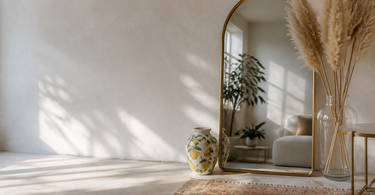
A mirror is one of the most functional and visually flexible elements in interior design. It can optically double the size of a room, direct natural light to where you need it, and function as wall decoration in the same way as a painting. The key is placement and format: large mirrors open up the room, round ones soften geometry, and a gallery hanging creates depth. Choose the format and frame based on the room's proportions — not just the style.
Most people think of a mirror as something functional — you check your outfit, your hairstyle, whether there's spinach in your teeth. But in terms of interior design, the mirror is one of the few elements that solves three problems at once: it creates a sense of space, improves the light level and contributes visually to the wall. However, this requires you to choose the right format for the right place and position it thoughtfully. Here's what you need to know.
Light and optics: what a mirror actually does
A mirror reflects all the light that hits its surface — natural daylight, artificial lighting and the diffuse light from the surroundings. It's not an illusion, but a real optical effect: the light intensity in the room increases because the light is bounced back instead of being absorbed by a matt surface.
The effect is greatest when the mirror is placed opposite or at right angles to a light source. A mirror placed directly opposite a window can almost double the amount of daylight in the room — particularly in north-facing rooms, which rarely get direct sun. It's one of the cheapest and least invasive ways to improve the lighting conditions, and it requires neither electricity nor a new lighting installation.
The second optical effect is depth. A larger mirror — typically from 80 cm in height and upwards — creates a visual extension of the room. The eye registers a continuation of the space, making the perceived area larger than the actual one. This is why mirrors are standard in small entrance halls and narrow corridors, where there isn't room to do anything else to ease the feeling of claustrophobia.
Tip: If you want to maximise the light effect, the mirror should hang at eye level opposite the window — not to the side of it. An angle of more than 45 degrees from the light source significantly reduces the reflection.
Format by room — size, shape and frame
Size: large mirrors work, if you dare
One of the most common mistakes is choosing a mirror that's too small. A mirror measuring 40 × 60 cm on a large living room wall does very little — neither for the light nor for the room's proportions. As a rule of thumb, a mirror that's meant to have a real effect on the sense of space should make up at least a third of the wall's width.
Large mirrors from floor to ceiling or close to it are effective in living rooms, bedrooms and entrance halls. Floor mirrors — typically 160–200 cm tall — are versatile because they don't require hanging and can be moved.
Shape: round vs. rectangular
The shape affects the room's expression more than you might think. A rectangular mirror repeats the straight lines of the architecture and appears structured. A round mirror breaks up the geometry and softens a room with many right-angled surfaces — it's particularly effective in the bathroom, the hallway and as an accent piece in the living room.
Oval mirrors combine the best of both: they have the organic shape without being fully circular, and they suit walls of medium width well — typically 60–90 cm.
The frame defines the style
A brass frame is warm and classic, and it suits interiors with natural materials — wood, ceramics, linen. A black or anthracite frame is more graphic and sharp. No frame — a projecting mirror pane with a polished edge — is minimalist and timeless.
Choose the frame material based on what's already in the room: if you have brass details on candlesticks or light fittings, a brass mirror frame can tie it all together without looking too calculated.
Strategic placement: where and why
The entrance hall
The entrance hall is the classic spot for a mirror — and for good reason. You can check yourself before leaving the house, and the mirror often makes the narrow and dark hallway lighter and more welcoming. Place it at eye level, about 150–160 cm from the floor to the centre of the mirror, and preferably opposite or at right angles to the front door to reflect the light from it.
The living room
In the living room, a large mirror works best above a sofa, a console or a sideboard. Avoid hanging it so that it reflects a cluttered corner or a screen — after all, it doubles everything, including what you don't want to see. The mirror should reflect something visually positive: a window, a plant, natural light.
The bathroom
This is where the mirror's function is clearest, but the design still matters. A round mirror above the basin with a simple frame — or none at all — is today's standard in Scandinavian bathroom decor. Add backlighting, and you activate the mirror's light effect even in the evening.
The bedroom
A floor mirror along a wall is the most practical choice in the bedroom. It gives full-body reflection without you needing to mount anything. Place it next to the wardrobe or close to where you get dressed — not opposite the bed, if you prefer a calm sleeping atmosphere.
The mirror as wall decoration
A mirror with a characterful frame — sculptural, unusual in shape, or with a distinct material expression — works as wall decoration in exactly the same way as an art print or a painting. The difference is that the mirror is active: it changes with the light throughout the day and reflects the room's movement.
Especially in interiors otherwise based on neutral colours and clean surfaces, a single mirror with a striking frame — organic, asymmetrical or in an unexpected material — can give the same effect as a statement piece of furniture: it gives the eye somewhere to rest.
Think of the mirror as an alternative to posters and art, not as a supplement to it. A wall with one well-chosen mirror and nothing else can have more impact than an overcrowded gallery wall.
If you combine the mirror with other elements on the wall — posters, ceramic wall hangings or a wall vase — the mirror should have a clear role: either as the centre with the elements grouped around it, or as a supporting element that echoes the shape's curves or the materials' colour.
Gallery hanging with multiple mirrors
A gallery arrangement with several small mirrors is an alternative that creates depth and movement in a way one large mirror can't. The effect is more dynamic, because each mirror reflects a slightly different angle of the room.
How to put it together
Choose 3–7 mirrors in varying sizes, but with a common denominator — either the same shape (all round), the same frame material, or the same overall expression. If you mix too randomly, the arrangement loses coherence.
Sketch the composition on paper first. Cut out full-size templates and tape them to the wall before you drill any holes. Typically, an asymmetrical grouping works better than a strictly symmetrical one — it looks more organic and is more forgiving if the measurements aren't perfectly precise.
The distance between the mirrors should be consistent: 5–10 cm is normal. Too much distance fragments the group; too little makes it feel heavy.
| Type | Effect | Best for | Typical size |
|---|---|---|---|
| Large rectangular mirror | Maximum room and light effect | Living room, bedroom, hallway | 80–120 cm wide |
| Round mirror | Softens geometry, modern accent | Bathroom, hallway, living room | 40–80 cm diameter |
| Oval mirror | Organic shape, classic expression | Hallway, bedroom | 50–90 cm height |
| Floor mirror | Full-body reflection, flexible | Bedroom, fitting room | 160–200 cm height |
| Gallery hanging | Dynamic depth, decorative focal point | Living room wall, staircase | Varying, 3–7 pcs. |
Frequently asked questions
How high should a mirror hang?
As a rule of thumb, the centre of the mirror should be at eye level — approx. 150–160 cm from the floor. In hallways and passages, where you mainly use it standing up, the same rule applies. Above furniture such as consoles or sideboards, the mirror is typically hung 15–20 cm above the top of the furniture to create visual cohesion without looking disconnected.
Can a mirror make a small room feel bigger?
Yes — but only a sufficiently large mirror. A mirror under 60 cm in width has minimal effect on the room's perceived size. A mirror that covers a large part of the wall, or a full-length floor mirror, creates a real optical expansion, because the eye perceives a continuation of the room in the mirror.
What's the best placement for more light?
Place the mirror directly opposite a window or at a right angle to it — max 45 degrees from the light source. It reflects daylight into the room and is especially effective in north-facing rooms. A mirror on the opposite side of a lamp can likewise increase the perceived brightness in the evening.
Round or rectangular mirror — which should I choose?
It depends on what the rest of the room is doing. If you have lots of straight lines — rectangular furniture, sharp corners, geometric tiles — a round mirror will create contrast and soften the expression. If you already have organic shapes and soft contours, a rectangular mirror can add structure. The shape should complement, not repeat.
Can I hang a mirror in the bathroom without lighting?
Yes, but it limits the functionality. Without direct light close to the mirror, shadows appear on the face, making make-up application and shaving difficult. Adding a wall light beside the mirror or background lighting significantly improves both the light quality and the mirror's decorative effect.
What should I look for when choosing a frame material?
Take your cue from what's already in the room. Brass goes well with warm tones, natural materials and classic Scandinavian décor. Black or dark brown suits more graphic, contemporary interiors. Natural wood is neutral and warm. Frameless mirrors work in almost any room and are especially strong in minimalist interiors.
Summary
A mirror is rarely just a mirror. Chosen and placed correctly, it's a lighting tool, a space-enhancing device and a decorative focal point — all at once. The key is to consider three things: the size (large enough to have a real effect), the shape (round, oval or rectangular based on the room's geometry) and the placement (opposite light, at eye level, reflecting something you'd like to see more of). Gallery hanging with several mirrors is a strong alternative when one surface isn't enough. Use the mirror deliberately — not as an afterthought.
Explore our range of mirrors for your home — from round and oval to large floor mirrors and small accent mirrors.