
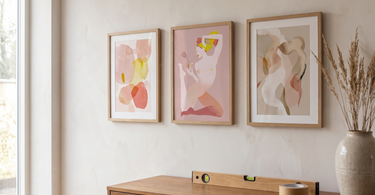
The height is the most common source of error when hanging posters, because most people aim for the top of the frame rather than its centre. A hand's width is the go-to rule of thumb — both above furniture and between several frames. Planning on the floor or with tape on the wall saves you unnecessary holes, and the wall type determines whether you need a plug, a special hook or just an ordinary nail.
Contents
A poster in a lovely frame can still look wrong if it hangs too high or too close to the neighbouring poster. Here are the technical rules for height, spacing and mounting, without the styling advice.
The height is what most often goes wrong
The most common mistake is hanging too high. This usually happens because people work from the top of the frame rather than its centre. The rule is simple: the centre of the picture should hit eye level for a standing person, not the top of the frame and not the bottom edge.
In practice, this means that large frames need to hang lower than you might think, because there's more frame above the centre point once it's hung correctly. Measure up from the floor to the intended eye level, and use that measurement to find the centre of the frame, not to find the nail hole.
Above a sofa, bed or chest of drawers
When a poster is to hang above a sofa, a bed or a chest of drawers, a different logic applies than on an open wall. Here, the aim isn't eye level, but making the picture and the piece of furniture read as one group. Keep a hand's width from the top of the furniture to the bottom edge of the frame.
If the picture hangs further away from the furniture, a gap appears, and the two elements start to live separate lives on the wall. A hand's width is close enough to create a connection, while still leaving enough air that the frame doesn't feel squeezed in above the furniture.
Spacing between several posters
If several posters are to hang together, the spacing between them matters more than whether they're perfectly symmetrical. Aim for a hand's width between the frames as a starting point. If the frames are small, the spacing can be reduced so the group doesn't visually fall apart.
- Even spacing between all frames in the group, regardless of their relative sizes
- Reduced spacing for small frames, so they don't get lost in empty space
- The same distance from top to bottom, if the frames vary in height
Once the eye has become used to a fixed spacing, that matters more for the overall impression than whether each individual frame sits millimetre-precise in relation to the others. Inspiration for whole set-ups can be found in the guide to creating a personal picture wall.
Plan the wall before you drill
Before you drill a single hole, it's worth laying out the whole set-up on the floor. Place the frames as they're meant to hang, and adjust spacing and order until it looks right. It's far easier to move things around on the floor than to move holes in the wall.
- Lay the frames out on the floor in the planned arrangement
- Tape paper sheets up in the size of the frames on the wall as a rough sketch
- Mark the nail hole with tape instead of drilling directly
- Move the tape until the placement is final, and only then drill
This method takes a bit of extra time, but it means you avoid test holes that need filling and painting over afterwards.
Hanging according to wall type
What holds a frame up depends entirely on which wall it's hanging on. Plasterboard needs plugs or special hooks designed for cavity walls, lightweight concrete needs plugs suited to the material, and solid masonry needs a drill and plug to stay secure. Wood panelling is the only one of the four where the screw can go straight in without any extra fixings.
- Plasterboard: plugs or special hooks for cavity walls
- Lightweight concrete: plugs suited to the material
- Solid masonry: drill and plug
- Wood panelling: screw straight in
Heavy frames with glass need more than a single nail or screw. Glass makes a frame significantly heavier than an equivalent frame in acrylic, and this should be reflected in how sturdy the fixing is.
If you're not allowed to drill
If you want to spare the wall entirely, there are several methods that don't require drilling. Adhesive strips work well for light frames, but have a limit to how much weight they can bear, and glass makes a frame heavier than you'd first think. A picture rail mounted on the ceiling, or set up as a single horizontal row on the wall, is an alternative that still gives a firm grip without permanent holes in the frame itself. A picture ledge, where the frames are simply leant against the wall, is the most flexible solution, as the arrangement can be changed at any time without a new hole.
See more wall decor and posters suited to these solutions under posters and wall decor.
Frequently asked questions
How high should a poster hang?
The centre of the picture should hit eye level for a standing person. The reference point is therefore the centre of the frame, not its top.
How much space should there be between two posters?
A hand's width is a good rule of thumb, and the gap can be reduced for smaller frames. What matters is that the spacing is consistent throughout the group.
How high above the sofa should the picture hang?
Keep a hand's width from the top of the sofa to the bottom of the frame, so the picture and furniture read as one cohesive group.
How do you hang posters without drilling?
Use adhesive strips for light frames, a picture rail mounted on the ceiling or in a horizontal row, or a picture ledge to stand the frames on.
How do you plan a picture wall before drilling?
Lay the frames on the floor in the desired arrangement, or tape up sheets of paper the size of the frames on the wall, and mark the nail hole with tape before you drill.
Summary
Height and spacing are the two factors that decide whether a poster display looks well thought-out, and both follow simple rules of thumb rather than fixed measurements. Eye level for the centre of the frame and a hand's width as a fixed unit, both above furniture and between frames, come up again and again as the guiding principles. The wall type determines which fixing is needed, and heavy frames with glass should be taken seriously regardless of the surface. If you want to spare the wall, there are solutions that don't require drilling, but they have their limits when it comes to weight. Planning on the floor or with tape on the wall is the easiest way to avoid regretted holes.
Read also
- Create a personal picture wall
- Wall decor: How to style your walls
- Macramé as wall decor
- How to hang a wall tapestry
- Furnish a small flat
Find something for the wall at Dims Studio — posters, wall decor and wall tapestries.