
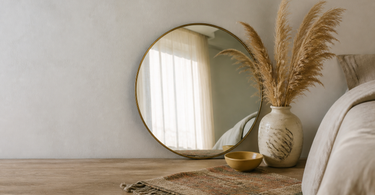
The right mirror depends on three factors: the room it's going to hang in, the size that suits the wall and furniture, and the frame that matches your style. Round mirrors are versatile and break up straight lines; large mirrors visually open up rooms; grouped mirrors work as a wall composition. A good rule of thumb is that a mirror above a chest of drawers should be 50-75% of the chest's width, centred at eye height 150-170 cm from the floor.
A mirror is one of the few things in the home that solves two tasks at once: it's functional and sets the tone of the room at the same time. The right mirror can make a narrow hallway feel twice as wide, reflect daylight into a dark corner and give a bare wall a purpose. But with so many shapes, sizes and frame materials to choose from, it's easy to end up with something that just hangs there. This guide helps you make the choice that actually suits your home.
Which shape suits your room?
A mirror's shape isn't just aesthetics — it interacts with the room's architecture. A room with lots of straight lines, square windows and sharp furniture edges takes on a new quality with a round or oval mirror, because the contrast softens the overall look. Conversely, a rectangular mirror in a room with curved details can create a sharp, modern tension.
Here are the most common shapes and their effect:
- Round: Soft, modern and incredibly versatile. Breaks up the straight lines in a room and gives a calm, harmonious feel. Works in the hallway, above the sink in the bathroom and as a statement piece in the living room.
- Oval: More classic than the round one. Oval mirrors are ideal above chests of drawers and in bathrooms with a traditional style — the vertical orientation visually extends the height of the room.
- Square and rectangular: The most functional choice, giving maximum mirror surface. Fits naturally in modern and minimalist rooms, where the geometry is already present in the furniture.
- Asymmetric and organic: Works as a sculpture on the wall. Mirrors with irregular, freestanding shapes are conversation starters in living rooms and hallways, and don't need anything else on the wall.
Tip: Before you buy, hold a piece of paper in the mirror's format up against the wall and see how the shape works in the room. It takes 30 seconds and saves you from a wrong purchase.
Round mirrors: the versatile choice
In recent years, round mirrors have dominated Scandinavian homes — and there's a good reason for that. The circular shape has no "direction", which makes it extremely flexible. A round mirror can hang above a chest of drawers, in a hallway, in a bathroom or as the sole element on a large, blank wall and always look intentional.
A large round mirror above the sofa works almost like a window — it reflects light and gives the room a depth it doesn't have on its own. The diameter matters: under 50 cm, the mirror disappears into the room, while 70-90 cm starts to take up space in the right way in average living rooms and hallways.
Choosing a frame for round mirrors
The frame defines the character. A thin brass edge gives a warm, sophisticated look that suits wooden floors and light walls. A wide black frame creates a more graphic, industrial look. Without a frame, you get the cleanest, most minimalist result — the glass itself appears to float on the wall, and this works particularly well in the bathroom, where you don't want competing elements.
Large mirrors as a styling trick
Few styling tricks are more effective than a large mirror. Placed against the wall in the bedroom, it works as a full-length mirror and visually opens up the room. In the hallway, it lets you check your whole outfit. In the living room, placed opposite a window, it reflects daylight into dark corners — an effect that's hard to achieve with artificial lighting alone.
Large mirrors don't necessarily need to be hung up. Many people choose to place them on the floor, leaning gently against the wall, for a more relaxed, gallery-like look. It also gives you flexibility if you don't want to make holes in the wall, or if you like to rearrange your furniture.
Proportions: how big should the mirror be above a chest of drawers?
A good rule of thumb is that the mirror should be between half and three-quarters of the width of the chest of drawers. A 60 cm mirror above a 120 cm chest of drawers looks proportionate. For the height, the centre of the mirror is typically placed 150-170 cm from the floor — this corresponds to the average eye height of a standing adult. If the chest of drawers is tall, a slightly smaller mirror can work; if it's low and wide, a larger mirror can compensate and create balance.
| Width of chest of drawers | Recommended mirror width | Mirror centre height from floor |
|---|---|---|
| 80 cm | 40-60 cm | 150-170 cm |
| 100 cm | 50-75 cm | 150-170 cm |
| 120 cm | 60-90 cm | 150-170 cm |
| 150 cm | 75-112 cm | 150-170 cm |
Mirrors in groups
One of the more underrated options is to combine several small mirrors in a wall composition. Grouped mirrors are a strong trend in Nordic interior design, because they allow for an arrangement that feels personal and alive rather than predictable.
Feel free to mix different shapes — a round, an oval and a square — within the same colour family on the frames, so the composition holds together visually. You can hang them close together in a cluster above a sofa or spread them along a hallway wall. Another option is to mix mirrors with wall decor such as posters and ceramic wall hangings for a gallery wall with depth and texture.
Tip: Lay the mirrors out on the floor in the desired composition before you start drilling. Take a photo from above and use it as a reference when hanging them up — it saves you a lot of unnecessary holes in the wall.
Room by room: what works where?
Every room has its own needs, and the right mirror in the wrong room won't solve any problems.
Hallway
Here, the mirror's function is primary — you check your appearance before heading out. Choose a full-length mirror or a medium-sized mirror with a shelf or hooks underneath for keys and sunglasses. In narrow hallways, a large mirror is one of the most effective ways to visually open up the space.
Bathroom
Functionality matters most here. A mirror with good lighting — either built-in or from a fixture placed above the mirror — is essential for a precise morning routine. Oval and round mirrors typically soften the otherwise harsh, clinical bathroom aesthetic and give the bathroom more character.
Living room
In the living room, it's all about reflecting light and creating a sense of space. Place the mirror opposite a window for maximum light effect — the mirror will catch and spread the daylight throughout the room. A decorative mirror with a characterful frame works as art and doesn't need any other company on the wall.
Bedroom
A large mirror standing on the floor or hung above the chest of drawers combines function and style. One thing you should avoid: placing the mirror directly opposite the bed. Many people find this unsettling — especially at night, when movement in the dark can disturb your sleep.
Frames and materials
The frame is the element that anchors the mirror in the room's overall style. Here are the most commonly used materials and what they offer:
- Brass: Warm, timeless and sophisticated. A brass finish complements wooden floors and light walls, giving a golden glow that doesn't age badly — in fact, it develops a lovely patina over time for an even more characterful look.
- Wood: Natural and warm. Light wood — oak, birch, ash — gives a Nordic look. Dark wood, such as walnut, feels more classic and dramatic.
- Black metal: Industrial and graphic. A black frame defines the mirror sharply against the wall and suits modern, minimalist rooms. It also works as a striking contrast to light, pastel-toned walls.
- Frameless: The cleanest look. Frameless mirrors almost disappear into the wall, creating a floating effect. Especially effective in the bathroom and in smaller rooms, where you don't want the frame to take up visual space.
Beyond the frame, you can complement the room with other decorative elements — for example candlesticks on the chest of drawers under the mirror, or vases with botanical branches that reflect in the mirror's surface and reinforce the composition.
Frequently asked questions
How do you safely hang a heavy mirror?
Use fittings and screws sized for the mirror's weight. Plasterboard walls require wall plugs; in brick and concrete, use rawl plugs and a concrete drill bit. For mirrors over 10 kg, two mounting points are recommended to distribute the weight evenly. Always check that the fitting is secure before you let go of the mirror — and use a spirit level to make sure it's hanging straight.
Can mirrors make a small room look bigger?
Yes — it's one of the oldest and most well-documented interior design tricks. A mirror placed opposite a window reflects daylight and creates an illusion of depth. In narrow hallways and small entrances, a large mirror can genuinely double the perceived size of the room. The effect is greatest when the mirror is large and positioned low enough to reflect the floor.
What's the best mirror for a dark living room?
Choose a large mirror with a light or brass-coloured frame and place it so it captures the room's primary light source — whether that's a window, a lamp or a spotlight. A round brass mirror is a classic solution, because the brass tone itself adds warmth to a dark room.
How high should you hang a mirror?
Centre the middle of the mirror at eye level, typically 150-170 cm from the floor. For decorative mirrors that aren't used functionally, you can hang them a little higher — but avoid placing them so high that they only reflect the ceiling. Above furniture such as chests of drawers and console tables, the bottom edge is typically placed 15-25 cm above the furniture's surface.
Can you hang a mirror above the sink in the bathroom?
Yes, and it's actually the most functional placement. Choose a mirror that's at least as wide as the sink — ideally a little wider. Oval and round mirrors are popular here, because they break up the rectangular geometry that bathrooms typically have. Check that the mounting is approved for humid rooms.
What does a good mirror cost?
Prices vary a lot depending on size, frame and manufacturer. Small decorative mirrors start from a couple of hundred kroner. A quality mirror in a good size (70-90 cm) with a brass edge or wooden frame typically costs from 500-2000 DKK. Large floor mirrors can cost considerably more depending on materials and finish.
Summary
A mirror is an investment that serves two purposes at once. Start by clarifying what you primarily need: full function (full-length mirror, bathroom), light optimisation (large mirror opposite a window) or decoration (organic shape, wall composition). Then choose a shape based on the room's existing geometry — round and oval mirrors soften sharp-edged rooms, rectangular mirrors maximise the reflective surface and suit modern interiors. The frame — brass, wood, black metal or none — is your stylistic choice and should match the room's other materials. Proportions are crucial: a mirror that's too small disappears, one that's too big dominates. Use the rules of thumb as a starting point, and remember to test the composition on the floor before you drill.
Explore our range of mirrors for every room and style — from round and oval to large floor mirrors.