
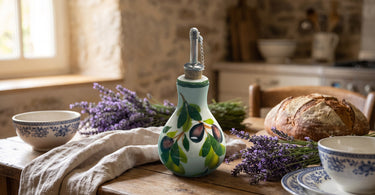
French country style takes its expression from rural France and Provence, where patina, patterned textiles and everyday ceramics set the tone. You don't need new furniture to bring the style into your home, because it's the accessories such as jugs, butter keepers and dried herbs that make the difference.
Dims Studio's own figures: Among the items sold in the jugs category, 64% were wholly or partly stoneware (more than 300 items sold, from November 2025 to October 2026). Butter keepers followed the same pattern, with 50% being stoneware (more than 80 items sold in the same period).
Contents
- What exactly is French country style?
- The roots: from provincial furniture to Provence
- Characteristics of French country style
- Textiles: boutis and toile de Jouy
- Ceramics and kitchen table: faience, butter keepers and jugs
- Herbs and flowers from the Provençal landscape
- How to do it, step by step, without buying new furniture
- Frequently asked questions
- Summary
Many people dream of a home with warmth and history, without needing a complete new set of furniture. French country style is exactly the style where wear and age become a quality, and where everyday things, like a jug on the table or a pot with dried herbs, tell the story.
In this guide, you'll learn the roots of the style, its characteristics and concrete suggestions for how to create it with ceramics, textiles and patina, without touching the furniture.
What exactly is French country style?
French country style is a decorating style that takes its expression from rural France, particularly the Provence region in south-eastern France between the river Rhône, the Mediterranean and the Alps. The style builds on a craft tradition that remained unbroken until the railways arrived, and which therefore preserved simple, rural forms long after Paris had moved on to new fashions.
What you see when something is in French country style is rarely new and perfect. It's patina on ceramics and pots, patterns with rural motifs on textiles, and kitchen utensils like the butter keeper, which is still used today both as decoration and function.
The roots: from provincial furniture to Provence
French furniture craftsmanship covers both the refined furniture made for the king and court in Paris, and the simpler provincial furniture from the towns of the provinces. Alongside these existed a conservative, craft-based rural tradition for French country furniture that remained unbroken right up until the arrival of the railways. Provincial furniture followed the new designs from Paris, but often with a delay of decades, so the rural forms lived on long after the capital had moved on.
This delay is part of the explanation for why French country style feels timeless. Provence, where much of the inspiration comes from, was in the early 17th century predominantly rural with wheat, wine and olives, and small industries such as tanning, pottery and perfume emerged in the towns. Later, towards the end of the 18th century, textile craftsmanship flourished in towns like Orange, Avignon and Tarascon, while faience found its home in Marseille, Apt, Aubagne and Moustiers-Sainte-Marie. It's this blend of agriculture, craftsmanship and light that still defines Provence, and thereby French country style.
Characteristics of French country style
French country style is recognised by a number of recurring features in furniture and carvings. Since the shop doesn't sell furniture, the point here is to show how you can bring the same characteristics into your home through accessories instead.
| Characteristics | How to achieve it with accessories |
|---|---|
| Curved cabriole legs | Choose soft, rounded shapes in ceramics rather than sharp edges, for example rounded jugs and vases |
| Simple, wavy carvings | Look for pots and jugs with a light texture or wavy surface in the glaze |
| Carved wheat motifs | Leave dried ears of corn or herbs standing as a bouquet, playing the same rustic role |
| Ladder-back chairs with a woven rush seat | As furniture isn't part of the range, you can bring out the same handcrafted expression through ceramics with a rough, handmade finish |
| Aged patina in the carvings | Deliberately choose ceramics and pots where the glaze has a lively, slightly uneven surface |
Tip: Want to know more about why patina occurs, and when you should preserve it rather than polish it away? Read What is patina? How it occurs, and the choice to preserve it.
Textiles: boutis and toile de Jouy
Two textile traditions carry a large part of the French country style's expression, even though the shop doesn't sell fabric. It's good to know them when you're putting together colours and patterns in your home yourself, for example on cushions or table napkins you find yourself.
Boutis is a Provençal word for stuffing and denotes a particular form of quilting, where two layers of fabric are sewn together with padding between parts of the pattern, so the motif stands raised on the surface. The motifs can be oak leaves, flowers, fruits and berries, animals or cornucopias. Boutis quilts were made from the middle of the 17th century and were exported to England, Spain, Italy, Germany and the Netherlands, which says something about how widespread and valued the craft was.
Toile de Jouy has a different expression. The name means fabric from Jouy, after the town of Jouy-en-Josas southwest of Paris, and the pattern is characterised by a white or off-white background with a repeated, usually rustic scene, for example a couple picnicking by a lake or a flower arrangement, printed in one colour, most often black, dark red or blue. It's mostly used for curtains and upholstery fabric, but also on wallpaper, teapots and bedding, and the term originated in France at the end of the 18th century.
If you're drawn to a more subdued and worn expression, it's worth knowing that linen inspired by old French linen fabrics is especially popular in the related style shabby chic, where French country style is mentioned as a variant.
Ceramics and kitchen table: faience, butter keepers and jugs
The kitchen table is a good place to start if you want to feel the French country style in everyday life. Here, everyday ceramics play the leading role, rather than fine porcelain, which only comes out on special occasions.
Faience is among the most important types of ceramics in the style and has its roots in towns such as Marseille, Apt, Aubagne and Moustiers-Sainte-Marie, where the craft flourished at the end of the 18th century. Want to know what sets faience apart from stoneware and porcelain, you can read more in the article What is faience? The difference between faience, stoneware and porcelain.
Another icon from the French kitchen is the butter keeper, a cylindrical pot in two parts, where the butter sits in the lid, which is turned upside down and lowered into water in the base, so the butter stays soft and fresh without a fridge. The French-designed version dates from the end of the 19th century. In the shop you'll find, among other things, a cow butter keeper in stoneware from Quail and a bird butter keeper in stoneware from Quail, both with motifs from farmyard wildlife. Read more about the tradition in Butter crocks: A forgotten tradition revived.
On the table itself, jugs and milk jugs with motifs of animals from the countryside belong naturally. A cow jug in stoneware from Quail or a mouse jug in stoneware from Quail can be used for both milk and as a small vase, giving the table the same rustic touch found in French country kitchens. See the full range of jugs and milk jugs, or go straight to butter keepers and ceramic pots, if you want to build on your collection.
Put together your own French country-style kitchen table with jugs, butter keepers and pots from the shop.
See butter keepersHerbs and flowers from the Provençal landscape
Provence is known for its food, wine and perfume, its beautiful and wild nature and its special light, which has attracted many artists through the ages. A large part of the scent and character comes from the garrigue, the typical Provençal landscape with aromatic shrubs such as lavender, sage, rosemary and wild thyme.
In a home with French country style, you can bring in the same atmosphere by gathering dried bunches of these herbs in a jug or vase. It doesn't take a garden full of lavender, just a few stems that you tie together and leave to dry, or buy ready-dried. If you want to dry your own herbs and flowers, you can follow the method in How to dry flowers yourself, and get inspiration for arranging them in Dried flowers in a vase: how to style them.
A single flower vase with a bundle of dried thyme or rosemary on the kitchen table or windowsill is enough to bring the rustic, fragrant atmosphere of the garrigue into the room.
How to do it, step by step, without buying new furniture
You don't need to replace a single piece of furniture to bring French country style into your home. Here's a simple order you can follow:
- Start at the kitchen table. Swap fine porcelain for everyday ceramics, for example a jug or a butter keeper that can stand out all day.
- Let patina and wear be a quality rather than a flaw. Deliberately choose ceramics where the glaze has a lively surface, instead of looking for the completely uniform and new.
- Choose textiles with patterns. Think of the rustic scenes from toile de Jouy or the raised motifs from boutis when choosing cushions, tablecloths or other fabric you already own or come across.
- Collect everyday ceramics. Let jugs, milk jugs and pots stand out so they become part of the room instead of being hidden away in a cupboard.
- Add dried herbs. A bunch of lavender, rosemary or thyme in a vase or jug instantly adds that final, rustic touch.
Frequently asked questions
What is French country style?
French country style is an interior design style rooted in rural France and Provence, where patina, patterned textiles and everyday ceramics take centre stage.
What characterises French country style interiors?
The style is recognised, among other things, by curved cabriole legs, simple wavy carvings, wheat motifs and ladder-back chairs with woven rush seats, as well as an aged patina in the carvings.
How do you decorate in French country style without new furniture?
You can bring in the characteristics through accessories: choose ceramics with patina, jugs and pots with rustic animal motifs, patterned textiles and dried herbs such as lavender and rosemary, without replacing a single piece of furniture.
What is toile de Jouy?
Toile de Jouy is a pattern named after the town of Jouy-en-Josas, with a white or off-white background and a repeated, usually rustic scene printed in one colour, most often black, dark red or blue.
What is boutis?
Boutis is Provençal quilting, where two layers of fabric are sewn together with padding between parts of the pattern, so that motifs such as oak leaves, flowers, fruits or animals become raised on the surface.
What is the difference between French country style and shabby chic?
French country style is mentioned as a variant of shabby chic, but places more emphasis on rustic motifs from Provence, while shabby chic is more broadly about furniture and items that look old and worn, often with linen inspired by old French linen fabrics.
Summary
French country style is about letting rural France and Provence set the tone through patina, patterned textiles and everyday ceramics. You'll find the style's hallmarks in everyday things: a jug with a farm animal on it, a butter keeper on the table, faience in the cupboard and a bunch of dried herbs in the vase, and you can easily create the look without touching the furniture.
Read also
- What is faience? The difference between faience, stoneware and porcelain
- Butter crocks: A forgotten tradition revived
- What is patina? How it occurs, and the choice to preserve it
- How to dry flowers yourself
- Dried flowers in a vase: how to style them
- Kitsch: what is it, and how do you use it?
- Memphis design: colours, shapes and how to use it
- Pop art in interior design: how to use the style
Find your accessories for French country style
The whole range has been hand-picked by Dinna, so you can easily put together jugs, butter keepers and jars that suit the style.
Shop ceramic jars