
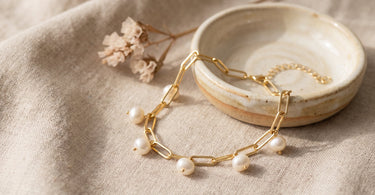
The short answer is that you measure your wrist with a piece of string or a tape measure just above the wrist bone and then add a little extra so the bracelet sits comfortably. How much you add depends on whether you want it snug or loose, and whether the bracelet is wide or thin.
Contents
A bracelet that fits properly should neither slide down over your hand nor feel tight when you bend your wrist. Because sizing varies from maker to maker, it's a good idea to know your own wrist measurement before choosing a new bracelet or giving one as a gift. Here's a simple method you can use at home in just a few minutes.
The short answer: measure and add extra
The key to finding the right size is quite simple: you find the wrist's circumference and add a small allowance so the bracelet has room to move with the wrist. It's about balance. Too little allowance, and the bracelet sits too tight. Too much, and it spins around or slides down over the hand. With a simple measurement at home, you can find the length that suits you, or the person you're giving a gift to, best.
How to measure your wrist
Take a piece of string, a thin strip of paper or a tape measure, and wrap it around the wrist just above the wrist bone, that is, where the bracelet will naturally rest. Pull it gently so it lies snug without tightening, and feel or mark where the ends meet.
Then place the string against a ruler or tape measure, and read off the length in centimetres. That figure is your starting point when choosing the bracelet's total length.
Add extra so it fits
Once you've found the wrist's circumference, you need to decide how the bracelet should sit:
- Snug fit: add a smaller allowance than usual, so the bracelet follows the wrist closely with little movement.
- Normal fit: add around 1 to 2 cm to the measurement, so the bracelet hangs slightly and moves naturally.
- Loose fit: add a bit more if you prefer the bracelet to be able to slide a little on the wrist.
As sizing varies between makers, it's always a good idea to check the specific bracelet's length before ordering.
Tip: Sizing varies between makers, so always check the specific bracelet's length in the product description before ordering.
Width, clasp and shape
Not all bracelets behave the same, even at the same length. Wide, stiff bracelets need more room than thin chains, because they don't bend as easily around the wrist. If you have a wide or rigid bracelet, it can therefore be worth adding a bit extra compared with a thin chain of the same length.
The clasp matters too. An adjustable clasp, often in the form of a small extender chain, makes it easy to fine-tune the length as needed, while a fixed ring or clasp requires you to get the measurement right from the start. You'll find a selection of bracelets in various widths and clasps in Bracelets.
Find bracelets in various widths and clasps, so you can choose the model that best suits your wrist.
See braceletsAs a gift
If the bracelet is a gift and you don't know the recipient's exact wrist size, an adjustable bracelet with an extender chain is the easiest solution. It allows for fine-tuning the length once the gift has been unwrapped, without needing an exchange.
Another method is to borrow a bracelet the recipient already has and wears often, and measure it while it lies flat. This gives you an accurate picture of the length that usually fits. In the shop, Fidindajo bracelet from Goio Galore and Atentigi bracelet from Goio Galore are examples of pieces that work well as gifts, and all items in the shop are handpicked by Dinna. If you'd like more ideas on how to choose and wrap jewellery as a gift, you can read more in Jewellery as a gift: The safe guide.
Frequently asked questions
How do you measure your wrist for a bracelet?
Wrap a piece of string or a tape measure around your wrist just above the wrist bone, pull it gently, and read off the length in centimetres. That figure is your starting point for choosing the bracelet's length.
How long should a bracelet be?
Start with the circumference of your wrist, and add roughly 1 to 2 cm for a normal fit. If you want the bracelet tighter, add less; if you want it looser, add more.
What do you do if the bracelet is too big?
Check whether the bracelet has an adjustable clasp or extension chain, so you can tighten it to the right length. If it has a fixed clasp, it's a good idea to measure again so you know the right size next time.
Can you give a bracelet as a gift without knowing the size?
Yes, an adjustable bracelet with an extension chain is the easiest solution when you don't know the recipient's exact measurements. Alternatively, you can borrow and measure a bracelet the recipient already wears.
How do you close a bracelet with a clasp yourself?
Hold the bracelet around your wrist with one hand, and bring the clasp together with the other until it clicks into place. If the clasp is hard to reach, it can help to lay the bracelet on a table and fasten it before putting it around your wrist.
Summary
Finding the right bracelet size is about measuring your wrist just above the wrist bone and adding a suitable allowance, depending on whether you want a tight, normal or loose fit. Width and clasp matter too, and as a gift, an adjustable bracelet is always a safe way to get it right.
Read also
- Jewellery as a gift: The safe guide
- Gifts for her: Inspiration list for all occasions
- Gift wrap and packaging: Complete the gift
Ready to find your bracelet?
Measure your wrist, add a little extra, and explore the range. You can also browse more jewellery if you want to match the bracelet with the rest of the collection.
See bracelets