
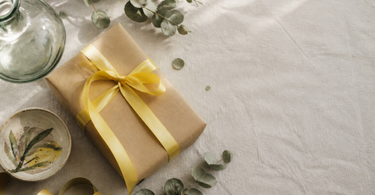
Good wrapping lifts a gift from "something you bought" to "something you thought about". You can use the gift itself as packaging — tuck a small item inside a vase or bowl, and the recipient gets two gifts in one. Add an ornament or a candle as an extra detail, and if you're unsure what to choose, a gift card is always a solution that works.
Dims Studio's own figures: In the period November 2025 to October 2026, half of the sold jugs cost under 160 DKK (more than 700 items sold), and half of the sold ornaments cost under 155 DKK (more than 600 items sold).
Wrapping isn't about bows and shiny paper for the sake of it. It's about the recipient being able to sense, the moment they see the parcel, that thought has gone into it. Thoughtful wrapping extends the gift moment itself — from the moment it arrives to the moment it's opened. Here you'll find concrete ways to make your wrapping better, without it necessarily costing much time or money.
Use the gift as packaging
The easiest way to save on wrapping materials while adding extra value is to let the gift itself act as the container. The principle is simple: a vase, bowl or jug can hold a smaller gift, so the recipient actually gets two things out of one parcel.
Vases as gift containers
A small vase typically has enough of an opening to hide jewellery, a small candle or a soap inside. If you choose a ceramic vase with a characterful shape, for example a figure or an animal, the vase shape itself becomes part of the gift, and the small extra content is just a bonus. Simply wrapping fabric or paper around the vase instantly looks more thoughtful than a plastic bag.
Bowls and dishes
A small dish or bowl is perfect for presenting, for example, a pack of speciality coffee, a pair of earrings or chocolate. Place the contents in the bowl, wrap it in a piece of fabric or paper, and tie a ribbon around it. It looks well thought out and gives the recipient something useful to use the bowl for afterwards.
Jugs
A ceramic or glass jug with a lid is particularly suited to loose gifts such as sweets, spices, personal care products or candles. Jugs from, for example, European ceramic producers come in sizes from 5 cm and upwards, so there are options for almost anything.
Tip: Put a note inside or under the wrapped vase with a short note about what the bowl or vase can be used for — this helps the recipient appreciate the "container" as a gift in its own right, not just as packaging.
Gift boxes and bags
Even the most everyday gift is lifted by a proper box. It's psychology more than aesthetics: a closed, sturdy box creates anticipation in a way that a transparent bag doesn't. If you're buying something for someone who lives far away, or you're sending the gift by post, a sturdy box is also practical protection.
What makes a good gift box?
- The right size — the contents shouldn't "swim around" inside
- A neutral or simple colour that doesn't steal attention from the gift itself
- A layer of tissue paper or a fabric napkin inside, so the gift doesn't rattle
- A simple ribbon or a piece of string on the outside is enough — it doesn't need to be complicated
Many web shops offer gift wrapping as an add-on at checkout. It's a good investment, especially if the gift is being sent directly to the recipient — then it arrives ready to be handed over.
Recycled wrapping
Fabric, newspapers or used gift paper are all real alternatives to new paper. The Japanese furoshiki technique — wrapping fabric around a gift instead of paper — gives a durable, attractive wrapping, and the fabric becomes part of the gift. A small tea towel, a scarf or a piece of close-knit fabric all work fine.
Personal details that make the difference
It's rarely the paper itself that's remembered. It's the details that show someone's spent five extra minutes thinking about it. It could be a little extra thing tied into the ribbon, a handwritten card, or wrapping that matches something the recipient's interested in.
An ornament in the ribbon
Tie a small ornament into the ribbon around the parcel — a little figure, a star or an animal in ceramic. It works as decoration on the parcel, and the recipient can use it afterwards. It gives the wrapping an extra layer without requiring any special skills.
A candle alongside it
If you place a candle alongside the actual gift, it's a signal that you want to set the mood, not just give a thing. The combination of a main gift and a candle as an "accessory" is low-effort yet personal.
Handwritten cards
A handwritten card weighs next to nothing, but it weighs more than anything else in the eyes of the recipient. Avoid generic phrases, write one specific thing you appreciate about the person. It takes under two minutes and lifts the whole parcel.
| Wrapping idea | Time spent | Extra cost | Effect |
|---|---|---|---|
| Gift in a vase/bowl | 5 min | 0 DKK (the gift is the packaging) | Two gifts in one |
| Ornament in the ribbon | 2 min | 20–60 DKK | Personal and reusable |
| Candle as a side gift | 1 min | 50–120 DKK | Sets the mood |
| Furoshiki fabric wrapping | 10 min | 0–80 DKK | Sustainable + gift ribbon |
| Handwritten card | 2 min | 5–10 DKK | Remembered the longest |
Gift cards as a safe solution
Some people will always rather choose for themselves — and it's not a lack of imagination on your part, it's a reality on theirs. A bed in size 140 might be 120 at the recipient's home. A vase in the "right colour" is a colour you don't know. This is where a gift card solves the problem completely.
A gift card isn't an easy way out — it's a respect for the recipient's taste. It says: "I know you have an opinion about things, so choose for yourself." It works particularly well for home decor, where personal style, existing colour palette and specific measurements come into play.
Practical considerations
- Choose an amount that matches what you'd normally give — 200–500 DKK is a realistic range for a smaller gift, 500–1000 DKK for a big occasion
- Combine the gift card with a small physical item (such as a candle), so there's still something to unwrap
- Write on the card what you hope they'll choose — "Thought of a new candlestick for your living room" — it gives more direction than a blank gift card
If you're looking for inspiration on what would suit them, you can find a curated selection of selected gifts — it's a good way to arrive at specific ideas before you decide on a gift card or a specific item.
Tip: The gift card doesn't have to look boring. Print it, put it in a small frame or fold it into a good-quality envelope. Presentation counts, even when the content is digital.
Frequently asked questions
Can I use a vase as a gift container for all types of gifts?
Not for everything, but for many things. Jewellery, candles, soaps, chocolate, a small plant or seeds work well. The gift needs to be able to lie or stand in the vase without damaging it. If the gift is too big, a bowl or jar might be a better choice.
What's the difference between giving a gift card and just leaving it up to the recipient?
A gift card signals that you've thought about it — you've chosen a specific webshop or shop that matches the recipient's taste, and set an amount. It's far more personal than saying "buy something yourself". Feel free to combine it with a small handwritten note about what you hope they'll choose.
What is furoshiki wrapping?
Furoshiki is a Japanese technique where a square piece of fabric is wrapped around a gift instead of paper. The method is sustainable, flexible and results in elegant wrapping. The fabric becomes part of the gift and can be used as a tea towel, scarf or tote bag afterwards.
When is an ornament in the ribbon a good idea?
When you're giving something to a person who appreciates details, or when the parcel itself looks a bit dull. A small ceramic or metal ornament adds a layer without requiring extra wrapping skills. Choose an ornament that suits the recipient's style — not necessarily your own.
Is there a rule of thumb for when gift wrapping is "enough"?
The wrapping is enough when it signals thoughtfulness without overpowering the gift. A clean, neatly finished parcel with one personal touch — a handwritten card, an ornament or an extra little item — is almost always better than wrapping for wrapping's sake.
What makes a good side gift for a candlestick?
A candle in a matching size is the obvious choice — a candlestick without a candle is hard to use straight away. You can also add a small ornament, a vase for flowers or a decorative dish to place the candlestick on, so it becomes a little style group rather than just one object.
Summary
Good gift wrapping isn't about buying expensive gift paper or spending an hour on bows. It's about showing that you've put thought into it. The most effective methods are those that give double value: a vase or bowl as a container, an ornament that can be reused, a candle that can be lit straight away. And if you're in doubt about what the recipient will appreciate, a gift card with a handwritten note about the intention is always a solution that respects their taste. The wrapping is the first signal, make it clear.
Read also
Explore our range of selected gifts for every occasion.