
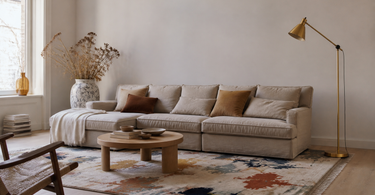
The rug size for the living room depends on the room's dimensions and your furniture layout. As a rule of thumb, the rug should be at least 160×230 cm in a standard living room with a 2-3 seater sofa and coffee table. If you want the entire seating group on the rug, you'll need to go up to 200×300 cm or larger. Always mark out the size with painter's tape on the floor before ordering — it takes five minutes and removes all doubt.
A rug can do more for a living room than almost any other single item — it pulls the furniture together, dampens sound and marks out a zone in the room. But only if the size is right. Too small, and it looks like the rug has shrunk towards the wall. Too large, and there's no breathing room left. Here is a practical guide to finding the right size, whether you have a small apartment living room or a large open space.
Why size matters
The size of a rug is not just a question of aesthetics — it's about how the room works visually and physically. A rug with the right proportions creates a natural cohesion between the sofa, coffee table and other seating. It gives the eye an anchor and defines the "living zone", especially in open-plan layouts where the kitchen and living area flow into each other.
What happens with the wrong size?
- Too small: The furniture appears to "float" loosely around, and the room can look cluttered. A rug of e.g. 120×170 cm under a large sofa emphasises the imbalance rather than resolving it.
- Too large: The rug dominates and leaves insufficient free floor space along the walls. As a rule of thumb, there should be at least 30-45 cm of bare floor from the rug edge to the wall.
- Right size: Creates a logical zone where the furniture hangs together visually and the room feels balanced.
Choosing rugs for the living room is therefore not just about pattern and colour — the proportions are the foundation you build the rest of the décor on.
Typical rug sizes for the living room
The market for living room rugs is in practice structured around four standard sizes. Here is what they are suited for:
| Rug size | Suitable for | Typical scenario |
|---|---|---|
| 140×200 cm | Smaller living rooms | Only the coffee table on the rug — the sofa stands behind on bare floor |
| 160×230 cm | Standard living rooms | Front legs of a 2-3 seater sofa + coffee table on the rug |
| 200×300 cm | Large living rooms | The entire seating group incl. chaise longue or 3+2 arrangement can stand on the rug |
| 250×350 cm | Very large rooms / open plans | Multi-seat sofa group + dining group sharing a zone |
Note that these measurements are guidelines — manufacturers vary, and you may also encounter 170×240 cm or 240×340 cm. What matters is not the exact measurement but the principle: the rug should have a clear purpose in the room.
Our selection of colourful rugs comes in several of these standard sizes, and at Doing Goods you'll also find more unique formats in handmade materials.
Three ways to position the rug
Size and placement are two sides of the same coin. The rug's dimensions alone are not enough — you also need to decide how the furniture relates to it. There are three classic principles:
1. Only the coffee table on the rug
Here the rug covers only the area the coffee table and possibly a pouffe or stool occupies. The sofa and other furniture stand on bare floor. This works well in smaller rooms (under approx. 15 m²), but requires the rug to be large enough not to look lost — typically a minimum of 140×200 cm. This choice gives the room breathing space and highlights the floor material.
2. Front sofa legs on the rug
The most common solution. The front legs of the sofa rest on the rug while the back legs stand on the floor. This method visually ties the furniture together without requiring a huge rug. A 160×230 cm typically covers a standard 3-seater sofa with a coffee table in front. Remember that the rug must be wide enough so that both ends of the sofa are covered — at least 15-20 cm should extend on each side.
3. The entire seating group on the rug
All furniture — sofa, armchairs, coffee table — stands fully on the rug. This gives a spacious and cohesive feel reminiscent of a genuine "room within a room". Normally requires 200×300 cm or more. Perfect for large open living rooms where you want to clearly define the seating zone.
Tip: Use painter's tape to mark out the rug's outer edges on the floor before ordering. It takes five minutes and is far more accurate than trying to imagine the sizes in your head. Try all three placement principles with the tape so you know which suits your room best.
How to measure correctly
Before you start looking at rugs, you need three measurements:
- The room's total dimensions (length × width) — to ensure there is a clear zone along the walls.
- The seating group's footprint — measure the total width from the outermost point to the outermost point including corner pieces or chaise longue.
- The distance from sofa to coffee table — typically 35-50 cm to move comfortably.
With these measurements you can calculate which placement method is realistic and which rug size to look for. A good starting point: the rug's width should at least match the sofa's width, preferably with 20-30 cm extra on each side.
When looking at floor rugs, it's also worth checking whether the manufacturer gives net measurements or production measurements — there can be a 3-5 cm difference between what's on paper and reality for hand-woven rugs.
What about irregular rooms?
L-shaped living rooms, rooms with bay windows or open plans require a little more creativity. It pays to sketch the room on graph paper in scale and draw the seating group in, before deciding on the rug's placement and size. In open-plan layouts the rug is often the only element that defines where "the living room" ends and "the hallway" begins.
Size, shape and style
Rectangular rugs are the most commonly used format for living rooms because they mirror the right angles of sofa corners. But round and oval rugs can work surprisingly well — especially under a round coffee table or in a room that is otherwise very "square" in expression.
Round rugs
A round rug of ø150-200 cm can be placed under the coffee table alone and acts as a graphic element. However, it places greater demands on the room's symmetry — if the furniture arrangement is skewed or asymmetrical, a round rug can look out of place.
Pattern and size
A large, dominant pattern on a small rug looks cut off and unfinished. Large geometric patterns and bold colours generally require a larger format for the pattern to "unfold". A tiger or animal-print rug at 160×230 cm has room to show the full motif, while the same motif at 140×200 cm might only show half the tiger stripes.
Neutral, single-coloured or finely textured rugs are more flexible and can easily be used in a smaller format. See e.g. animal-inspired rugs for patterns that need space to breathe.
The most common mistakes
Even experienced interior decorators make these mistakes — it's worth knowing them in advance:
- Buying too small: The most frequent mistake. A 140×200 cm rug in a large living room with a 3-seater sofa always looks too small.
- Not measuring first: Many people judge sizes by eye and end up with something that doesn't fit. Use a tape measure and painter's tape.
- Forgetting the clear zone along the walls: There should always be at least 30-45 cm of bare floor from the rug edge to the wall — otherwise the rug "strangles" the room.
- Miscalculating the furniture's footprint: An L-shaped sofa takes up significantly more space than a standard 3-seater. Measure your specific sofa, not a generic model.
- Ignoring the rug's orientation: Most rectangular rugs look best when the long side runs parallel to the sofa's front line. If you rotate a 160×230 cm rug 90 degrees, you end up with a rug that is too narrow for the sofa.
Frequently asked questions
What is the most common rug size for a standard living room?
160×230 cm is the most frequently chosen size and suits most living rooms with a 2-3 seater sofa and a coffee table. It provides space for the front sofa legs and the coffee table to stand on the rug without feeling overwhelming in the room.
Can a round rug be used in the living room?
Yes, a round rug can work well in a living room — typically under the coffee table alone, ideally in the size ø150-200 cm. It requires the furniture arrangement to be relatively symmetrical, otherwise it can look out of place. Round is an obvious choice if you also have a round coffee table.
How much free floor space should there be along the walls?
As a rule of thumb, there should be 30-45 cm of bare floor from the rug edge to the wall. This gives the room breathing space and makes the rug look deliberately placed rather than "filling everything". In very large rooms the clear zone can be up to 60-70 cm.
Should I choose a rug that is as wide as the sofa?
Ideally wider. The rug should ideally be at least as wide as the sofa — preferably 20-30 cm wider on both sides. A rug that is narrower than the sofa creates a visual imbalance where the sofa appears to "hang over the edge".
What do I do if my room has an irregular shape?
Sketch the room on graph paper in scale and draw the seating group in. This gives a far more accurate picture than eyeballing it. Then use painter's tape on the floor to mark out the rug's potential placement before making a decision.
Can I use a small rug in a large living room?
Yes, but only if it's intentional. A small rug in a large living room works best as an accent element — e.g. a round rug under a single armchair in the corner. If you try to use a small rug as the room's primary rug in a large living room, it will almost always look insufficient.
Summary
Choosing a rug size for the living room comes down to three things: the room's dimensions, the seating group's footprint and your preferred placement method. Use painter's tape to mark out the size on the floor before ordering — it's the safest method. As a starting point, 160×230 cm is right for most living rooms with a 2-3 seater sofa. If you have a larger seating group or an open space, you should go up to 200×300 cm. Always remember to leave 30-45 cm of free floor space along the walls, and make sure the rug is at least as wide as the sofa — preferably wider. With these rules of thumb in place, the choice becomes much easier.
Explore our selection of rugs for the living room — from hand-woven varieties to colourful patterns in all standard sizes.