
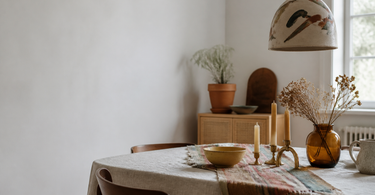
A dining table lamp should hang 60–75 cm above the tabletop and have a diameter or length equal to half to two-thirds of the table's measurements. For round tables, round or oval lamps work best in the 40–60 cm size range. For elongated tables, you can choose one long pendant or several smaller lamps in a row. A dimmable function offers flexibility from everyday lighting to a cosy atmosphere — and the choice of material largely determines the lamp's character in the room.
A lamp above the dining table isn't just practical lighting — it's the anchor point of the room. It defines where you gather, and it sets the tone for everything from everyday meals to dinner parties. But precisely because it's so dominant, it's also a choice that requires a bit of thought. Size, height, material and light source all affect the final result. Here's a concrete rundown of the parameters that actually matter.
The light's function and atmosphere
The dining table is used for many things: breakfast, homework, dinner parties, board games. This places different demands on the light — which is why it's worth considering the light's direction and character before you decide.
Direct versus diffuse light
A direct, downward-facing light concentrates on the tabletop and highlights the food. It works well for everyday use, but can feel sharp and harsh during longer stays. A diffuse light — for example from a fabric shade or frosted glass — spreads the light more softly and creates a more inviting atmosphere. The downside is that diffuse light typically requires supplementary lighting in the rest of the room to avoid the corners becoming too dark.
Dimmability offers flexibility
If you only choose one feature for your dining table lamp, it should be dimmability. With a dimmer, you can run full brightness while doing homework and dim down to 20–30% during dinner. Remember to check whether the lamp is compatible with your dimmer type — LED bulbs usually require an LED-suitable dimmer to work without flickering.
Tip: Warm white (2700–3000 K) makes food look more appetising and the atmosphere more relaxed than cool white (4000+ K), which is better suited to offices and task lighting.
Size and proportions
Proportions are the most often overlooked parameter — and the most common reason a lamp doesn't work in the room, even though it's lovely in itself. A lamp that's too small above a large table looks lost. One that's too big overwhelms the table.
Rule of thumb for size
For elongated lamps, the lamp's length should equal half to two-thirds of the table's length. If you have a table that's 200 cm, you're looking for something in the range of 100–135 cm — or two to three individual lamps in a row with the same combined span. For round lamps above round tables, the rule is that the diameter should be 30–50 cm smaller than the table's width.
| Table type | Recommended lamp shape | Typical size |
|---|---|---|
| Round table | Round or oval pendant | Diameter 40–60 cm |
| Elongated table (up to 160 cm) | One elongated pendant | Approx. 80–100 cm in length |
| Long table (160–240 cm) | Long pendant or 2–3 pendants in a row | Total approx. 100–160 cm |
| Square table | Round or square pendant | Diameter/side 40–55 cm |
Using pendants and ceiling lamps in a cluster rather than one large one gives you more freedom to scale to the table — and it's easier to adjust if you change tables at some point.
Height and placement
The height is crucial for both light effect and comfort. If the lamp hangs too high, the light spreads out and loses focus. If it hangs too low, it dazzles those sitting down.
Standard hanging height
Hang the lamp's underside 60–75 cm above the tabletop. This gives a focused light down towards the table without creating glare at eye level when you're sitting down. Eye level in a seated position is typically 110–120 cm above the floor, so the lamp's underside should sit lower than this to avoid being in direct line of sight.
High ceilings require a different approach
If you have ceiling heights over 3 metres, a lamp hung at standard height above the table will visually "float" detached from the rest of the room. Here, it's a good idea to lower the lamp further or choose a model with visual weight — for example, a shade with volume or a material like rattan or metal — that draws the eye down towards the table. A long, visible cord or chain can, in this context, work as an aesthetic feature rather than a weakness.
Tip: Measure the distance from floor to ceiling and subtract the table's height (typically 74–76 cm). The remaining distance is divided into approx. 65–70 cm for the lamp's underside and the rest as visible hanging distance. This way, you know exactly how long a cord or pendant you need.
Materials and design
The material determines the lamp's character in the room — and, to a great extent, how the light behaves. Here are the most common choices with their respective properties.
Metal
Metal is robust and gives a distinct expression — either industrial with black powder-coated steel or more elegant with brass and copper. Brass develops a patina over time, which many see as a quality rather than a flaw. A metal shade reflects light hard and sharply, so it's primarily a choice when you want a focused, downward-facing light.
Glass and acrylic
Clear glass gives a light, airy expression and lets the light pass through unhindered. Frosted or coloured glass diffuses the light and adds colour to the room. Lamps with glass shades work well in rooms that already have a lot of heavy materials, because they don't take up visual space in the same way.
Textile and paper
Lampshades in fabric or paper are classic choices for living rooms and dining rooms, because they diffuse the light softly and give a warm glow. However, they're more vulnerable to moisture and difficult to clean — a practical consideration in a room where food is cooked and drinks are served.
Natural materials
Rattan, bamboo and woven grass are popular in home styles that draw on organic or tropical references. They're lightweight, create interesting play of shadows and work well in combination with ceramics and textiles. Mushroom lamps in organic shapes are a related expression — compact, sculptural and with a soft light.
Light source and technical considerations
The lamp itself is the frame — but the light source determines the final result.
LED over incandescent bulbs
LED bulbs are today's standard choice for good reasons: they use 80–90% less energy than incandescent bulbs, have a lifespan of typically 15,000–25,000 hours and come in a wide range of colour temperatures. For a dining table lamp, we recommend 2700–3000 K (warm white) to support a cosy atmosphere.
Colour Rendering Index (CRI)
The CRI value indicates how accurately a light source renders colours. A CRI above 90 gives true-to-life colour rendering — food looks better, and the room's other colours and materials appear correctly. Cheap LED bulbs often sit at CRI 80 or lower, which can make colours flat and unappetising.
Wattage and dimming
A standard dining table lamp with one bulb typically needs 7–12 W LED (equivalent to approx. 60–100 W incandescent) to give sufficient light over the table. Always check the lamp's specifications for maximum permitted wattage — and make sure that any dimmer is compatible with the chosen LED bulb.
Put the style together
A dining table lamp doesn't exist in a vacuum — it's part of an overall design story. Here, it's useful to think in terms of material repetition and colour language.
If you have ceramics on the table and candlesticks in brass or stoneware on the sideboard, a lamp in the same material palette will pull the room together. If you use colourful rugs and textiles in the room, you can allow yourself a more neutral lamp — and vice versa.
If you want to create depth and movement in the look, there's no rule against mixing materials — metal and rattan, glass and brass — as long as the lamp's overall shape and colour scheme speaks to the room's palettes. Also consider the lamp's relationship to the table's surface: a wooden table with warm red tones typically pairs better with copper and brass than with black steel.
As supplementary lighting, candles and table lamps work well to fill in the light that a single dining table lamp might not cover — particularly in the corners of the room or on the buffet.
Frequently asked questions
How high should a dining table lamp hang?
The lamp's lower edge should hang 60–75 cm above the tabletop. This gives a focused light over the table without dazzling those sitting down. With high ceilings over 3 metres, you can lower the lamp further to create visual closeness and avoid the lamp appearing too disconnected from the table.
What size lamp suits my dining table?
For a round table: choose a lamp with a diameter of 40–60 cm, or 30–50 cm less than the table's diameter. For an oblong table: the lamp's total length should correspond to half to two-thirds of the table's length. A 200 cm table therefore calls for a lamp or lamp combination of 100–135 cm.
Can I use several small pendants instead of one large one?
Yes — two or three smaller pendants in a row is a well-functioning solution for oblong tables and gives you the freedom to scale to the table's size. Keep the lamps at the same height and let them hang with 30–40 cm spacing for a harmonious result. This also gives you more flexibility if you change the table's size.
Which colour temperature is best for a dining table lamp?
Warm white at 2700–3000 K is recommended for the dining table and living room. It gives a soft, atmospheric light that makes food appetising and the mood relaxed. Cool white (4000 K+) is better suited for task lighting and kitchens, as it feels more energising than cosy.
What's the difference between direct and diffuse light in a dining table lamp?
Direct light points downwards at the table and gives a clear, focused level of lighting — great for visibility and contrast. Diffuse light is spread via a shade in fabric, frosted glass or similar and gives a softer, more comfortable atmosphere — but usually requires supplementary lighting in the room to avoid dark corners.
Should I choose a dimmable lamp for the dining table?
Dimmability is one of the most practical features you can choose for a dining table lamp. It lets you use full brightness for everyday use and dim down to 20–30% for parties and cosy evenings. Remember to check that your bulb and dimmer are compatible — LED bulbs require an LED-suitable dimmer.
Summary
Choosing a dining table lamp is about finding the balance between function and expression. Start with the hard facts: the table's size determines the lamp's dimensions, the ceiling height determines the length of the pendant, and the light source's colour temperature sets the mood. Hang the lamp 60–75 cm above the tabletop, choose LED with 2700–3000 K and a CRI above 90, and consider dimmable function as standard. The choice of material is where you can give the lamp personality — and connect it to the rest of the room's style. A dining table lamp is a long-term investment that settles into the room from day one.
Explore our range of pendants and ceiling lamps — from simple industrial shapes to organic materials and vibrant designs.