
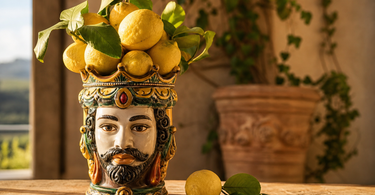
Testa di Moro is a classic Sicilian porcelain tradition: vases shaped like human heads — typically a man and a woman, often sold as a pair. The motif originates from medieval Sicily and has roots in the legend of a young Sicilian woman and a Moorish prince. The vases are decorated with lemons, fruit or flowers on the head, making them both flower holders and standalone sculptures. Today they're still produced by Italian ceramicists and are available at Dims Studio in several sizes from 30 to 45 cm.
If you've ever seen an Italian balcony in Palermo or visited a homeware shop in Taormina, you might have spotted an unexpected figure in the window: a glazed porcelain head filled with lemons or basil. It's a Testa di Moro — one of Italy's most characterful ceramic traditions with over 800 years of history. Here's the full story of what it is, where it comes from, and why you'll find them at Dims Studio.
What is a Testa di Moro?
Testa di Moro is a Sicilian porcelain vase shaped like a human head — typically a man and a woman, often sold as a pair. The head shape itself is centred around the hollow inner space, where you can place flowers, fruit or a small potted plant. The top of the head is open (usually with a removable "crown" of stylised hair), so the vase can be filled from above.
The material is traditionally fine porcelain, glazed with detailed facial features, hairstyle and decoration. The decoration on the "crown" itself is often lemons, fruit or flowers — giving the vase its characteristic silhouette.
The legend behind the motif
The most widespread legend originates from medieval Sicily — around the 1100s. It tells of a young Sicilian woman who lived in the Kalsa district of Palermo. While watering her plants on the balcony one day, she saw a Moorish prince (a man) passing by below. They fell in love and began a secret relationship.
After some time, the prince revealed that he had a wife and children back home and would soon return there. The young woman, enraged by the betrayal, killed him in his sleep and used his head as a pot for her basil. The neighbours were fascinated by her "head-potted" basil on the balcony, and began having their own head-shaped pots made in terracotta — first as imitation, later as cultural tradition.
Today, Testa di Moro stands as one of Sicily's most distinctive cultural symbols — displayed everywhere from museums to Dolce & Gabbana fashion collections.
Did you know? In 2020, Dolce & Gabbana designed an entire collection based on the Testa di Moro motif for their Alta Moda show in Palermo. It marked a broader renewed international interest in Sicilian craftsmanship.
From medieval times to modern homes
The Testa di Moro tradition moved from pure legend to craftsmanship in the 1500s-1600s, when Sicilian ceramicists — particularly in the towns of Caltagirone and Sciacca — developed it into an art form. Each ceramicist added their own style: facial expressions, hairstyle types, crown colours, background patterns.
In the 1900s, production became smaller and more artisanal. Today, Testa di Moro is still handmade in Italy — primarily in Sicily — with variation that honours the original tradition.
At Dims Studio, we import exclusively from producers who follow this craft tradition. We have a selection of Testa di Moro vases with variations in size, skin colour (classic terracotta, but also red), and crown motif (lemons, fruit, flowers).
Motifs and types
The classic Testa di Moro comes in pairs — a man and a woman, sold together or separately:
- Man version (Moro): Beard, strong facial features, often with a turban. Classic yellow or red glazed skin colour with detailed eyes.
- Woman version (Mora): Often with jewellery, long earrings, soft facial features. Same skin colour palettes.
The crown features several classic motifs:
- Lemons — the most classic; signalling Sicily's citrus landscape
- Fruit — oranges, grapes, strawberries — Sicilian abundance
- Flowers — Sicilian garden flora
We also have variants with more modern interpretations — for example red skin colour or more stylised faces.
Use and styling
- As a vase: A single branch, a small bouquet, or a potted basil plant on top
- As decoration:Standing alone on a console table or shelf — the shape alone has visual power
- As a pair: Man and woman together — the classic Sicilian composition
- In combination: Together with lemon vases and lemons and fruit objects for a unified Mediterranean theme
How to choose a Testa di Moro
- Size: 30 cm for a shelf or desk. 45 cm as an eye-catcher on the dining table or console table.
- Single or pair: As a single vase it works well. As a pair (man + woman) you get the full cultural reference.
- Skin colour: Classic terracotta is traditional. Red gives more power. Choose according to the rest of your décor.
- Top motif: Lemons are classic; fruit versions are more maximalist; flowers are more subdued.
- Manufacturer: Check that the vase is made in Italy (Made in Italy). Asian-made copies often lack the cultural depth and craftsmanship finesse.
Frequently asked questions
What does "Testa di Moro" mean in English?
It's Italian and literally means "the head of a Moor" — where "moro" refers to the historical term for the North African/Arab peoples who had influence on Sicily from the 9th century onwards. The motif itself — a head as a vase — is the Sicilians' cultural tribute to this complex historical encounter.
What is the story behind Testa di Moro?
The most widespread legend: in 12th-century Sicily, a young local woman fell in love with a Moorish prince. When she discovered he had a wife and children in his homeland, she killed him in a rage and used his head as a pot for her balcony basil plant. The neighbours became so fascinated by her "head-potted" basil that they began making terracotta versions. Today, the motif is cultural heritage.
What kind of flowers suit a Testa di Moro vase?
Classic: small citrus plants such as basil, mint, or a potted citrus tree. If you use it as a vase: a single branch or a small bouquet of fresh flowers. Fresh basil sprigs feel very authentically Italian. Dried bouquets are also lovely and last longer.
What sizes does Testa di Moro come in?
At Dims Studio you'll mainly find 30 cm and 45 cm versions. Smaller collector's pieces (10-15 cm) are also available as decoration. The largest display pieces go up to 60-80 cm. 45 cm is the most practical size for the home — big enough to make an impression, small enough to fit on a table.
Can Testa di Moro hold water for flowers?
Yes, but make sure it's glazed on the inside. Keep the water in the top section (the head) and change it regularly to avoid mould. If the vase is antique or unglazed inside, use a small glass insert to protect the porcelain.
Summary
Testa di Moro isn't just a vase — it's a cultural object with over 800 years of history. When you place a Testa di Moro in your home, you're introducing a living Italian tradition — with beauty, mystery and a touch of darkness (the legend!). For lovers of ceramics, it's one of the most interesting objects you can own, and as a collector's piece it holds its value across generations.
Explore our range of Testa di Moro vases — handmade in Italy following the classic tradition.