
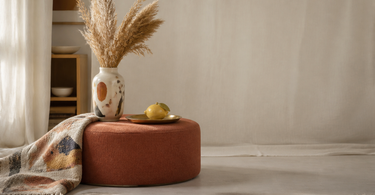
A pouf is a low, upholstered piece of furniture without a backrest or armrests. It is primarily used as a footstool in front of a sofa or armchair, but works equally well as extra seating, an improvised coffee table with a tray on top, or a decorative element in the hallway and bedroom. Poufs come in round, square and cylindrical versions in materials such as velvet, leather, wool and bouclé — making them easy to adapt to almost any interior style.
A pouf is one of the most versatile pieces of furniture you can have in your home. It takes up little space, costs relatively little and solves several problems at once: it supports your legs, acts as extra seating when guests arrive, and adds texture and volume to a room that lacks life. Yet it is often overlooked when people furnish their homes. This article explains exactly what a pouf is, how it differs from related furniture, and which materials and shapes suit which rooms and purposes.
What defines a pouf?
A pouf is essentially defined by three things: it is low, it is upholstered, and it has no backrest or armrests. This makes it fundamentally different from most chairs and armchairs, but it shares the absence of a backrest with the stool — more on that in the next section.
The height of a standard pouf is typically between 35 and 45 cm, roughly corresponding to the seat height of a sofa. This is no coincidence: at that height you can comfortably reach out with your legs when sitting at the edge of the sofa, and the pouf acts as a natural extension of the seating.
The five basic characteristics
- Low and compact: Easy to move around — most poufs weigh 2–5 kg and have no legs that catch on rugs.
- Upholstered: Soft and yielding surface, suitable both as seating and as a footrest.
- Multifunctional: Footstool, extra chair, coffee table with tray, decorative element.
- Shape-flexible: Available in round, square, oval and cylindrical models.
- Material-flexible: Fabric, velvet, leather, cotton, wool, knit, bouclé and patterned textiles are all popular choices.
Tip: Place a round tray (30–40 cm in diameter) on top of a firm, cylindrical pouf and you have a working coffee table that is easy to move aside when you need more floor space.
Pouf vs. similar furniture
Pouf, footstool, stool — the words are often used interchangeably, but the pieces of furniture are actually a little different in function and construction. The table below gives you a quick overview.
| Furniture | Primary function | Has backrest? | Footstool? | Typical placement |
|---|---|---|---|---|
| Pouf | Footstool, extra space | No | Yes | Living room, bedroom, hallway |
| Footstool | Support for legs and feet | No | Yes | Next to armchair or sofa |
| Stool | Seating | No | No | Kitchen, hallway, study |
| Armchair | Comfortable seating | Yes | No | Living room, reading corner |
| Bench | Seating and storage | No (usually) | Partly | Hallway, bedroom, foot of bed |
The key difference between a pouf and a stool is the upholstery. A stool typically has a hard seat and legs — making it tall enough for a kitchen counter, but too hard to rest your feet on for extended periods. A pouf, on the other hand, is dimensioned and upholstered precisely for that purpose. An ottoman is related to the pouf but is generally larger and more solid in construction — it often serves as a central piece of furniture in the living room rather than a flexible auxiliary piece.
Typical uses at home
Because the pouf is easy to move and does not take up much visual space, it turns up in almost every room. Here are the most common ways to use it:
- In front of the sofa or armchair — the classic use. The pouf gives your legs somewhere to rest and extends ergonomic sitting comfort.
- Extra seating — when you have guests and the sofa is full, the pouf is quick to roll out from the corner.
- Improvised coffee table — a flat, firm pouf with a tray on top works as a coffee table that costs a fraction of the price and is far easier to move.
- In the hallway — to sit down while putting on and taking off shoes. Here it is often combined with hallway hooks and a small mirror to create a cohesive functional vignette.
- Next to the bed — as a bedside table or to lay clothes on in the evening.
- Decorative element — in a slightly overlooked corner or under a window, where it adds texture and fills the space without dominating it.
The hallway is actually a place that deserves special attention. A pouf here signals hospitality and makes practical sense: you have somewhere to sit, and you can gather the other decorative elements around it. Combine it with a round mirror and a few coloured hooks on the wall to create a hallway that both looks great and works well.
Materials and styles
The choice of material, far more than the shape, determines what a pouf expresses in an interior. The same cylindrical base design can look minimalist Nordic in natural-coloured wool and bohemian lush in patterned bouclé.
Velvet
Velvet has a short, dense pile that catches the light and gives a subtly colour-shifting effect depending on the angle you view the piece from. It is a soft material with a luxurious look that suits a Scandinavian or hotel-like aesthetic. Maintenance: brush with a soft clothes brush in the direction of the pile to keep it even.
Leather and faux leather
Classic and durable. Real leather patinates over time and gains character, while faux leather is easier to clean. Both suit more masculine or rustic expressions. The downside is that it can feel cold to rest bare feet on in winter.
Wool and cotton
Natural fibres that regulate temperature and wick away moisture. Wool is more resistant to wear and stains than cotton, but both materials fit well into a Nordic minimalist interior. A coarse wool fabric gives structure and weight, while a finely woven cotton looks more refined.
Knit and bouclé
Bouclé — with its irregular loops on the yarn surface — has in recent years made its way from 1970s furniture design into contemporary interior decoration. It adds tactile texture and a relaxed, warm feel that matches the current interest in organic forms and natural colour tones. Pair a bouclé pouf with a colourful rug and you get layers of texture that elevate the whole room.
Patterned fabric
A pouf in patterned fabric — geometric, botanical or figurative — can serve as a solitary focal point in an otherwise neutral living room. It simply requires that you are conscious of what the pattern is speaking to: a pouf in a strongly graphic pattern works best surrounded by calm surfaces.
How to choose the right pouf
When choosing a pouf, three parameters matter most: dimensions, firmness and material.
Dimensions
For use as a footstool, the pouf should ideally be roughly the same height as the sofa seat — typically 38–45 cm. If it is lower, you end up sitting with your legs angled downward, and the point of the support is lost. For a hallway you can go a little lower (30–35 cm), as you typically sit on the edge for a shorter time.
Firmness
A firm pouf supports your weight stably and works best as a coffee table or decorative element. A softer pouf is more comfortable to rest your legs on for a couple of hours. Check the fill material: foam fill gives consistent firmness over time, while fibre padding is softer but compresses more.
Material in relation to room
In high-traffic rooms — hallway, children's room — a washable or easily wipeable material will save you trouble. In the living room, where the pouf is visible most of the day, aesthetics weigh more heavily. Remember to consider it in relation to the other textiles in the room: rugs, cushions and curtains should not compete for attention with a very dominant pouf.
If you want to give the pouf some company, candlesticks and decorative objects on a side table or shelf nearby are a natural next step — they tie the living room together without requiring major rearrangements.
Frequently asked questions
What is the difference between a pouf and an ottoman?
An ottoman is typically larger, firmer and constructed as a standalone piece of furniture — often with a flat, hard surface that can be used as a coffee table. A pouf is smaller, lighter and primarily intended to be moved around as needed. Both are upholstered and have no backrest.
What height should a pouf be to work as a footstool?
As a rule of thumb, the pouf should be roughly the same height as the sofa seat, typically 38–45 cm. At that height you can stretch your legs out and rest your heels on the pouf without your hips angling uncomfortably. If the pouf is too low, you end up sitting hunched forward.
Can a pouf be used as a coffee table?
Yes, if the pouf is sufficiently firm and not too soft on the surface. Many people use a round wooden tray (30–40 cm in diameter) on top of the pouf to create a stable, flat surface for glasses and cups. Choose a flat, square or cylindrical pouf rather than a very soft, bean-bag-like model for this purpose.
Which materials are easiest to keep clean?
Leather and faux leather can be wiped with a damp cloth and are forgiving of spills. Velvet requires regular brushing but is no harder to maintain than other upholstered furniture. Removable covers in cotton or synthetic fibres that can be machine washed are the most practical choice in households with children or pets.
Which shape works best in a small living room?
A round pouf is usually the best choice in a small living room because it has no sharp corners that visually fragment the space. The round shape is also easier to walk around. A diameter of 40–50 cm is sufficient for a footrest and does not look too dominant.
Can a pouf be placed in the hallway?
Absolutely. The hallway is actually a classic place for a pouf, as it provides somewhere to sit while putting on and taking off shoes. Choose a material that can handle daily use and does not collect too much dust. Combine the pouf with hooks on the wall to create a functional hallway.
Summary
A pouf is a low, upholstered piece of furniture without a backrest — compact, easy to move and capable of fulfilling several functions at once. It is used as a footstool at a height of 38–45 cm in front of a sofa or armchair, as extra seating, as an improvised coffee table with a tray on top, and as a decorative textile element in the living room, hallway or bedroom. The choice of material — velvet, leather, wool, bouclé or patterned fabric — determines far more than the shape what the pouf expresses stylistically. Choose firmness based on primary function: firm for coffee-table use, softer for a footrest. And remember to consider the pouf in relation to the other textiles in the room.
Explore our range of ottomans and poufs — or let yourself be inspired by our full decoration universe.