
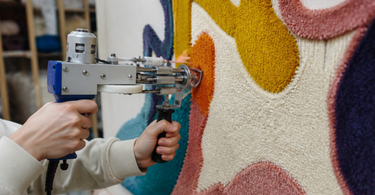
A hand-tufted rug is made by a craftsperson using a tufting gun to shoot loops of yarn through a primary backing – layer by layer. The result is a rug with depth, texture and craftsmanship precision that machines can't replicate. The process typically takes place in India or Nepal, the material is usually wool, and care simply requires regular vacuuming and the occasional clean.
When you're browsing rugs and come across the term "hand-tufted", it's natural to wonder what it actually means – and whether it's worth paying more for. Hand-tufted rugs differ from machine-made versions in almost every respect: production time, texture, choice of materials and durability. In this article, we'll go through the process step by step, explain which materials are used, and tell you what to look out for when choosing your next rug.
What does "hand-tufted" mean?
The term "hand-tufted" refers to a specific production method that sits between the fully hand-knotted rug and the machine-made rug. Unlike a hand-knotted rug, where every single knot is tied manually on a loom, a hand-tufting craftsperson uses a special tool – the tufting gun – to work faster and more evenly.
The key word, however, is "hand": a person controls every single stroke and decides how tightly or loosely the yarn sits. This gives a far higher level of control and variation than a machine can deliver. The design can be complex and curved, because the operator moves freely across the primary backing.
What isn't it?
It's important to distinguish hand-tufted rugs from:
- Hand-knotted rugs: Every knot is tied individually. Far more time-consuming – a medium-sized rug can take months.
- Machine-woven rugs: Produced on automated looms, typically in large batches without any human involvement in the actual pattern-making.
- Flatweave / kilim: No pile – the yarn is woven flat into the structure.
Tip: Turn the rug over and look at the back. A hand-tufted rug typically has a glued-on latex or jute backing that holds the yarn loops in place. It's a quick way to tell it apart from a hand-knotted rug, where the knots are visible on the back.
The technique behind it: tufting gun and primary backing
The process of making a hand-tufted rug takes place in several clearly separate stages, and it's precisely the combination of these stages that gives the rug its distinctive character.
1. The primary backing
The foundation is a tight, open-weave fabric – usually a coarse cotton or jute cloth – stretched onto a vertical frame. The craftsperson draws or transfers the pattern directly onto this fabric, either by hand or via a stencil.
2. The tufting gun
The tufting gun is an air-powered or electric tool with a hollow needle. The needle is pushed through the primary backing, and yarn is fed through with it. When the gun is pulled back, it leaves either:
- A loop (loop pile): The yarn remains as an uncut loop – giving a compact, hard-wearing surface.
- A cut pile: The loop is cut, giving soft, free-standing yarn fibres – creating the classic soft rug look.
An experienced craftsperson can vary speed, pressure and yarn thickness to create relief, shading effects and subtle transitions in the design.
3. Latex and secondary backing
Once the tufting is complete, a layer of latex is applied to the back of the primary backing. This fixes the yarn loops and provides stability. A secondary backing is then glued on – typically jute, cotton or a synthetic material – which protects the latex layer and gives the rug an even finish.
4. Cutting and finishing
If it's a cut pile rug, the pile height is cut and trimmed to an even level. Edges are sewn or bound, and the rug is washed and brushed to bring out the texture and colours.
Materials: wool, cotton and silk
The choice of material is one of the factors that has the biggest impact on a hand-tufted rug's price, appearance and durability.
Wool
Wool is the most widely used material in high-quality hand-tufted rugs. The fibres are naturally elastic, meaning the pile bounces back after pressure. Wool is also naturally dirt- and moisture-resistant thanks to the scale-like surface of each fibre. Wool rugs hold their colour well over time and are naturally fire-resistant.
Cotton
Cotton is primarily used for the base weave, but can also appear as pile material in lower-priced ranges. It's soft, but absorbs moisture faster than wool and is generally less durable in high-traffic rooms.
Silk and viscose
Silk and viscose (art silk) give the rug a distinctive sheen and are typically used as accent yarn in parts of the pattern. Viscose is more affordable, but requires careful care, as it reacts strongly to moisture.
Synthetic fibres
Polyester and nylon are used in more budget-friendly variants. They're hard-wearing and easy to clean, but don't have the same natural depth and warmth as wool.
If you're looking for rugs that combine hand-tufted techniques with striking animal motifs, you can find inspiration in leopard rugs and tiger rugs, where the pattern complexity really benefits from the freedom of hand-tufting.
Benefits of hand-tufted rugs
Hand-tufted rugs have a number of concrete characteristics that set them apart from machine-made alternatives.
Design freedom
Because a craftsperson controls the tufting gun freely, curves, organic shapes and detailed patterns can be created without the limitations a machine has. This opens up designs that wouldn't be possible with machine production.
Pile depth and tactile quality
Hand-tufted rugs are typically produced with a pile height of 8–20 mm, and the pile can vary within the same rug. This gives a tactile and visual depth that's difficult to achieve mechanically.
Durability with correct use
A well-made hand-tufted wool rug lasts 15–30 years with normal use. The latex layer is the weakest link and can start to crumble after 10–15 years in damp surroundings, but can in many cases be re-laminated.
Price ratio
Hand-tufted rugs are generally cheaper than hand-knotted rugs, because the production time is shorter, but more expensive than machine-woven ones, because human labour is still central. This makes them an attractive middle ground for those who want craftsmanship without the maximum price level.
If you want to explore a wider selection, it's worth looking at animal rugs, which typically include hand-tufted versions in premium materials.
Hand-tufted vs. machine-woven
Here's a direct comparison of the two production methods on the parameters that matter most in practice:
| Parameter | Hand-tufted | Machine-woven |
|---|---|---|
| Production time (2×3 m) | 1–4 weeks | A few hours |
| Design freedom | High – free curves and shapes | Limited by the machine's grid |
| Pile height | 8–20 mm, can vary | Typically 6–12 mm, uniform |
| Material choice | Wool, cotton, silk, blends | Usually synthetic or wool |
| Price (per m²) | 500–3,000 DKK | 150–800 DKK |
| Lifespan | 15–30 years | 10–20 years |
| Uniqueness | High – subtle variations | Low – identical pieces |
| Care | Vacuum, avoid moisture, professional cleaning | Vacuum, often machine washable |
| CO₂ footprint per piece | Lower (handcraft, natural materials) | Higher (energy-intensive machinery) |
The history and the India tradition
Hand-tufted rugs as a commercial product have their roots in 20th-century India, primarily in the states of Uttar Pradesh and Rajasthan. The cities of Bhadohi and Agra became world centres for rug production during the 20th century, and today India is estimated to export 90% of the world's hand-tufted rugs.
From hand-knotting to tufting
The Indian rug tradition is ancient – hand-knotted rugs have been produced in India since at least the Mughal period (16th century). But the tufting gun, invented in the USA in the mid-20th century, revolutionised production. When it reached India in the 1970s and 1980s, it enabled much faster manufacturing while retaining the precision of craftsmanship.
Nepal and Tibet
Nepal has a parallel tradition, particularly for hand-knotted rugs in the Tibetan style, but has also adopted hand-tufting. Nepalese rug production is known for its especially high wool quality (Himalayan wool from mountain goats) and natural dyes.
Design revival in the 1990s and 2000s
From the 1990s, Western designers and brands began collaborating directly with Indian workshops to produce hand-tufted rugs with contemporary designs. This created a new category of designer rugs that combined traditional craftsmanship with modern aesthetics – a category that's still growing.
Brands like Bongusta are examples of how Scandinavian design thinking and hand-tufted production methods come together in a contemporary expression.
Care and maintenance
A hand-tufted rug doesn't require complicated care, but it reacts differently than a machine-woven rug to moisture and mechanical strain.
The daily routine
Vacuum the rug 1–2 times a week with a nozzle without a rotating brush. Rotating brushes can loosen yarn fibres from the latex layer and unnecessarily increase wear. Always vacuum with the pile – that is, in the direction it naturally lies.
Stains
Treat stains immediately. Absorb liquid with a clean cloth by dabbing – never rubbing. Use a mild water solution (possibly with a small amount of neutral soap) and work from the inside out. Avoid excessive moisture, as latex and jute react negatively to prolonged dampness.
Deep cleaning
Professional deep cleaning is recommended every 2–3 years, depending on use and placement. Avoid steam cleaning, as high temperatures can break down the latex bonding. A professional rug cleaner experienced with hand-tufted rugs should always be consulted.
Rotation and underlay
Turn the rug 180 degrees every 6–12 months to ensure even wear. Always use an anti-slip underlay that allows air circulation beneath the rug – it extends its lifespan and protects the floor.
Tip: If you notice "fuzz" – small fibres sticking to the surface in the first few weeks – it's normal and not a sign of a fault. It's loose fibres from the production process. They disappear on their own after 4–6 weeks of use and regular vacuuming. Never cut fibres off with scissors; remove them by hand or with a lint roller.
If you'd like to see the full range of rugs with varying techniques and materials, you can start by browsing the rug catalogue to find the right match for your room.
Frequently asked questions
Are hand-tufted rugs of lower quality than hand-knotted ones?
Not necessarily. Hand-tufted rugs are generally less time-consuming to produce and thus cheaper, but the quality of materials and craftsmanship can be high. A well-made hand-tufted wool rug can last 20–30 years. However, hand-knotted rugs typically have a deeper structure and an even longer potential lifespan of 50–100+ years.
Can a hand-tufted rug be used outdoors?
Most hand-tufted rugs are designed for indoor use. Moisture breaks down the latex layer and can lead to mould in the jute backing. There are special editions with synthetic materials and a water-resistant backing for semi-covered outdoor use, but classic wool variants should be kept indoors.
How can I tell if a rug is hand-tufted or machine-woven?
Turn the rug over and look at the back. Hand-tufted rugs typically have a glued jute or fabric backing that covers the latex layer. Machine-woven rugs have a uniform, symmetrical back without these layers. The pattern on hand-tufted rugs often shows subtle irregularities, which is a sign of quality.
Do new hand-tufted rugs smell – and does the smell go away?
Yes, many new hand-tufted rugs have a slight smell from the latex layer and possibly the dyes. Air the rug out in a well-ventilated room for 1–2 weeks. The smell typically fades quickly. Avoid placing a new rug in a room with low air circulation for the first few days.
What does a hand-tufted rug typically cost?
The price varies a lot depending on size, material and brand. A hand-tufted wool rug measuring 160×230 cm typically costs between 2,000 and 8,000 DKK. Premium versions in silk blends or with complex designs can cost significantly more. Machine-woven rugs of the same size typically cost 600–2,500 DKK.
Are hand-tufted rugs sustainable?
It depends on the choice of materials and the production conditions. Wool rugs from responsible manufacturers are biodegradable and produced with minimal machine power. Latex, however, is a resource that requires attention. Look for certifications such as GOTS (wool) and GoodWeave (working conditions) when choosing a manufacturer.
Summary
A hand-tufted rug is the result of a well-defined craft technique, where a tufting gun is guided through a base fabric layer by layer, controlled by a person rather than a machine. In terms of quality and price, it sits between the fully hand-knotted and the machine-made rug – and for many, it's the best compromise between craftsmanship and affordability.
Wool is the preferred material for durability and texture, the latex layer is the key technical element, and India – especially Bhadohi and Agra – is the world's primary production hub. With the right care, a hand-tufted rug lasts for many years and keeps its visual depth and tactile quality. The key is regular vacuuming, prompt stain treatment and professional deep cleaning every couple of years.
Explore our range of hand-tufted and handmade rugs – and find the one that suits your room, your style and your budget.