
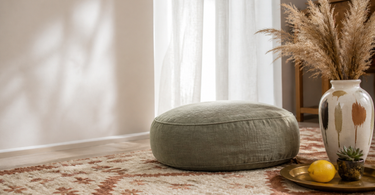
A floor cushion is a large, soft cushion — typically from 50×50 cm and up — placed directly on the floor and used as extra seating, a relaxation zone, or a decorative element. It comes in square, round, and rectangular shapes with fillings of foam, feathers, or polyester, and in materials such as cotton, wool, and velour. Floor cushions are easy to move and can be used in the living room, children's room, on the terrace, or to create a cosy nook.
The floor cushion is one of the most versatile pieces of furniture you can have in a home. It requires no installation, no fixed spot, and no special thought — you simply place it wherever you need it. It can serve as extra seating when you have lots of guests, as a soft surface for children on the playmat, or as a deliberate decorative choice in a lounge corner. Yet in many homes it is underused or chosen on a whim. This article gives you a clear overview of what a floor cushion actually is, what varieties exist, and how to use it actively in your decor.
What is a floor cushion?
A floor cushion differs from a sofa cushion primarily in size and function. While sofa cushions are typically 40–50 cm and mainly decorative or supportive, floor cushions are designed to bear your full weight — they start from 50×50 cm and can be much larger, depending on the purpose.
The shape varies: square is the most common, but round and rectangular versions are also popular. Round floor cushions work well as individual seats arranged in a circle, while square and rectangular ones are more versatile and easier to stack.
Sizes in practice
A 50×50 cm floor cushion is suitable for one child or as a footrest. For comfortable adult seating, 60×60 cm or 70×70 cm is more realistic. Rectangular models at 60×90 cm can be used for lying down, e.g. during meditation or yoga. Always check whether the stated size includes or excludes the filling — a loosely stuffed cushion can feel much smaller when in use.
Tip: If the floor cushion will be used by adults as a primary seat (e.g. around a low table), choose at least 60×60 cm and a firm filling such as a foam core. Soft polyester filling gives more sink and is best for short-term use or children.
Materials and filling
The choice of material and filling is crucial for whether a floor cushion holds up in daily use — or ends up at the back of a cupboard after two months.
Cover materials
| Material | Properties | Best for |
|---|---|---|
| Cotton | Breathable, washable, develops a worn look over time | Children's room, daily use |
| Wool | Warm, naturally dirt-resistant, durable | Living room, lounge corner |
| Velour / velvet | Soft surface, shows impressions easily, decorative | Guest room, decorative use |
| Leather / faux leather | Easy to wipe clean, robust, stiffer look | Hallway, office, teen's room |
| Outdoor fabric | UV- and moisture-resistant, typically polyester | Terrace, balcony |
Filling types
Filling determines comfort and durability. A foam core gives the firmest seating surface and springs back into shape, but can feel a little hard. Feather filling is the softest but settles and needs regular plumping. Polyester filling is the most common alternative — hypoallergenic, easy to wash, and cheaper than real feathers, but settles faster than foam. A combination of foam core with polyester or feathers around it often gives the best balance.
Benefits of floor cushions in home decor
The obvious benefit is extra seating without the footprint a chair requires. But the floor cushion's real strength is its informality — it signals a room you are allowed to relax in. It creates a different social flow than traditional furniture.
- Flexibility: A floor cushion typically weighs 1–3 kg and is easy to move from room to room or stack in a corner when not in use.
- Scalability: You can quickly double the number of seats for a gathering without buying an extra piece of furniture.
- Texture and colour: Floor cushions are an inexpensive and reversible way to add pattern or contrast to a room. A single cushion in a striking fabric can serve as the only coloured element in a neutral living room.
- Zoning: Gathered around a low table, floor cushions define a seating area and create a visual zone in an open-plan room — effective like a rug, but with seating function.
How to use a floor cushion
Here are the five most natural uses, ranked from the most practical to the most deliberately stylistic.
1. Extra seating
The most straightforward use: place one or two floor cushions in front of the sofa and you have seating for four extra guests at a low coffee table. In front of a sofa with a seat height of 40–45 cm, a coffee table of 30–35 cm works well as a shared table when sitting on the floor cushions.
2. Cosy nook and lounge corner
Combine three or four floor cushions with a round, low table in a corner of the living room. Add a floor rug underneath to visually define the zone. See our range of colourful rugs that can form the base of such a setup. The result is an informal alternative to a sofa group.
3. Children's room and play areas
Floor cushions are ideal in children's rooms because children naturally sit and play on the floor. Here, washability matters — choose cotton covers that can be removed and washed at 40°C or higher.
4. As a colour accent
In a room with a neutral colour palette, a single floor cushion in a bold fabric can make a big impact. It works on the same logic as a coloured candleholder or a striking vase — a single object that anchors the room's colour scheme without overwhelming everything else.
5. Outdoor use
For the terrace or balcony, weather-resistant floor cushions in polyester or Olefin fabrics handle moisture and UV light. Check that the cover is removable and tumble-dryer safe, as outdoor use almost always results in moisture in the filling over time.
Combining with other furniture and textiles
Floor cushions rarely work best as a standalone element. They work well alongside other low-level or soft elements in the room.
With rugs
A rug under the floor cushions creates a natural gathering point and softens a cold or hard floor. Rugs in wool or cotton are particularly good, as they add texture themselves and are kept in place by the weight of the cushions. Avoid very smooth rugs if you want the cushions to stay put.
With ottomans and poufs
An ottoman can be combined with floor cushions as the fixed anchor point in a lounge corner — the ottoman serves as a table or extra seat, while the floor cushions provide the light, flexible spots around it. This combination is especially well-suited to rooms used for many purposes.
With decoration
In a cosy nook with floor cushions, the other decorative elements should be kept close to the floor or at eye level when seated. A low vase on the low table, candles on the surface, or a wall feature just above the seating zone keeps the proportions right and gives the room cohesion.
Tip: When mixing colours and patterns in a floor cushion arrangement, let one element (e.g. a colour) recur in at least two cushions. Then use one contrasting pattern as an accent. This looks deliberate rather than random.
Frequently asked questions
What is the right size floor cushion for adults?
For adults who need to sit comfortably for longer periods, a minimum of 60×60 cm is recommended. If you want to lie down or use the cushion for yoga and meditation, a rectangular model of 60×90 cm or larger is more suitable. Check that the firmness of the filling matches the intended use.
Can you wash a floor cushion?
It depends on the model. Many floor cushions have removable covers that can be machine washed. For the inner cushion, check the care label — foam filling rarely tolerates machine washing, while polyester filling can often be washed at a low temperature. Avoid spinning too vigorously, as this can damage the shape of the filling.
What is the difference between a floor cushion and a pouf?
A pouf typically has a firm interior — made of foam, pellets, or beans — and a defined, often round or cube-shaped outer form. A floor cushion is softer and flatter and behaves more like a traditional cushion. Poufs are generally more durable as stationary seats; floor cushions are more flexible and easy to move.
What materials are suitable for outdoor floor cushions?
Choose covers in Olefin, Sunbrella, or another UV-stabilised polyester that will not fade and can handle moisture. The inner cushion should ideally dry quickly — open-cell foam or polyester fibre filling is better than feather filling outdoors. Bring the cushions in if it rains heavily.
How do you store floor cushions when not in use?
Floor cushions can be stacked in a corner, hung in a basket, or stored in a large storage box. Square cushions are the easiest to stack neatly. Avoid storing them compressed for long periods, as foam and feather filling can take on a permanent shape after prolonged pressure.
Do floor cushions suit all interior styles?
Yes — the choice of fabric and colour determines the style. A floor cushion in natural linen suits a Scandinavian interior, while velvet in deep colours is ideal in a more eclectic or maximalist style. The shape rarely changes, but the material determines whether it feels at home in the room.
Summary
A floor cushion is a simple and affordable piece of furniture with a surprisingly wide range of uses. It provides flexible seating, defines zones in open-plan spaces, and works as an easy-to-manage decorative element. The size should be adapted to the user — minimum 60×60 cm for adults in daily use — and the choice of filling and cover determines whether it holds up in everyday life. Use it in combination with a rug and low furniture to create a cohesive lounge setup, or let a single cushion in a striking fabric serve as the colour anchor in a neutral room. Whatever the context, it is easy to move, easy to swap out, and requires no installation.
Explore our range of rugs and textiles to form the base of your next lounge setup.