
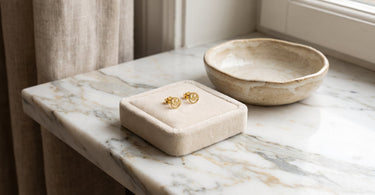
The number in a jewellery hallmark shows the fineness, meaning how many thousandths of the metal are pure precious metal. 925 means sterling silver, and 585 means 14 carat gold. The rest of the alloy is usually other metals, added to make the piece of jewellery harder.
Contents
When you turn a piece of jewellery over and find numbers like 925 or 585 stamped into the metal, it's not a random code. It's an international way of showing how much precious metal the piece of jewellery actually contains. Here's an explanation of the most common hallmarks, the difference between silver and gold in various fineness levels, and how gold-plated jewellery differs from solid gold.
This makes it easier to understand what you're paying for, next time you're looking at jewellery for yourself or as a gift.
Short answer: how to read the hallmark
Hallmarks such as 925, 585 or 750 are known as fineness marks. The number shows how many parts per thousand of the piece of jewellery are pure precious metal. The rest is other metals, mixed in to provide strength and durability.
The higher the number, the more pure precious metal the piece of jewellery contains. A piece marked 925 is therefore made from more pure silver than one stamped with a lower number, while 585 and 750 are both gold, just in different levels of fineness.
This simple logic applies no matter whether it's a ring, a necklace or a pair of earrings, and it's the first thing to check if you want to know what a piece of jewellery is actually made of.
Silver: what does 925 mean
The 925 hallmark stands for sterling silver, an alloy with a fineness of 925. This means 92.5 per cent pure silver, while the remaining 7.5 per cent is typically other metals, usually copper.
The reason silver is alloyed is that pure silver, also known as fine silver, is 99.9 per cent pure and relatively soft. To make the piece of jewellery more durable and hard-wearing in everyday use, copper is added to give it the strength and hardness a piece of jewellery needs.
One thing worth knowing about sterling silver is that it tends to tarnish, meaning it darkens or discolours over time. This is a completely natural process and not a sign of poor quality. In Denmark, you'll also occasionally see the hallmark 830 on older silver items, which means 83.0 per cent silver, a fineness typically found on pieces from earlier decades.
Gold: carat and fineness explained
With gold, carats are often used instead of, or alongside, the fineness number. Carats indicate how many parts out of 24 are pure gold. The higher the carat, the more gold the piece of jewellery contains.
Here's an overview of the most common hallmarks:
| Hallmark | Carat |
|---|---|
| 333 | 8 carat |
| 585 | 14 carat |
| 750 | 18 carat |
| 999 | 24 carat |
585 is a very common fineness for everyday jewellery, because 14 carat is a good compromise between gold content and durability. 750, that is 18 carat, contains more gold and is often used for finer jewellery or for plating on top of silver.
Tip: If you're deciding between 585 and 750 gold, think about how much the piece of jewellery will be used. A higher carat means more gold, but also a softer metal that can withstand less in everyday use.
Gold-plated: what's the difference between this and solid gold
Gold-plated means that a thin layer of gold has been applied on top of another metal, often silver. So it's not the same as solid gold, where the whole piece of jewellery is made of gold alloy all the way through.
One example is the jewellery from Goio Galore in the shop, which is made in 925 sterling silver with 18 carat gold plating. This means that the core is genuine silver, while the surface has a layer of 18 carat gold, giving the look and much of the feel of a gold piece of jewellery without the price of solid gold.
There's nothing wrong with choosing gold-plated, as long as you know what you're buying. It's a completely normal and widespread technique in the jewellery world, but be aware that it's not the same as buying a piece of jewellery made of solid gold.
Find jewellery with genuine sterling silver and gold plating in the shop.
See jewelleryHow to check the authenticity of a piece of jewellery
The easiest way to get a hint about what a piece of jewellery is made of is to look for a stamp with numbers such as 925, 585, 750 or similar. The stamp tells you the fineness, that is how much precious metal is actually in the piece of jewellery.
- Look for a small stamped number, often on the inside of a ring or on the clasp of a chain.
- Be aware that silver is not magnetic. If the piece of jewellery sticks to a magnet, it's therefore not genuine silver.
- If, on the other hand, the piece of jewellery doesn't stick to a magnet, that's not proof in itself that it's genuine silver, as many other metals aren't magnetic either.
- Buy from a shop that states the material clearly, so you know exactly what you're getting.
All items in the shop are hand-picked by Dinna, and here you can find, among other things, Genua earring and Spirala ring, both from Goio Galore.
A short note on caring for silver and gold
Whether your piece of jewellery is 925 silver, 585 gold or gold-plated, it will last longest if you treat it with a bit of care. Avoid spraying perfume directly on the jewellery, keep it away from chlorine, for example in a swimming pool, and avoid rubbing hard on the surface, especially if there's a gold plating, which can wear thinner over time.
Want to know more about how to keep your jewellery looking nice day to day? You can find more specific advice in our articles on jewellery as a gift and care of materials.
Frequently asked questions
What does 925 mean on a piece of jewellery?
925 is the fineness stamp for sterling silver and means that the piece of jewellery contains 92.5 per cent pure silver, while the rest is typically copper.
What is sterling silver?
Sterling silver is an alloy of silver with a fineness of 925, that is 92.5 per cent pure silver with other metals added to make it harder and more durable.
What does 585 mean in gold?
585 is the fineness stamp for 14 carat gold.
How many carats is 585 gold?
585 corresponds to 14 carat gold, which is a very widespread fineness for everyday jewellery.
What's the difference between gold-plated and solid gold?
Gold-plated means that a thin layer of gold has been applied on top of another metal, for example silver, while solid gold is made of gold alloy all the way through. Gold-plated is therefore not the same as solid gold.
Is silver magnetic?
No, silver isn't magnetic. If a piece of jewellery sticks to a magnet, it isn't genuine silver, but if it doesn't stick, that's not proof of authenticity in itself.
Summary
The hallmark on a piece of jewellery tells you the fineness in thousandths: 925 is sterling silver, 585 is 14 carat gold, and 750 is 18 carat gold. Gold-plated means a thin layer of gold on top of another metal, and it isn't the same as solid gold. Look for the hallmark, remember that silver isn't magnetic, and buy from a shop that states the material, so you know exactly what your jewellery is made of.
Read also
- Jewellery as a gift: The reliable guide
- Gifts for her: Inspiration list for every occasion
- Gifts for your best friend: Personal and creative ideas
Ready to find your next piece of jewellery
Whether you're looking for a ring, a necklace or a pair of earrings, there are handpicked pieces to choose from, all with clear information about the material.
See all jewellery