
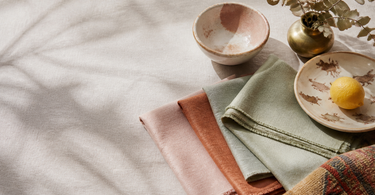
The most popular textiles for spring and summer are cotton, linen and linen blends — all lightweight, breathable and easy to maintain. Cotton suits bedding and cushions, linen is cooling and hard-wearing in curtains and tablecloths, for example, while muslin is the airiest choice for light summer curtains. Lightweight wool is surprisingly relevant even during the summer months, because it regulates temperature in both directions.
When the light shifts and the temperature creeps up, something happens to the way we decorate. The heavy wenge-coloured wool throws get tucked away under the bed, and the light, airy textiles come out instead. It's not just about comfort against the skin — the choice of textile also affects the room's expression, colour play and overall sense of season. Here's a rundown of the textiles gaining the most ground during the spring and summer months, and what they can really do.
What defines a good spring and summer textile?
A textile suited to the warm months is about more than just looking bright. There are four qualities that together determine whether a material works in the season:
- Breathability: The material needs to let moisture and heat pass through, so it doesn't trap warmth against the skin or in a room.
- Lightweight: The weight per square metre (g/m²) is key. Summer textiles typically range from 80 to 200 g/m², while winter variants can be 300 g/m² and upwards.
- Easy to maintain: Summer means more use, more sweat and more frequent washing. Machine-washable materials at 40–60°C are a practical advantage.
- Visual expression: Natural, often slightly irregular surfaces — like linen's characteristic texture — give an organic summer character that suits bright rooms and natural materials.
Tip: If you want to switch quickly between seasons, a light throw in cotton or muslin is an easy way to give the room a new look without moving furniture. Fold away the winter version, and lay a lighter one on top.
Cotton — the versatile classic
Cotton is the most widely used textile material in the world, and for good reason. It's soft, withstands frequent washing and has a natural breathability that keeps the temperature down. In home decor, cotton is used widely: bedding, cushion covers, light curtains and colourful throws in flat-weave techniques.
It's worth knowing the difference between cotton types. Percale cotton has a tight, slightly cool weave with a thread count typically of 200–400 threads per square inch — it's the fabric that feels fresh and smooth straight out of the wash. Satin cotton has a softer, glossier drape, but is generally heavier. For summer, percale is the obvious choice for bedding.
In home decor, flat-weave flat-weave style cotton throws are especially popular during the summer months. They're thin enough for underfloor heating to come through, and they're typically easy to shake free of sand and dust — a plus in a season when the terrace door is open half the day.
Linen — the cooling choice
Linen is one of the oldest cultivated plant fibres — documented in use for over 10,000 years — and it has endured for a very concrete reason: it's one of the most thermally cooling natural fibres around. Linen fabric conducts heat away from the skin 5 times faster than cotton, and it absorbs up to 20% of its own weight in moisture before it starts to feel wet.
This gives linen a naturally crisp drape and a slightly irregular texture that softens with every wash. In interiors, linen fabric is classically used for tablecloths, curtains and bed linen. It's hard-wearing — in fact stronger than cotton — and holds its colour well over time.
For summer use in the living room, light linen curtains are an obvious solution: they filter direct sunlight without blocking it out entirely, and the natural texture gives an organic, bright look that suits light walls and ceramic details. Combine, for example, with vases in ceramic or glass on a windowsill for an easy, coherent style.
Linen blends: the best of both worlds
A blend of linen and cotton — typically 55/45 or 70/30 — creates a fabric that combines the texture and cooling properties of linen with the softness and easy fit of cotton. It's a good compromise for cushion covers and bed linen, where you want the linen look but prefer a slightly softer surface against the skin.
Muslin and light cotton flannel
Muslin is an open, lightweight cotton weave with a very low weight — typically 80–120 g/m². It's the lightest and most airy fabric among all the common summer materials. In interiors, muslin is mainly used for light summer curtains, where the semi-transparent drape creates a soft, diffuse light in the room rather than harsh sun or full blackout.
Muslin is also used in baby blankets and as a lightweight throw, because it folds down to almost nothing and doesn't develop odours, even after long-term storage. The downside is that it's not particularly hardwearing compared to linen or tightly woven cotton, and it can shrink when washed above 40°C.
Unlike muslin, light cotton flannel is a broadly woven, lightly brushed fabric with a soft drape. It's not a classic summer textile, but during a cold May or early September, a light cotton flannel throw can be used without feeling too heavy — a transitional solution that offers a bit more comfort on cool summer evenings. Paired with candles and a big cup of tea, it's perfect for those late spring evenings that aren't quite summer evenings yet.
Lightweight wool — summer's surprise
It sounds paradoxical, but wool — in the right form — is an excellent summer material. Lightweight merino wool with a weight of 130–180 g/m² actively regulates temperature: it cools when it's warm and insulates when it's cold. This is due to the wool fibres' natural crimped structure, which traps air and regulates moisture without feeling clammy.
Merino can also absorb up to 30–40% of its weight in moisture before it feels wet, and it has natural odour-resistant properties, as odour-causing bacteria don't thrive in the fibre. This makes lightweight wool throws a great choice for the terrace or outdoor use, where you don't necessarily want to machine wash it after every use.
In interiors, lightweight wool particularly proves its worth as a light, flexible throw over the sofa or as a wall hanging — decorative, yet still functional all year round.
Overview: materials and uses
| Material | Benefits | Typical g/m² | Use in interiors |
|---|---|---|---|
| Cotton (percale) | Soft, breathable, machine washable at 60°C | 120–200 | Bed linen, cushion covers, curtains, blankets |
| Linen | Cooling, hardwearing, natural texture | 150–250 | Tablecloths, curtains, bed linen |
| Linen blends (linen/cotton) | Soft surface, linen look, easy care | 130–200 | Bed linen, decorative cushions |
| Muslin | Very light and airy, diffuse light drape | 80–120 | Summer curtains, light throws |
| Light cotton flannel | Soft, transitional-friendly | 150–200 | Summer throws, light blankets |
| Lightweight merino wool | Temperature-regulating, odour-resistant | 130–180 | Throws, wall hangings, patio blankets |
Tip: If you're unsure about care, check the woven label in the corner of the textile — but as a rule of thumb, linen and cotton can handle 40–60 °C, muslin max 40 °C, and lightweight wool typically hand wash or a 30 °C gentle cycle. Avoid tumble drying linen: it increases the risk of shrinkage.
If you want to match textiles with the table's look, it's natural to think in the same colour temperature. A sand-coloured linen tablecloth pairs well with colourful plates and bowls in warm terracotta shades or citrus yellow tones — a combination that's consistently strong in spring and summer decor.
For outdoor use or in the hallway, it's worth considering textiles that can handle a bit more wear: short-pile cotton rugs and flat-woven linen are the most robust choices. Combine with hallway hooks for bags and light jackets — decor that's ready for the busy season.
Frequently asked questions
What's the most breathable textile for summer?
Muslin is the lightest and airiest choice with a weight typically of 80–120 g/m². For truly cooling effect against the skin, linen is more effective, though, as it conducts heat away faster and absorbs moisture better than most other natural fibres.
Are linen and flax the same thing?
Yes, in everyday speech "linned" and "hør" (linen and flax) are often used synonymously — both terms cover textiles woven from flax fibre (Linum usitatissimum). "Linned" is the older Danish word for the finished textile item, while "hør" usually refers to the fibre and plant itself.
Can you use wool in summer?
Lightweight merino wool at 130–180 g/m² is actually well-suited for summer. The fibre actively regulates temperature and is odour-resistant, which makes it great for throws on the patio or as a light blanket. It's a different experience from heavy, pressed winter felt.
What is a linen blend?
A linen blend is typically a fabric that combines linen fibres and cotton fibres — usually in a ratio of 55/45 or 70/30. This gives linen's characteristic texture and cooling ability combined with cotton's softness, resulting in a fabric that's easier to care for than pure linen.
Which textiles are best for summer curtains?
Muslin and light linen curtains are the two most popular choices. Muslin gives a semi-transparent, soft light diffusion, while linen curtains filter light and add a natural, textured quality. Both are easy to hang up and take down for washing during summer.
How warm should the wash be for summer textiles?
Cotton and linen generally handle 40–60 °C, and linen can even become softer with frequent washing. Muslin is best washed at max 40 °C to avoid shrinkage. Lightweight wool should be hand washed or washed at 30 °C on a gentle cycle — never in the tumble dryer.
Summary
Cotton, linen and muslin form the backbone of the most commonly used spring and summer textiles — each with clear strengths depending on whether you prioritise softness, cooling properties or maximum airiness. Linen blends are a good compromise for bedding and cushions, while lightweight merino wool surprises with its temperature-regulating ability and broad versatility both indoors and on the patio. The most important factor is the weight: stay under 200 g/m² for a genuinely light summer textile, and think about washability and durability when choosing for floors and hallways. The materials' natural textures pair well with colourful decorative elements and ceramics — a combination that lasts well into autumn.
Explore our selection of rugs and textiles for the home — from light cotton blankets to colourful rugs for every season.