
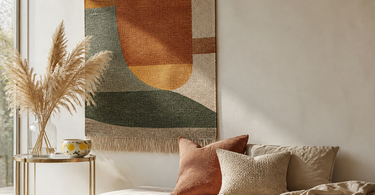
Wall hangings are textile art with a history spanning thousands of years — and one of the most effective ways to bring texture, warmth and personality to a room. They come in techniques such as jacquard, tufted, macramé and cotton, and work both aesthetically and acoustically. Hang them above the sofa, the bed or in the hallway — at eye level or a little higher. Cotton can be washed at 30°, while wool and jacquard should be vacuumed or aired.
A piece of textile on the wall does something different to paint or a poster. It changes the room's acoustics, introduces tactile depth and shifts in expression with the daylight. Wall hangings have adorned walls for thousands of years — from insulating against cold stone in medieval castles to today's bohemian living rooms and minimalist bedrooms. Today, interest in wall hangings is well and truly back, driven by an appetite for materials with soul and rooms that feel lived in.
From medieval castle to modern flat
The tradition of wall hangings stretches back to ancient Egypt, but had its European heyday in the Middle Ages. The great tapestry workshops — particularly in Flanders and France — produced intricate, figurative weavings that told stories from the Bible, the hunt and the court. They insulated against cold, signalled status and functioned as portable walls when the nobility travelled between their castles.
Today the function is different, but the fascination is the same. Scandinavian interior design has in recent years turned its gaze towards textile as a decorative element: we seek surfaces that aren't smooth, rooms that aren't just white, and objects that bear witness to a craft process. The wall hanging places itself precisely at that intersection — it's visual art, it's textile craftsmanship, and it's interior design all at once.
Tip: Hang your wall hanging at eye level or a touch higher — typically with the top edge of the hanging 160-175 cm from the floor. This gives the hanging the visibility and the breathing room it needs.
Techniques and materials
The choice of technique and material determines not just the look, but also the weight, care and lifespan. Here are the most common types:
| Technique | Material | Look | Care |
|---|---|---|---|
| Jacquard | Cotton, wool, polyester mix | Artistic, intricate patterns | Air or vacuum gently |
| Tufted | Cotton, acrylic, wool | Soft, almost 3D surface | Vacuum, spot clean |
| Macramé | Cotton | Bohemian, open knot look | Shake and air out |
| Flat-woven cotton | Cotton | Light, colourful, casual | Wash at 30° |
| Wool | Wool | Rich, deep colour rendition | Air outdoors |
Jacquard
The jacquard technique uses a mechanically controlled loom to create complex patterns directly in the fabric — no embroidery, no printing. The result is reminiscent of classic tapestries and has a distinctly artistic feel. Doing Goods' jacquard wall hangings are a great example: animal motifs like tigers and parrots woven in bold colours with a quality that lasts for decades.
Tufted
Here, yarn threads are pushed through a base fabric with a tufting gun, creating a soft, almost three-dimensional surface. Tufted wall hangings are popular as statement pieces in the bedroom or as a playful element in the children's room. Bongusta's tufted designs work with graphic and geometric motifs in bold palettes.
Macramé and cotton
The macramé knotting technique gives an open, boho look in natural cotton cord. Flat-woven cotton rugs are lightweight, hold colour well and are the easiest to maintain — many can be machine washed at 30 degrees. For a more understated, Scandinavian look in natural colours, Bloomingville wall hangings are an obvious starting point.
Where should you hang it?
A wall hanging works in almost any room, but placement and size have a big impact on the effect.
Above the sofa in the living room
The classic choice — and for good reason. A wall hanging above the sofa pulls the furniture arrangement together and creates a natural focal point. Rule of thumb: choose a hanging that's roughly 2/3 to the full width of the sofa. Too narrow, and it looks random; too wide, and it overwhelms the furniture.
Above the bed in the bedroom
Instead of a classic canopy, a wall hanging gives a soft, warm backdrop behind the headboard. The textile dampens sound, makes the room feel more intimate and is easier to swap out than a painted piece when your taste changes.
In the hallway
A smaller wall hanging in the hallway sets the tone for the rest of the home from the very first moment. Combine it with wall hooks or decorative masks for a curated, personal look that welcomes guests.
In the children's room
Tufted rugs with figures and animal motifs are easy to swap out as the child grows — and they absorb sound in a room that can otherwise get noisy with hard surfaces.
Can a wall hanging replace a painting?
It certainly can. A wall hanging does the same thing as a painting — it catches the eye and sets the tone — but adds an extra dimension: texture. Where a canvas is flat, a wall hanging invites you to touch it and changes character with the light. Many handmade examples are a more long-term investment than mass-produced wall decoration, because they last for decades without fading or going out of style.
Acoustic benefits
Modern homes with concrete floors, large windows and open floor plans can sound hollow. Sound waves reflect off hard surfaces and create reverberation, which makes voices and music unclear. This is where wall hangings play a concrete, measurable role.
Textiles absorb sound waves — particularly in the frequency range of human speech and music (typically 500-4000 Hz). A large jacquard or wool hanging on an open wall can noticeably reduce reverberation, on a par with specialised acoustic panels, but with a far more lively look. Combine it with a rug for the best effect: two absorbent textile surfaces from floor to wall make a marked difference to the room's acoustics.
Wool is generally the most effective sound absorber due to the material's porous fibre structure. Thin cotton throws absorb less, but still contribute positively compared to a bare, plastered surface.
How to hang it up
The method depends on the weight of the hanging and how permanent the solution needs to be:
- Wooden rod with cord: The most commonly used method. A round or square rod is pulled through the loops at the top of the hanging and hung on two hooks. Gives a relaxed, natural look and is easy to adjust.
- Decorative clips or hangers: Suitable for lighter hangings in cotton and macramé. Clips are spaced evenly along the top edge, so the hanging sits flat without sagging.
- Nails or screws: For heavy wool and jacquard hangings. Use rawlplugs in concrete or brick walls. Distribute the load over at least 3-4 hanging points to stop the hanging from tilting.
- Velcro tape: A gentle solution that doesn't leave holes. Works best for light, flat hangings in cotton — not for heavier materials.
Tip: Want to hang a kilim or rug on the wall? It works well — but be mindful of the weight. A rug weighing 2-3 kg needs sturdy screws with rawlplugs, not just nails. Measure the width of the rug and space the hanging points a maximum of 40-50 cm apart.
Care
Wall hangings collect far less dust than rugs, because they aren't exposed to mechanical wear and footsteps. Even so, they need a bit of attention to stay looking good:
- Cotton: Most flat-woven cotton hangings can be machine washed at 30 degrees. Use a gentle spin speed and hang to dry.
- Wool: Vacuum gently with an upholstery brush attachment or air outdoors in the shade. Avoid machine washing — wool felts and shrinks.
- Jacquard: As with wool — vacuum gently or air out. Always check the manufacturer's washing instructions, as blended materials can vary.
- Tufted: Spot-clean with a damp cloth for stains. Vacuum on low suction without a rotating brush, which can pull threads loose.
- Macramé: Shake and air. Cotton macramé can usually be hand-washed in lukewarm water.
Frequently asked questions
How do you wash a wall hanging?
It depends on the material. Flat-woven cotton rugs can typically handle 30 degrees in the machine. Wool and jacquard should be gently vacuumed or aired outdoors in the shade — never in the machine, as wool felts and shrinks. Always check the specific washing instructions on the product, as blended fibres may have different requirements.
Can I use a floor rug as a wall hanging?
Yes, many people do this to great effect. Kilim rugs and other flat weaves work well on the wall and give a more robust, rustic look. Keep the weight in mind: a heavy rug needs solid screws with wall plugs and at least 3-4 hanging points spread along the top edge.
Which wall hanging suits a minimalist home?
Choose neutral colours such as sand, cream white or warm grey in natural materials like cotton or wool. A simple macramé hanging in natural-coloured cotton adds texture without breaking a minimalist look. Avoid too many colours or complex patterns — one bold, simple motif works better than a detailed one.
How big should a wall hanging be in relation to the sofa?
The rule of thumb is that the hanging should be 2/3 to the full width of the sofa. If the sofa is 220 cm wide, a hanging of 140-200 cm in width is appropriate. Too narrow looks random; wider than the sofa can seem overwhelming, but works fine if the wall is big enough to carry it.
Do wall hangings help the acoustics in a flat?
Yes, noticeably. Textiles absorb sound waves and reduce reverberation — particularly at the frequencies of speech and music. A large wool hanging on an open concrete wall can make a real difference. The effect is boosted further if you combine it with a rug and other soft surfaces like curtains and upholstered furniture.
Can a wall hanging be hung in a bathroom or kitchen?
This isn't recommended in rooms with high humidity, such as the bathroom. Textiles absorb moisture and can go mouldy. In the kitchen it's possible, if the hanging is placed away from the cooker and sink. Cotton is easiest to maintain in these rooms, as it can be washed. Wool and jacquard are better suited to dry rooms.
Summary
Wall hangings are one of the most versatile interior elements you can invest in. They add texture and warmth, absorb sound, and do the same job as a painting — but with a tactile dimension no canvas can match. The choice of material determines the look and upkeep: cotton is easy and colourful, wool is deep and luxurious, jacquard is artistically complex, and tufted gives a soft, almost sculptural surface. Whether you want a statement piece above the sofa or a quiet, textured backdrop in the bedroom, you'll find a technique and format to suit your space. Hang it at eye level, use solid fixings for the heavy ones, and swap it out whenever the mood calls for it.
Explore our range of wall hangings in cotton, wool and jacquard — from colourful animal motifs to muted, Scandinavian designs.